
Understanding Adverbs And Its Placement
Adverbs are words that modify verbs, adjectives, or other adverbs. They give extra information about how, when, where, or to what extent an action occurs. Understanding adverbs and its placement is crucial because placing an adverb in the wrong spot can change the meaning or confuse the listener or reader. For intermediate learners, mastering adverb placement improves both writing and speaking skills.
For example, consider these sentences: “She quickly ran to the store” versus “She ran quickly to the store.” Both are correct, but the emphasis shifts depending on the adverb’s position. Recognizing these nuances helps learners sound more natural and confident in English.
Download Free Worksheets and Notes
These free adverbs and its placement worksheets and notes focus on clear grammar rules and natural sentence structure. The materials cover adverbs of frequency, verb placement, negatives, questions, modals, and continuous tense. Each worksheet targets one rule only. As a result, learners can practice without confusion.
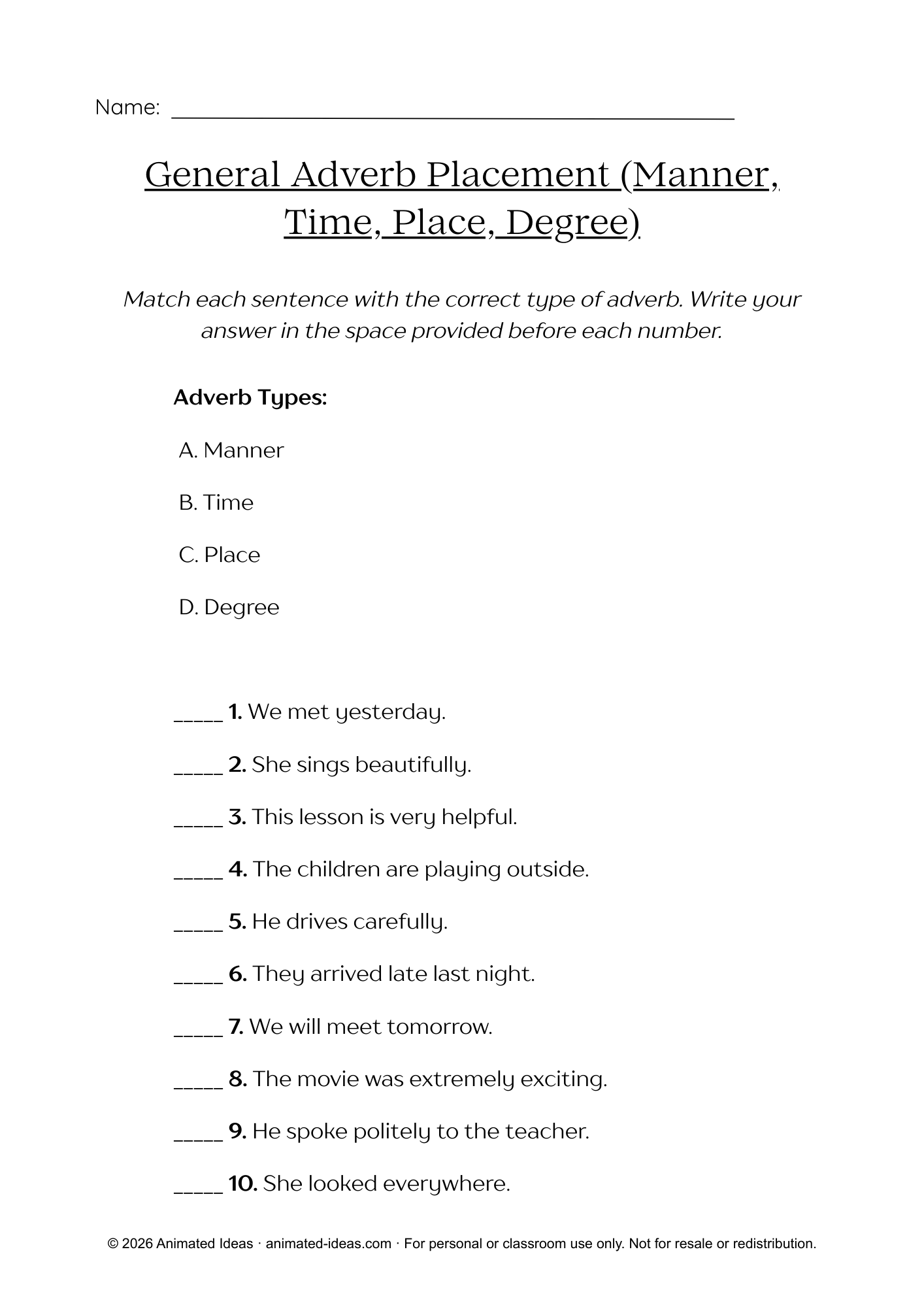
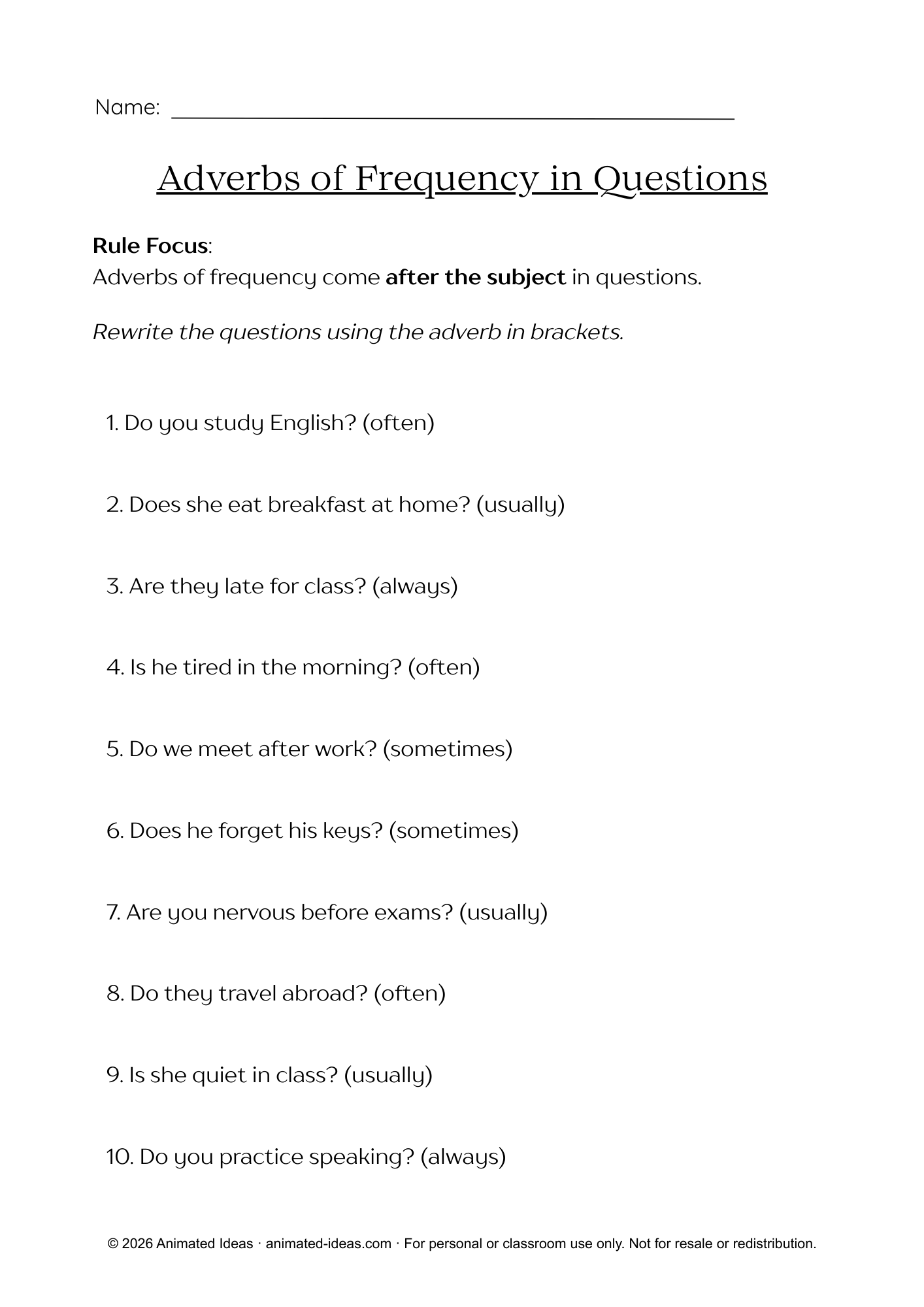
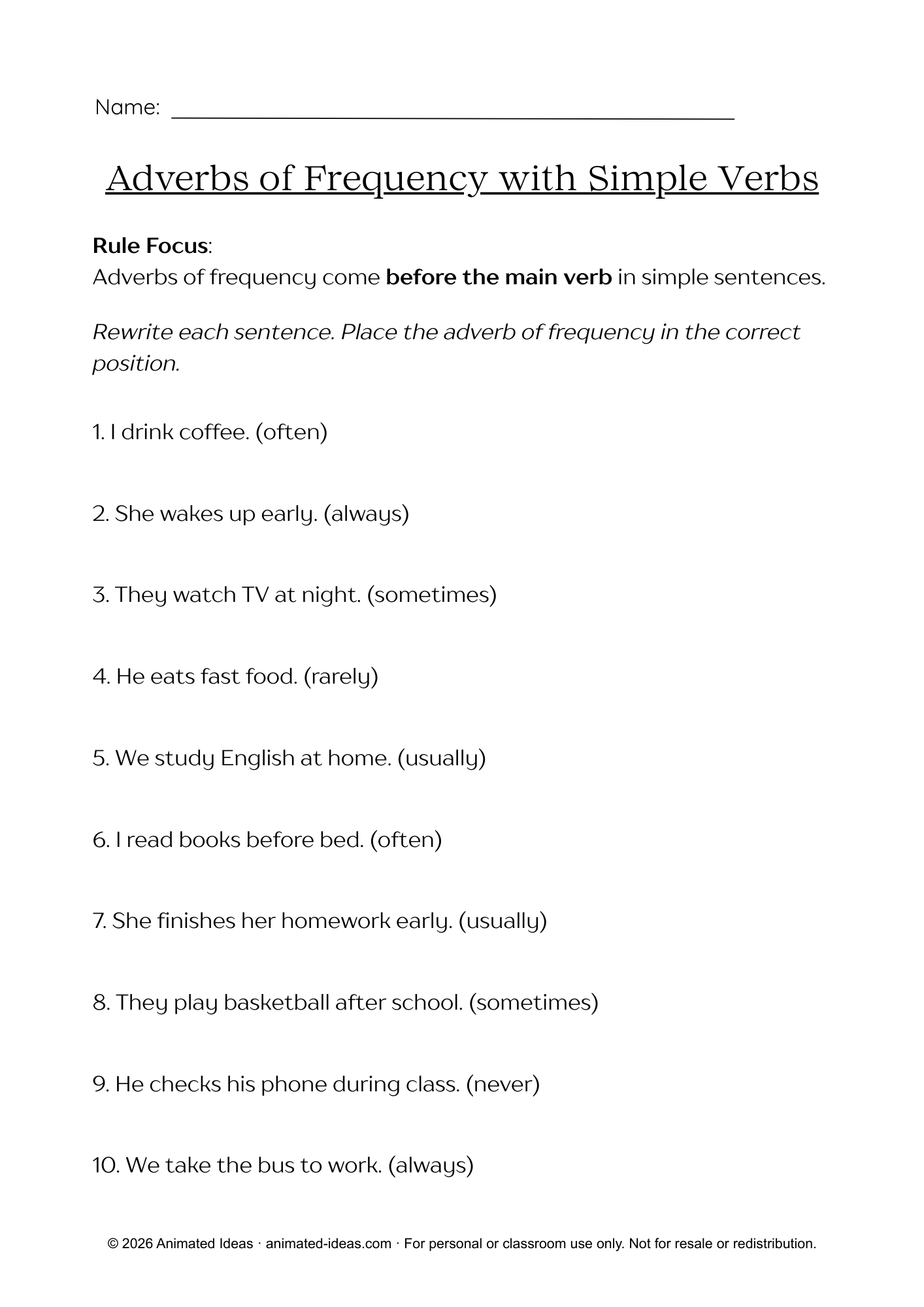
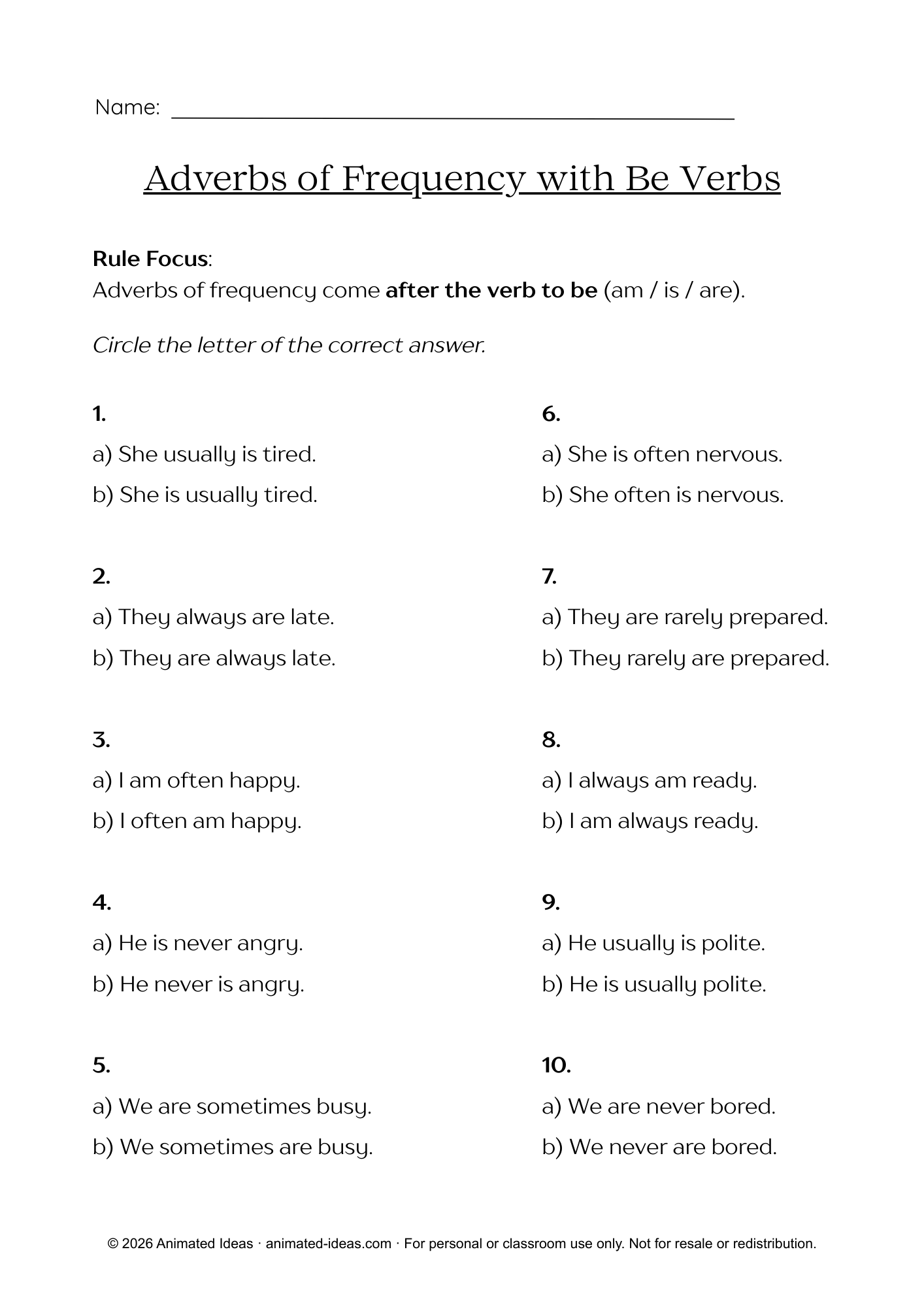
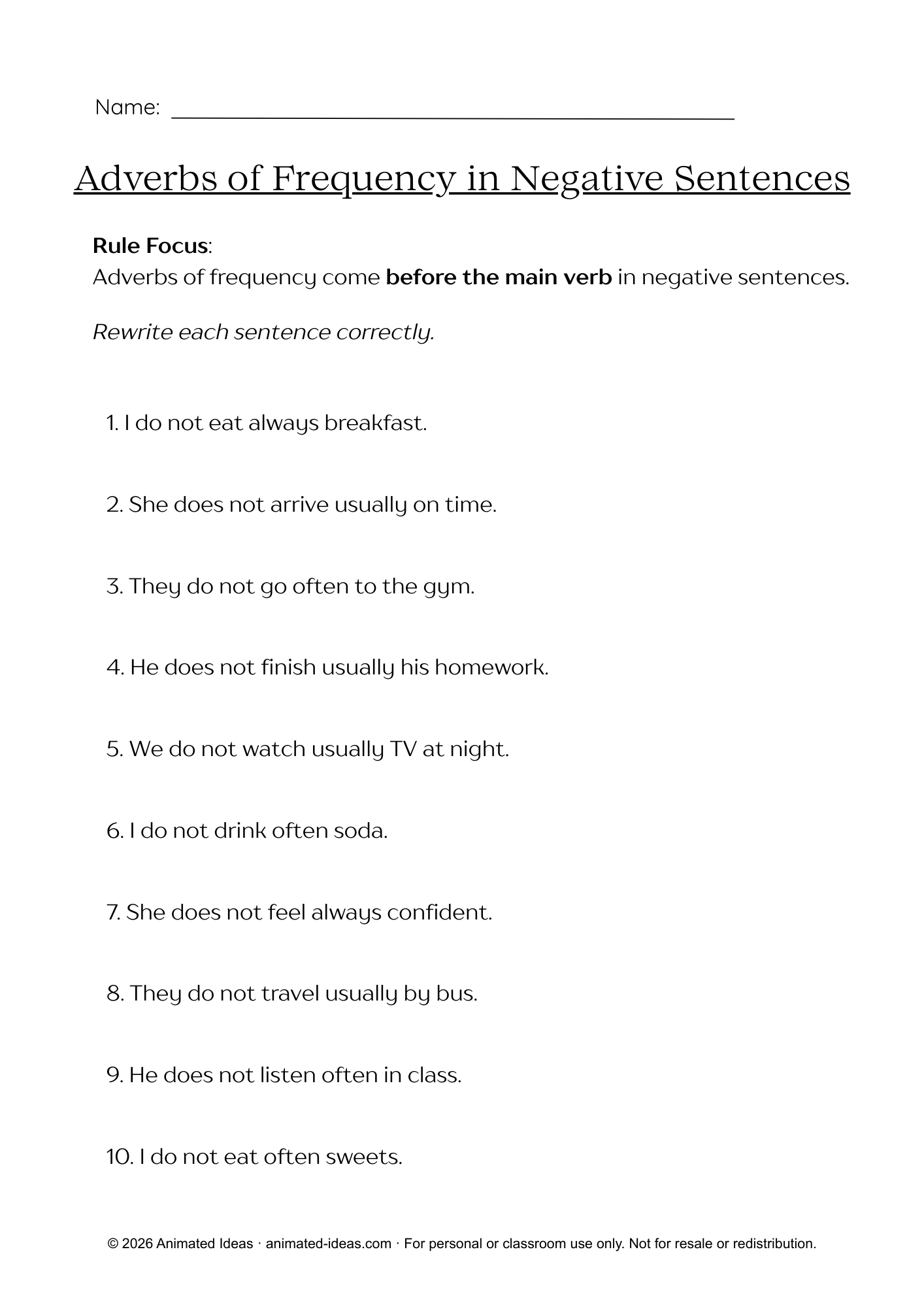
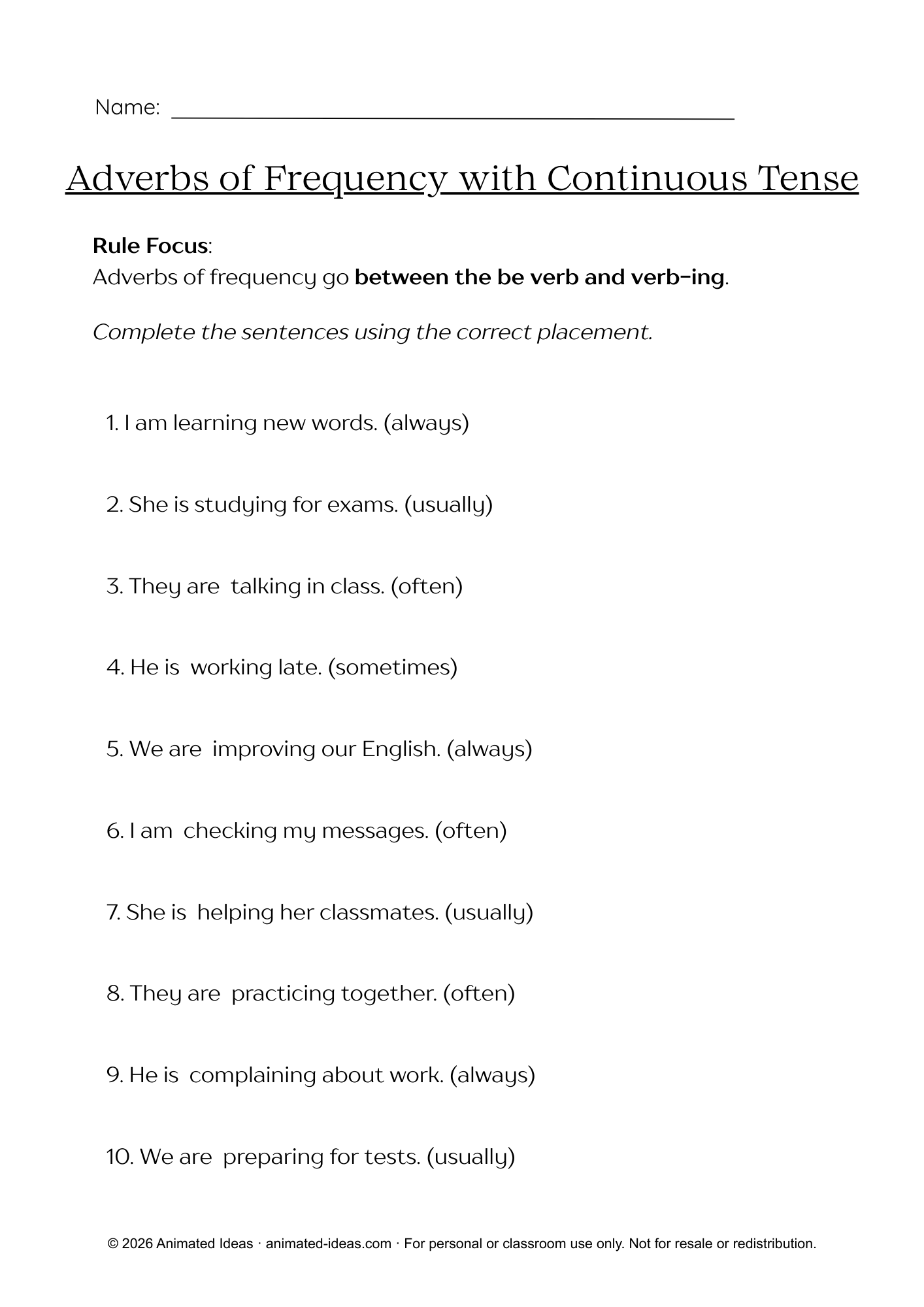
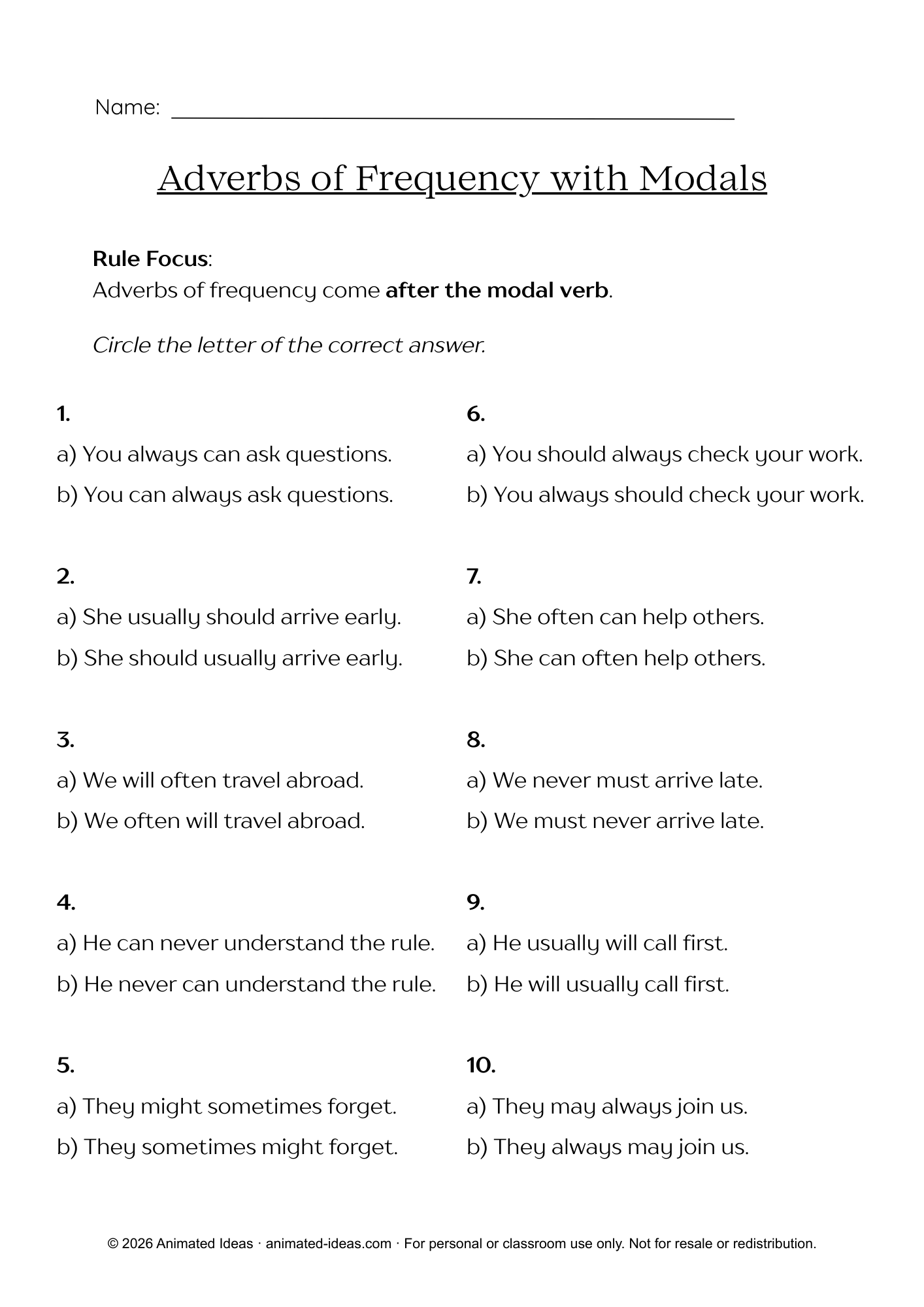
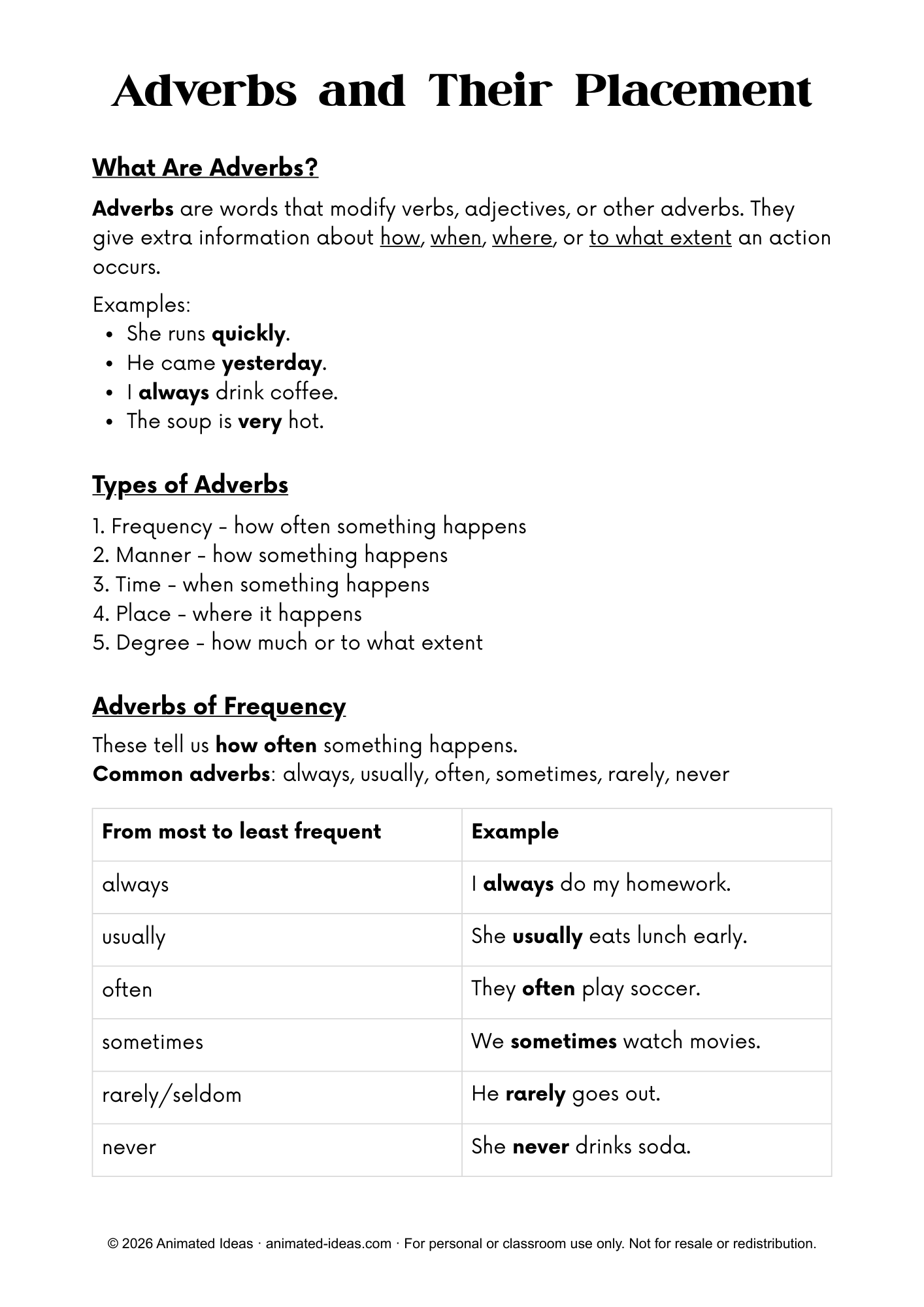
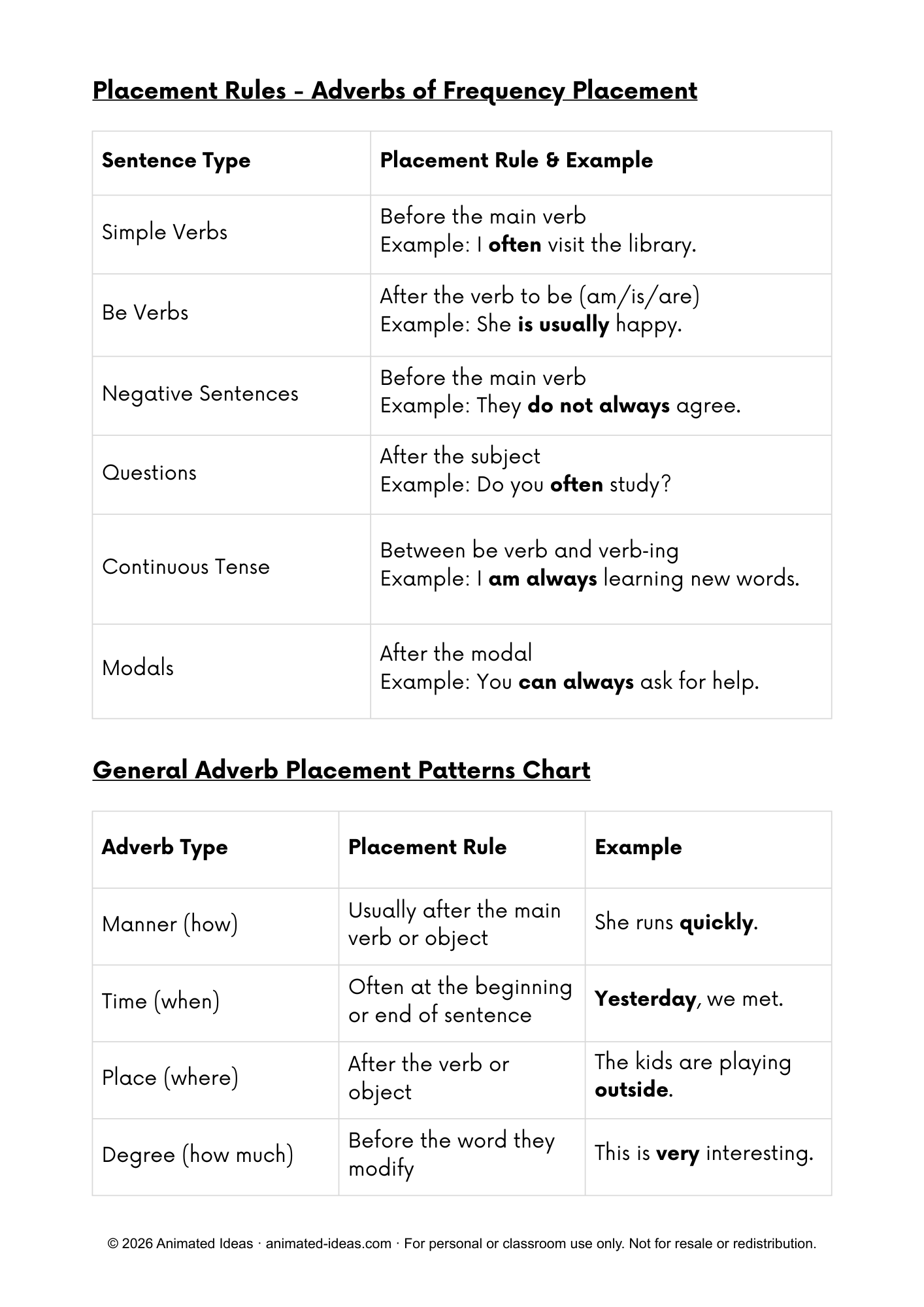
These free worksheets and notes are most suitable for intermediate English learners who want accuracy and confidence. Teachers can use them for review lessons or grammar support. Learners can also use them for self-study. The clean layout and short sentences make the content easy to follow and effective.
Types of Adverbs and Their Placement
1. Adverbs of Manner
Adverbs of manner describe how an action happens. They usually appear after the main verb, or after the object if one exists. Common adverbs of manner include slowly, carefully, loudly, happily, quickly.
Examples:
- She writes carefully.
- The children played happily in the park.
- He speaks loudly during presentations.
| Adverb of Manner | Verb Example | Sentence Example | Position in Sentence |
|---|---|---|---|
| slowly | walk | She walks slowly. | After the verb |
| carefully | write | She writes carefully. | After the verb |
| loudly | speak | He speaks loudly during presentations. | After the verb (or after object if present) |
| happily | play | The children played happily in the park. | After the verb (or after object if present) |
| quickly | run | He runs quickly to catch the bus. | After the verb |
2. Adverbs of Time
Adverbs of time tell us when an action occurs. They can be placed at the beginning or end of a sentence, depending on emphasis. Examples include now, yesterday, soon, later, always.
Examples:
- Yesterday, we went to the museum.
- I will call you later.
- She always finishes her homework on time.
Placing a time adverb at the beginning emphasizes the timing, while placing it at the end emphasizes the action itself.
| Adverb of Time | Verb Example | Example Sentence | Position in Sentence |
|---|---|---|---|
| now | start | We start the meeting now. | Beginning or end of sentence |
| yesterday | go | Yesterday, we went to the museum. | Beginning or end of sentence |
| soon | leave | She will leave soon. | Beginning or end of sentence |
| later | call | I will call you later. | Beginning or end of sentence |
| always | finish | She always finishes her homework on time. | Beginning or end of sentence |
3. Adverbs of Place
Adverbs of place indicate where an action happens. They typically appear after the verb or object. Examples include here, there, outside, inside.
Examples:
- The cat is sleeping inside.
- We will meet there at 5 PM.
- Please sit here.
| Adverb of Place | Verb Example | Example Sentence | Position in Sentence |
|---|---|---|---|
| here | sit | Please sit here. | After the verb or object |
| there | meet | We will meet there at 5 PM. | After the verb or object |
| outside | play | The children are playing outside. | After the verb or object |
| inside | sleep | The cat is sleeping inside. | After the verb or object |
4. Adverbs of Degree
Adverbs of degree describe how much or the intensity of an action, an adjective, or another adverb. Common adverbs of degree include very, too, almost, quite, enough. They usually come before the word they describe.
Examples:
- She is very talented.
- I am almost ready.
- The soup is too hot to eat.
Degree adverbs are flexible, but their placement can change the meaning of a sentence.
For example:
- She almost always arrives on time. → She usually arrives on time, but not every time.
- She always almost arrives on time. → She is always close to arriving on time, but she never arrives exactly on time.
So, pay attention to where you put adverbs of degree, because it can change what you mean.
| Adverb of Degree | Verb/Adjective/Adverb Example | Example Sentence | Position in Sentence |
|---|---|---|---|
| very | talented (adjective) | She is very talented. | Before the word it describes |
| too | hot (adjective) | The soup is too hot to eat. | Before the word it describes |
| almost | ready (adjective) | I am almost ready. | Before the word it describes |
| quite | good (adjective) | He is quite good at singing. | Before the word it describes |
| enough | strong (adjective) | She is strong enough to lift it. | After the word it describes |
General Rules for Adverbs And Its Placement
- After the main verb – Most adverbs of manner appear directly after the verb.
- After the object – When the sentence has an object, the adverb follows it.
- Before adjectives or other adverbs – Degree adverbs precede the word they modify.
- Sentence beginnings – Time or frequency adverbs often start a sentence to emphasize timing.
- With “be” verbs – Place adverbs after forms of “be” such as is, am, are, was, or were.
Examples:
- She is always cheerful.
- They are usually on time.
- He is very smart.
Common Adverbs Placement Patterns
Mid-position
Adverbs describing frequency, certainty, or likelihood usually go between the subject and main verb, except with “be” verbs.
Examples:
- I usually take the bus to work.
- She probably forgot her notebook.
- They always enjoy ice cream after dinner.
Front-position
Some adverbs can be placed at the beginning of a sentence for style or emphasis.
Examples:
- Recently, I started exercising every morning.
- Fortunately, the meeting ended early.
- Suddenly, it began to rain.
End-position
Certain adverbs, especially adverbs of manner, place, or time, naturally appear at the end of the sentence.
Examples:
- He finished the work quickly.
- We traveled there by bus.
- She will come later.
Adverbs in Negative Sentences
In negative sentences, adverbs usually follow auxiliary or modal verbs. Proper placement makes the sentence clear.
Examples:
- She does not often eat fast food.
- They will never forget this experience.
- He cannot easily solve this problem.
Incorrect placement, like “He not easily solves this problem,” can confuse readers. This is because negative adverbs like ‘not’ need to follow an auxiliary or modal verb. Without it, the sentence does not follow normal English structure and sounds wrong.
Correct examples:
He cannot easily solve this problem.
He does not easily solve this problem.
| Adverb | Auxiliary/Modal Verb Example | Example Sentence | Position in Sentence |
|---|---|---|---|
| not | does | She does not often eat fast food. | After auxiliary/modal verb, before main verb |
| never | will | They will never forget this experience. | After auxiliary/modal verb, before main verb |
| easily | cannot | He cannot easily solve this problem. | After auxiliary/modal verb, before main verb |
| hardly | has | She has hardly seen him this year. | After auxiliary/modal verb, before main verb |
| rarely | do | I do rarely watch TV these days. | After auxiliary/modal verb, before main verb |
| seldom | will | We will seldom visit that place again. | After auxiliary/modal verb, before main verb |
| barely | can | He can barely understand the instructions. | After auxiliary/modal verb, before main verb |
How to Combine Multiple Adverbs and Place Them Correctly
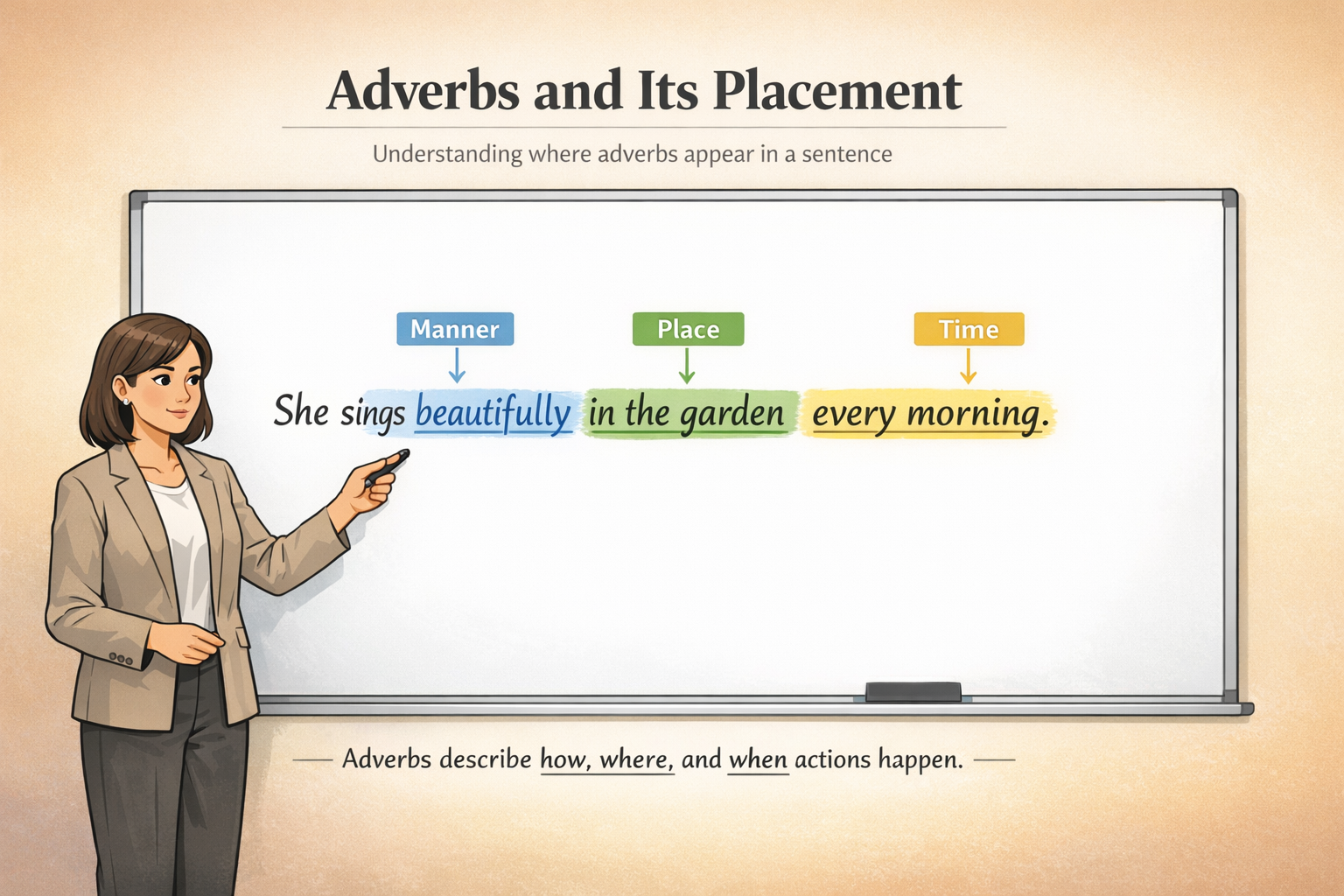
Sentences can have more than one adverb. The usual order is: manner → place → time, which sounds natural in English.
- Manner tells us how the action is done (e.g., beautifully, loudly).
- Place tells us where the action happens (e.g., in the garden, outside).
- Time tells us when the action happens (e.g., every morning, yesterday).
Examples:
- She sings beautifully in the garden every morning.
- They played loudly outside yesterday.
Following this order makes sentences clear and easy to read. If the order is changed, the sentence can sound awkward or confusing.
Using Adverbs With Be Verbs
When using forms of “be,” place the adverb after the verb. This rule applies to both simple and continuous sentences.
Examples:
- He is always polite.
- They are usually early for class.
- She was very excited about the trip.
Adverbs can appear at the beginning of the sentence for stylistic effect:
- Usually, he is polite to everyone.
| Adverb | Form of “Be” Example | Example Sentence | Position in Sentence |
|---|---|---|---|
| always | is | He is always polite. | After the verb “be” |
| usually | are | They are usually early for class. | After the verb “be” |
| very | was | She was very excited about the trip. | After the verb “be” |
| often | is | He is often helpful to his classmates. | After the verb “be” |
| sometimes | are | They are sometimes late for meetings. | After the verb “be” |
Conclusion: Mastering Adverbs and Their Placement
Understanding adverbs and its placement helps intermediate learners express actions clearly and naturally. Correct placement improves reading, writing, and speaking skills. Using visuals and examples reinforces learning and makes grammar rules more memorable. By practicing these rules, learners can confidently construct sentences with proper emphasis, detail, and clarity.