
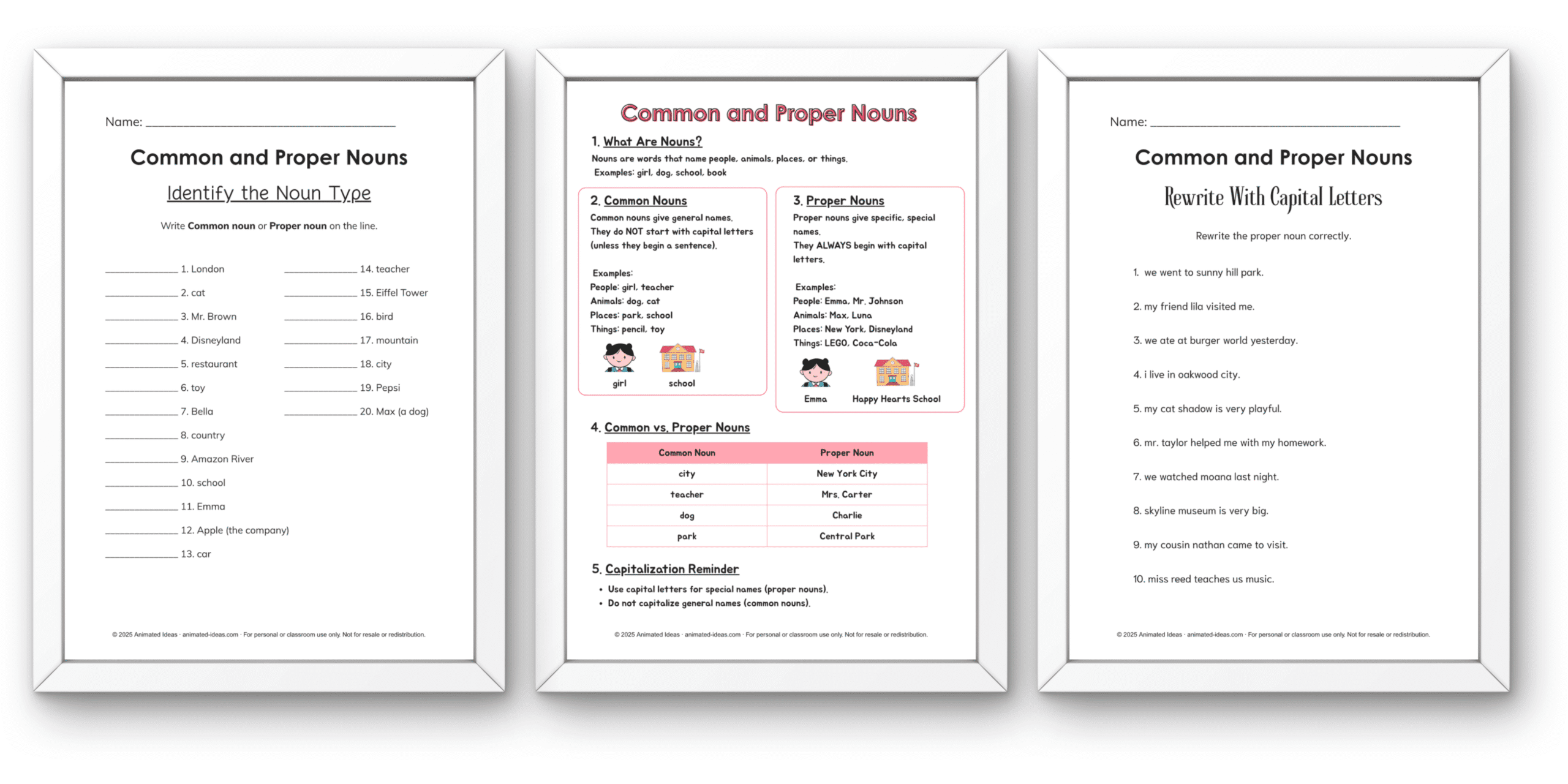
Common and Proper Nouns
Understanding Common and Proper Nouns is an important skill for young learners. In this lesson, students will explore how names of people, places, animals, and things can be general or specific. With clear examples and simple explanations, this guide helps children recognize nouns easily and build a strong grammar foundation.
Introduction to Nouns
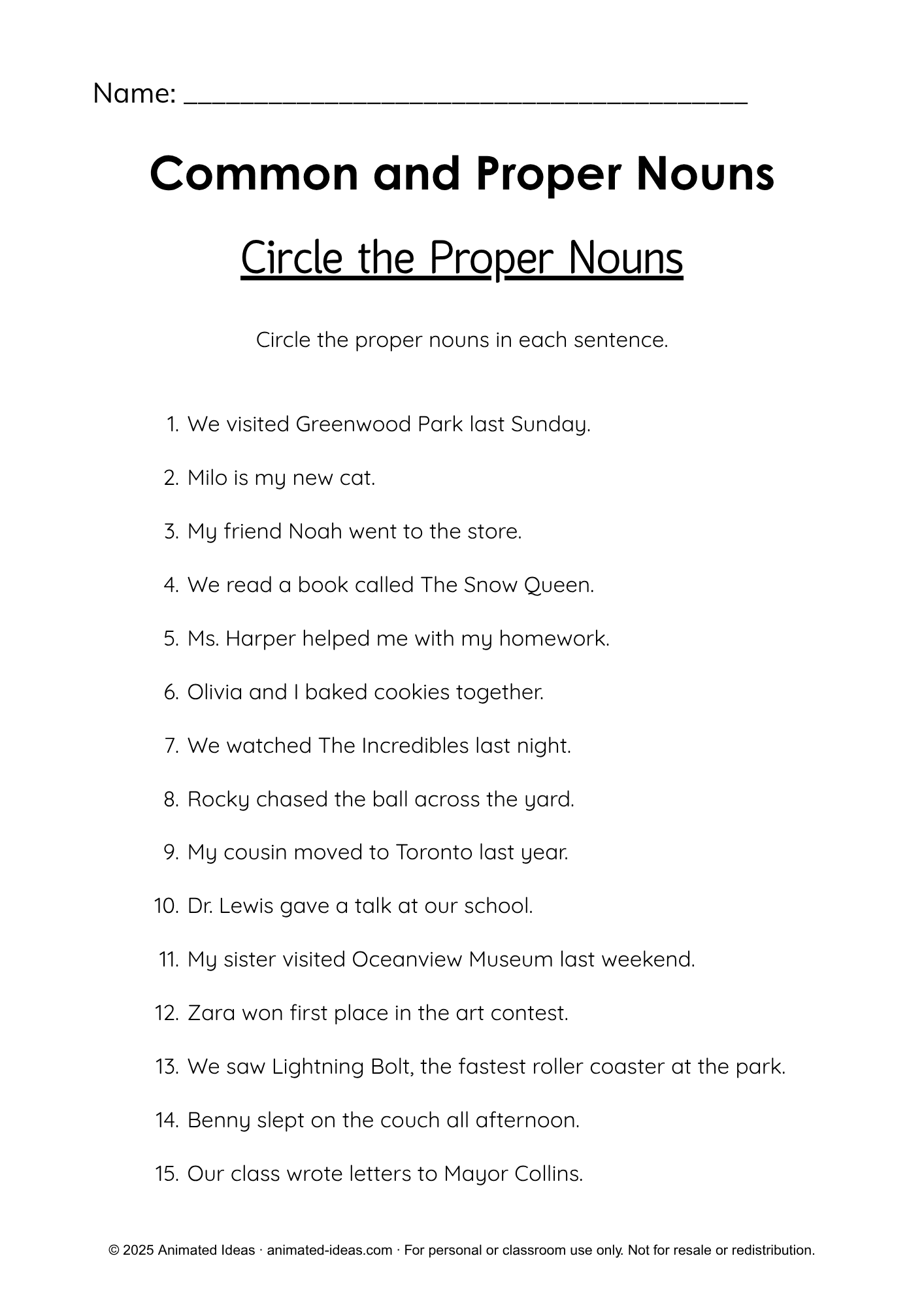
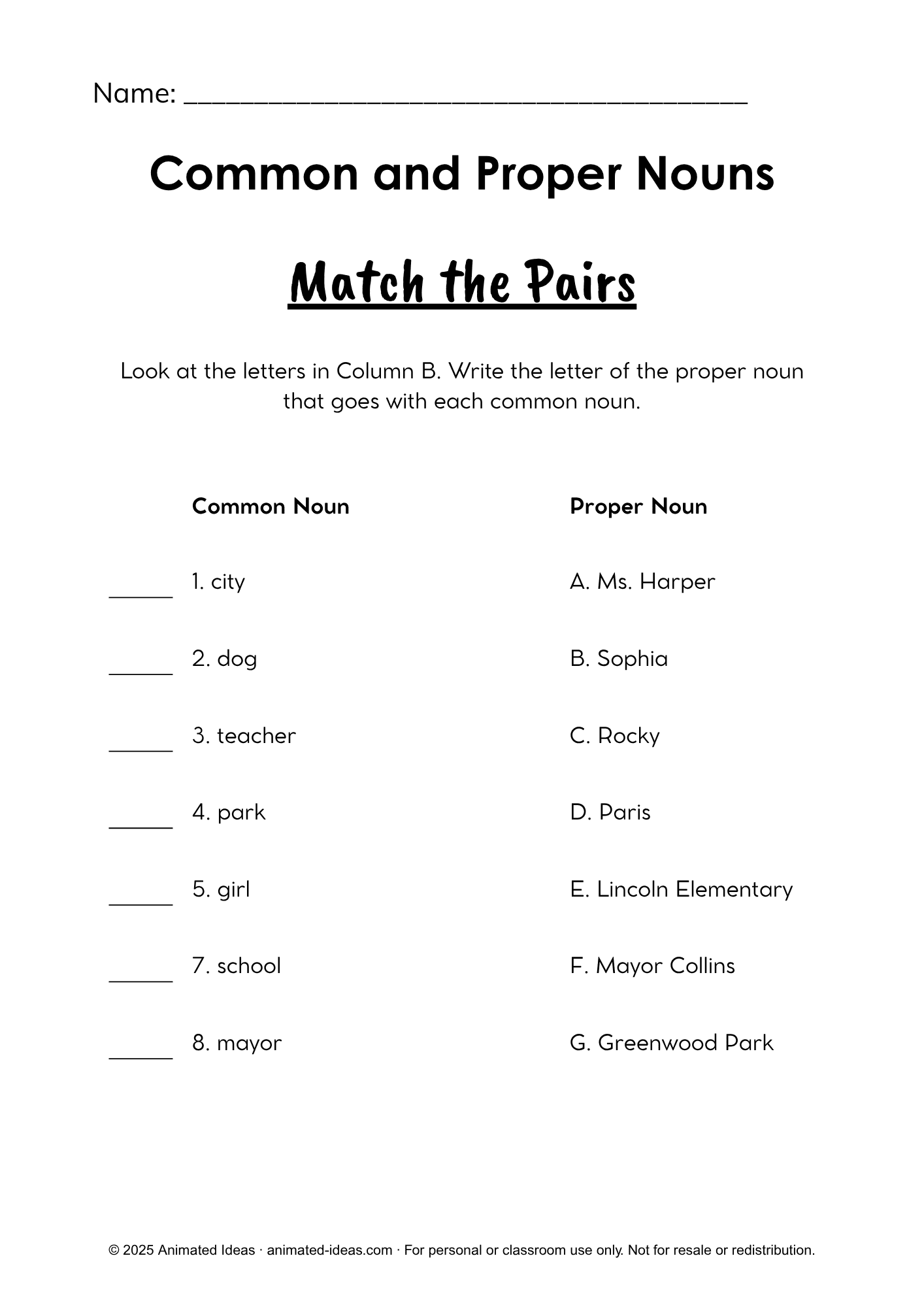
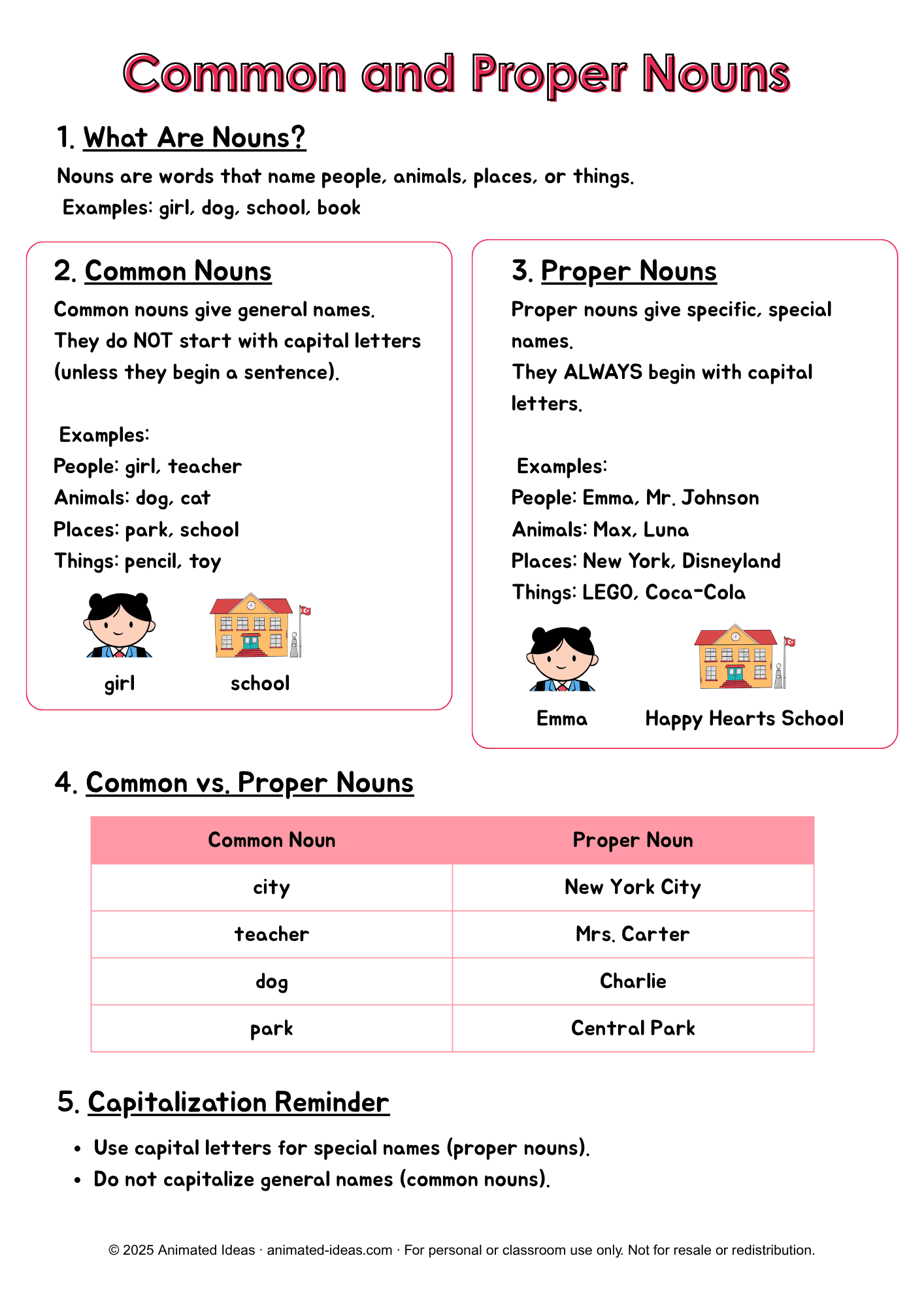
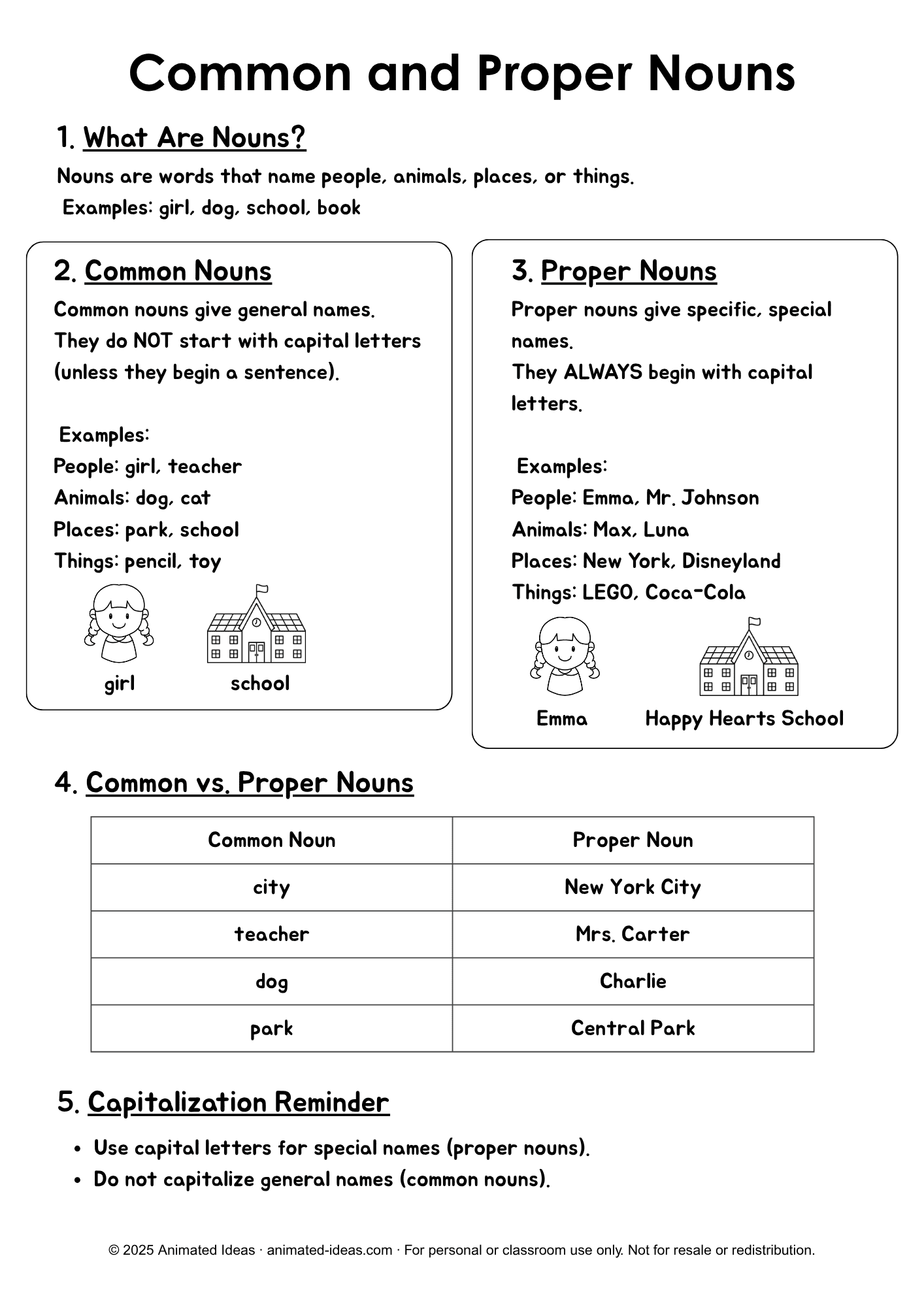
In English, we use words to talk about everything around us—people, animals, places, and objects. Some words help us name these things. These words that name people, places, animals, and things are called nouns.
A noun can be someone you know, something you see, somewhere you go, or even something you cannot touch but can think about. In other words, nouns are all around you.
What Are Common Nouns?
A common noun is a word that names any person, animal, place, or thing in a general way. It does not tell the specific name of someone or something. Instead, it gives a common or general word that we use every day.
Common nouns usually begin with a small letter, unless they start a sentence.
Examples of Common Nouns
1. People (General Names)
- girl
- teacher
- doctor
- friend
These words do not tell us the girl’s name or the teacher’s name. They only tell us what kind of person they are.
2. Animals
- dog
- cat
- bird
- tiger
These words tell the type of animal, not a specific animal’s name.
3. Places
- park
- school
- city
- store
These are names of places in a general way.
4. Things
- chair
- pencil
- toy
- book
These words name objects we can see and touch.
Common nouns help us talk about things in a simple and general way. They help us describe things without giving special or exact names.
What Are Proper Nouns?
A proper noun gives the specific name of a person, place, animal, or thing. It tells exactly who or what we are talking about.
Proper nouns always begin with a capital letter, no matter where they appear in a sentence.
Examples of Proper Nouns
1. People (Specific Names)
- Emma
- Mr. Johnson
- Mrs. Carter
- Liam
These names tell exactly who the person is, not just the general word like “girl” or “teacher.”
2. Animals
- Max (a dog’s name)
- Luna (a cat’s name)
- Rocky (a bird’s name)
These names belong to specific pets or animals.
3. Places
- New York
- Central Park
- London
- Disneyland
These places have their own names, making them proper nouns.
4. Things (Brand Names or Titles)
- LEGO
- Crayola
- Coca-Cola
- Harry Potter (book title)
These names point to one specific thing or brand.
Common Nouns vs. Proper Nouns: What’s the Difference?
| Common Noun | Proper Noun |
|---|---|
| city | New York |
| school | Happy Hills Elementary School |
| dog | Rocky |
| teacher | Mrs. Carter |
| park | Central Park |
A common noun tells the general word, while a proper noun tells the exact name.
Why Capital Letters Matter in Proper Nouns
Proper nouns must start with a capital letter because they are special names.
For example:
- We write school in lowercase when we mean any school.
- We write Green Valley Elementary School with capital letters because it is the school’s actual name.
Using capital letters helps readers understand that you are talking about a specific person or place.
More Examples in Sentences
Common Nouns in Sentences
- The girl is reading a book.
- A dog is sleeping on the carpet.
- My teacher gave us new worksheets.
- We went to the park yesterday.
These sentences do not tell the exact names of the girl, the dog, or the teacher.
Proper Nouns in Sentences
- Mary is reading Harry Potter.
- Buddy is sleeping on the rug.
- Teacher Mia gave us new worksheets.
- We went to Central Park yesterday.
Here, each underlined word gives a specific name.
How to Easily Identify Common and Proper Nouns
Ask Two Simple Questions:
- Is it a general name?
If yes, then it is a common noun. - Is it a special or exact name?
If yes, then it is a proper noun.
Try These Examples:
- “store” → general name → common noun
- “Walmart” → specific name → proper noun
- “boy” → common noun
- “Noah” → proper noun
- “country” → common noun
- “Canada” → proper noun
Why Learning Common and Proper Nouns Is Important
Understanding common and proper nouns helps children:
1. Write clear sentences
If you use the wrong type of noun, your reader may get confused.
2. Use capital letters correctly
Knowing when to capitalize helps improve writing skills.
3. Become better readers
When students know the difference, they can understand texts more easily.
4. Build strong grammar foundations
This lesson prepares students for more advanced grammar topics later on.
Extended Examples for Better Understanding
People
- Common noun: man → Proper noun: Mr. Johnson
- Common noun: doctor → Proper noun: Dr. Carter
Places
- Common noun: hospital → Proper noun: General Hospital
- Common noun: river → Proper noun: Amazon River
Animals
- Common noun: parrot → Proper noun: Polly
- Common noun: dog → Proper noun: Max
Things
- Common noun: movie → Proper noun: Frozen
- Common noun: restaurant → Proper noun: McDonald’s
These examples show that proper nouns are always capitalized and refer to one unique person, place, animal, or thing, while common nouns are general names.
Summary of the Lesson
Nouns are words that name people, animals, places, and things.
Common nouns are general names. They usually start with a small letter.
Proper nouns are specific names. They always begin with a capital letter.
We use proper nouns when we want to talk about one special or exact person, place, or thing.
Learning to tell common and proper nouns apart helps make writing and reading clearer.
Thank You for Reading!
Thank you for reading this lesson guide about Common and Proper Nouns. We hope it helped you understand the difference between general and specific names. To continue learning and practicing English grammar, check out more worksheets from Animated Ideas, including Mass and Count Nouns, Singular and Plural Nouns, and Pronouns – Words that Replace Nouns.
For more fun and educational content, don’t forget to visit our YouTube channel for video lessons, follow updates on our Facebook page, and explore creative ideas on our Pinterest profile. These resources provide extra practice and engaging activities to help students master nouns and other important English concepts.
Keep practicing, and enjoy learning English!
Words have power—learn their names, and you can give life to your ideas.