

Identifying Complete Sentences and Sentence Fragments
Introduction
Identifying Complete Sentences and Sentence Fragments is a key grammar skill every student must master. This lesson helps Grade 3 learners understand how to form complete thoughts, avoid sentence fragments, and write with confidence.
I. What Is a Sentence?
A sentence is a group of words that expresses a complete thought. It tells us something, asks something, gives a command, or shows a strong feeling.
Every sentence begins with a capital letter and ends with a punctuation mark such as a period (.), question mark (?), or exclamation point (!).
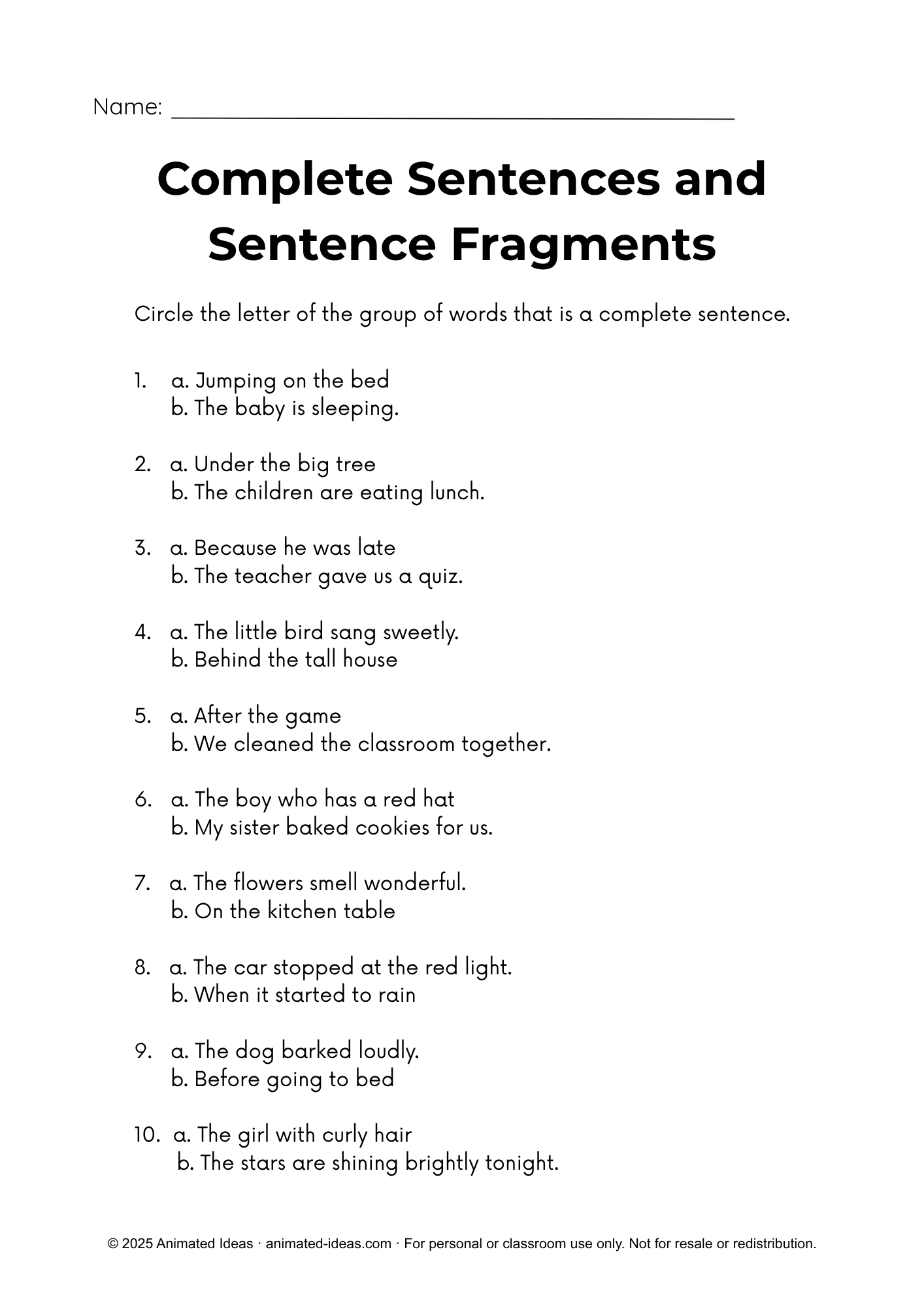
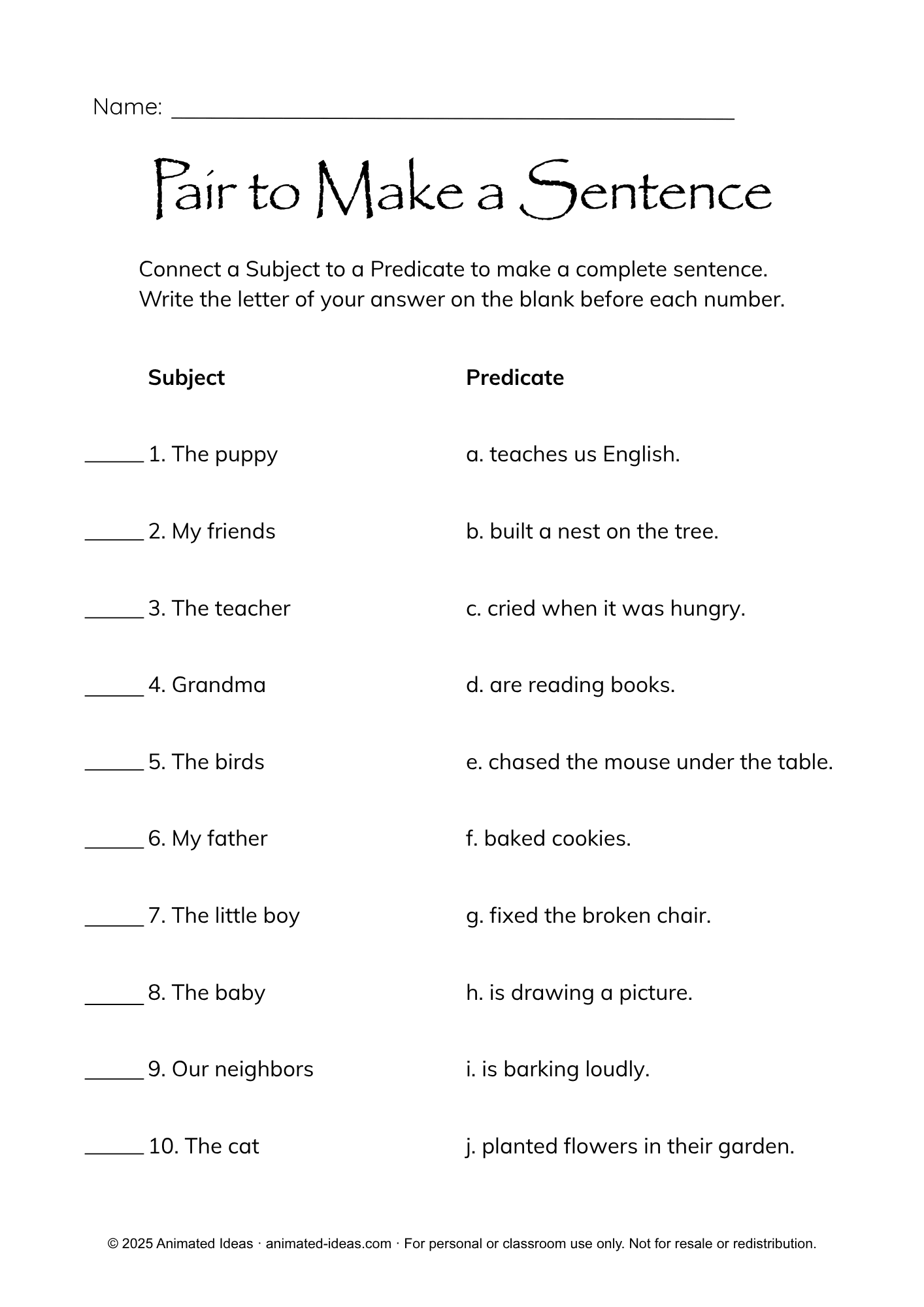
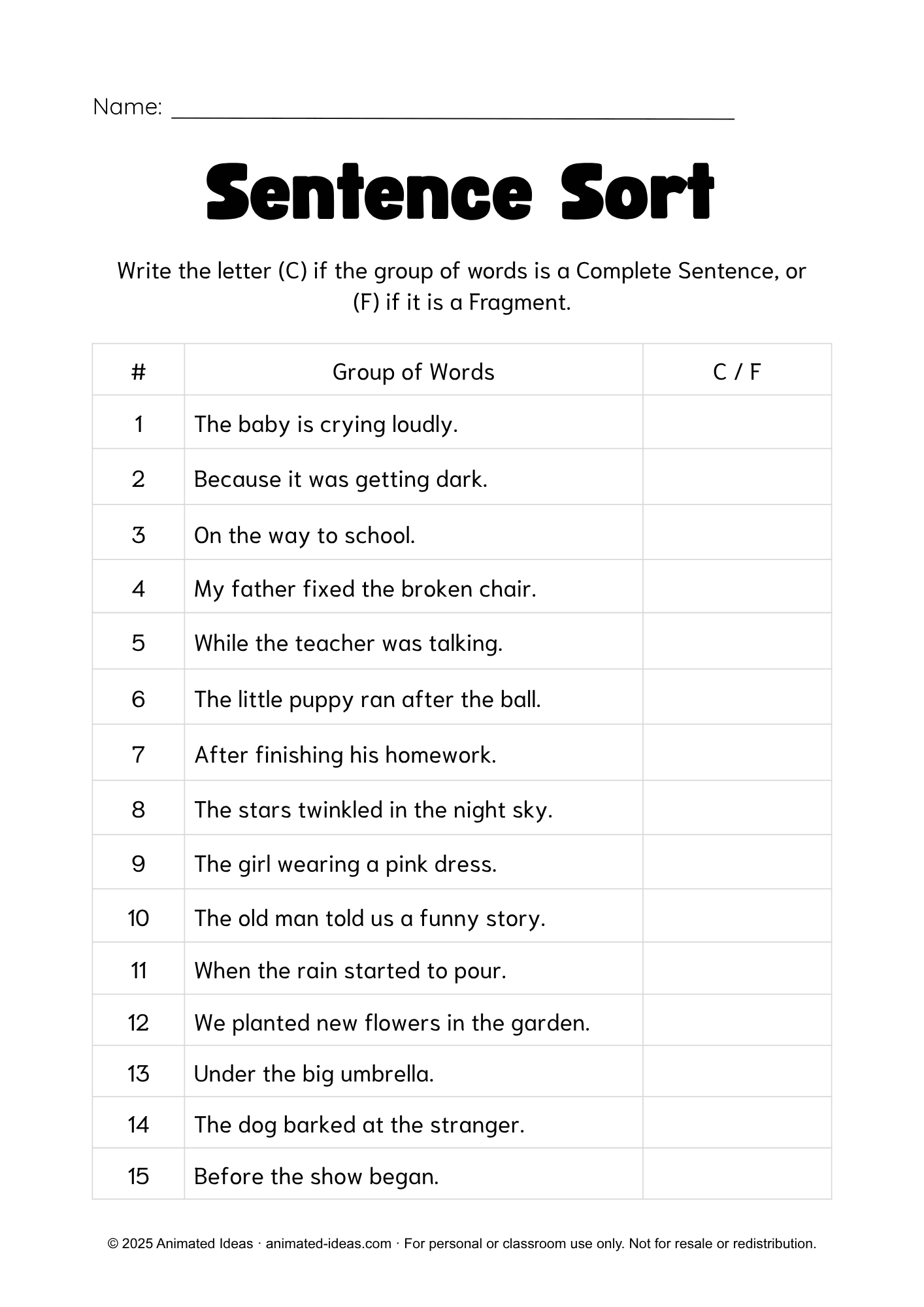

Examples of Complete Sentences:
- The cat sleeps on the bed.
- My teacher reads a story every morning.
- Are you coming to school today?
- Wow! That rainbow is beautiful!
Each of these sentences gives a complete idea. When we read them, we can understand what they mean.
II. Parts of a Complete Sentence
A complete sentence has two main parts:
- Subject – tells who or what the sentence is about.
- Predicate – tells what the subject does or what happens.
Examples:
| Sentence | Subject | Predicate |
|---|---|---|
| The dog barks loudly. | The dog | barks loudly |
| Anna likes to draw. | Anna | likes to draw |
| The flowers are blooming. | The flowers | are blooming |
💡 Tip: The subject and predicate must work together to make sense.
If one is missing, the sentence becomes incomplete.
III. What Is a Sentence Fragment?
A sentence fragment is a group of words that does not express a complete thought.
It might be missing a subject, a predicate, or both.
A fragment sounds unfinished and leaves the reader hanging.
Examples of Sentence Fragments:
- Running down the hallway.
- The tall man.
- Because it was raining.
Let’s look at why these are not complete:
- “Running down the hallway.”
– Who is running? The sentence doesn’t tell us.
Complete sentence: The children were running down the hallway. - “The tall man.”
– What about the tall man? What did he do?
Complete sentence: The tall man opened the door. - “Because it was raining.”
– This sounds like part of a sentence, but it doesn’t tell the full idea.
Complete sentence: We stayed inside because it was raining.
Remember: A sentence fragment may look like a sentence, but it doesn’t make complete sense.
IV. How to Identify Complete Sentences
When you read a group of words, ask yourself these three questions:
- Does it have a subject? (Who or what is it about?)
- Does it have a predicate? (What happens or what does the subject do?)
- Does it make a complete thought? (Can it stand alone and make sense?)
If the answer is yes to all three, then it is a complete sentence.
If the answer is no to any question, it is a sentence fragment.
V. Examples of Complete and Incomplete Sentences
| Group of Words | Type | Explanation |
|---|---|---|
| The sun is shining. | Complete Sentence | Has a subject (sun) and a predicate (is shining) |
| In the morning. | Fragment | Missing a predicate; it doesn’t tell what happens |
| We play outside after lunch. | Complete Sentence | Expresses a full idea |
| Because they were tired. | Fragment | Starts with “because,” but the thought is not complete |
| My brother likes pizza. | Complete Sentence | Full thought with subject and predicate |
| After the rain stopped. | Fragment | Needs more words to complete the idea |
VI. Why Learning This Is Important
Knowing how to identify complete sentences helps you:
- Write correctly and clearly.
- Avoid sentence fragments in your writing.
- Make your stories, essays, and answers easy to understand.
When you use complete sentences, your writing sounds smooth, correct, and confident.
Fragments can make your writing confusing or unclear.
VII. Quick Review
Let’s review what we have learned:
- A sentence expresses a complete thought.
- A complete sentence has a subject and a predicate.
- A sentence fragment is incomplete—it might be missing a subject, predicate, or full idea.
- To check if it’s complete, ask:
- Does it have a subject?
- Does it have a predicate?
- Does it make a complete thought?
Example Recap:
| Fragment | Complete Sentence |
|---|---|
| After the game. | We went home after the game. |
| The little puppy. | The little puppy wagged its tail. |
| Because she was late. | She ran fast because she was late. |
VIII. Conclusion
Understanding the difference between complete sentences and sentence fragments helps you become a better writer and speaker.
Remember:
A complete sentence gives the reader a whole idea.
A fragment gives only part of an idea.
💬 A complete sentence = full thought.
💬 A fragment = missing thought.
When you write or speak, always make sure your words form complete sentences that clearly share what you want to say.
To continue supporting your learners, explore more printable and easy-to-follow grammar lessons from Animated Ideas. Each resource is designed to make English learning engaging and effective for young students.
Recommended Resources from Animated Ideas:
Pronouns – Words that Replace Nouns
Grade 3 Notes and Worksheets
Lesson Guides
Stay Connected with Animated Ideas
Find more creative teaching tips, visuals, and free classroom resources:
📺 YouTube: Animated Ideas Watch fun and simple English lesson videos.
📘 Facebook Page: Animated Ideas Follow for teaching ideas, resource updates, and community tips.
📌 Pinterest: Animated Ideas Explore printable materials and classroom inspiration.
Thank you for reading this grammar guide about Identifying Complete Sentences and Sentence Fragments!
We hope these resources help make your English lessons more engaging and meaningful. Continue exploring Animated Ideas for more lesson guides, printables, and educational activities for teachers and learners.