
Inversion After Negative Adverbials
Inversion after negative adverbials is an advanced grammatical structure used in formal and academic English. It creates emphasis. It also adds dramatic or rhetorical force. Therefore, it frequently appears in academic writing, journalism, speeches, and literature.
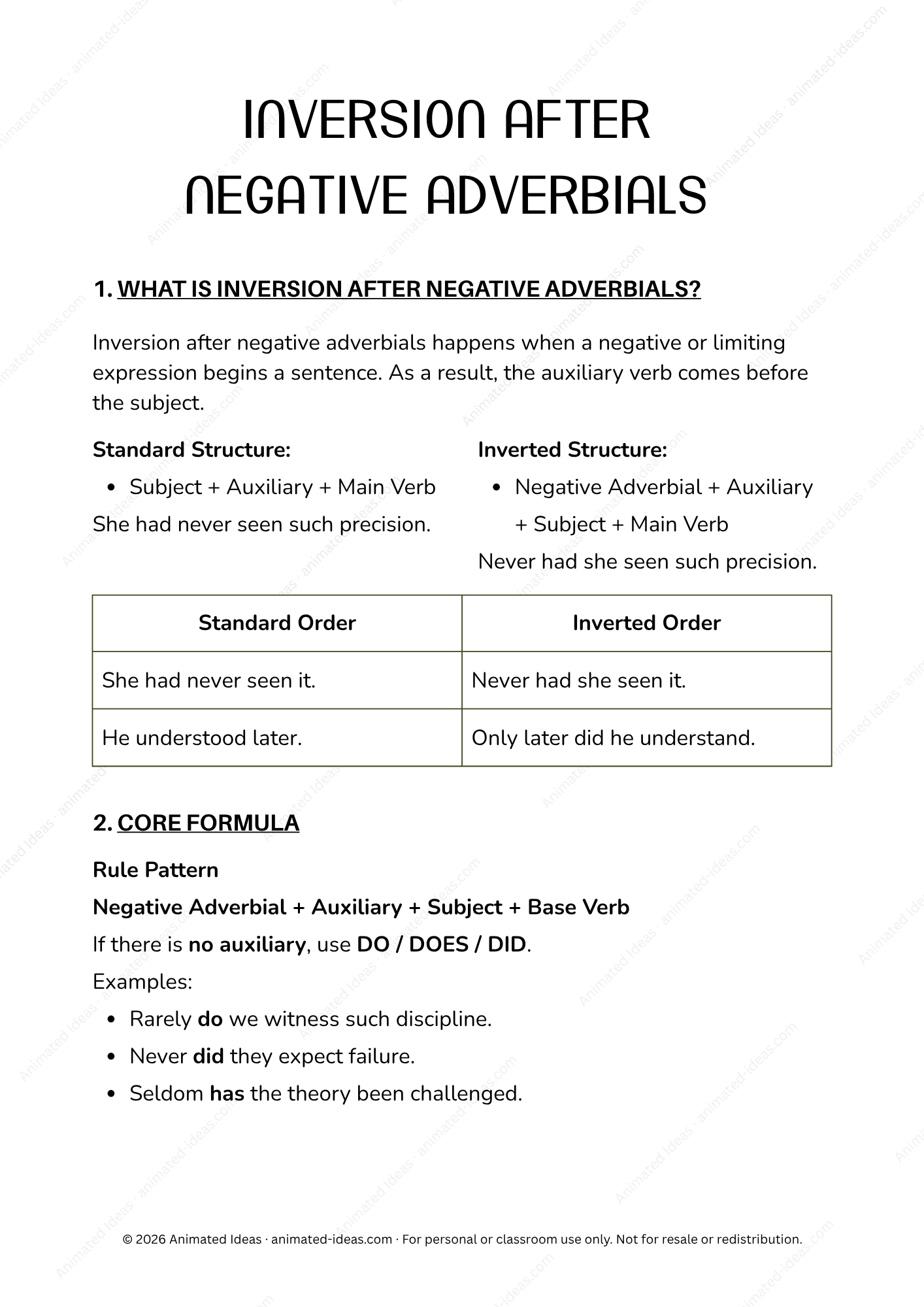
In standard English word order, the subject comes before the verb. However, when certain negative or limiting adverbials appear at the beginning of a sentence, inversion occurs. As a result, the auxiliary verb moves before the subject.
For example:
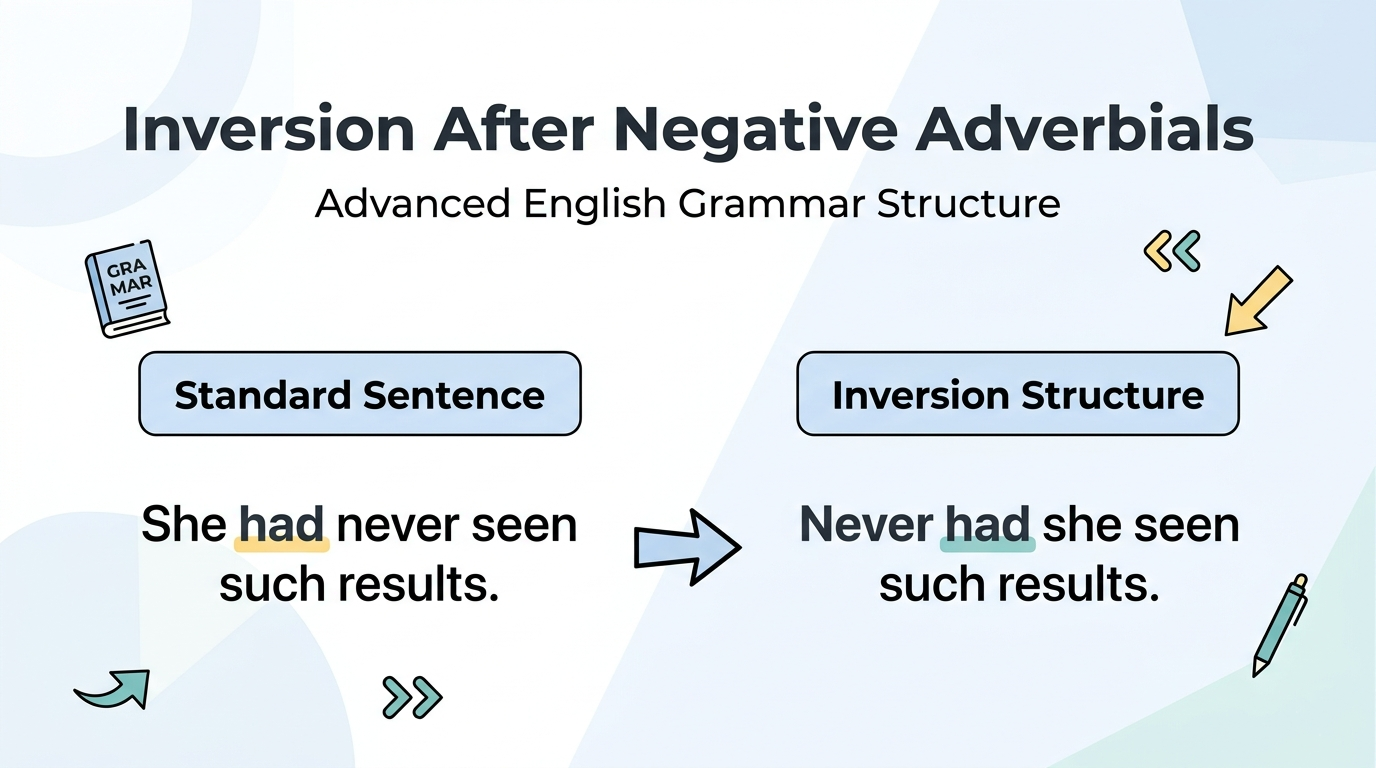
- Standard order: I had never seen such chaos.
- Inverted order: Never had I seen such chaos.
Notice that the auxiliary had moves before the subject I. This shift creates emphasis. Moreover, it signals a formal tone.
In this lesson, we will explore:
- What inversion after negative adverbials means
- Why it happens
- Which expressions trigger inversion
- How tense and auxiliary verbs behave
- Subtle differences in meaning and tone
- Common errors advanced learners make
Throughout the discussion, we will examine structure carefully. Furthermore, we will analyze examples in detail.
Download Free Worksheets and Notes
These downloadable worksheets and detailed grammar notes are designed for:
- Advanced ESL learners (C1–C2 level)
- University students
- Academic writing learners
- English teachers preparing high-level lessons
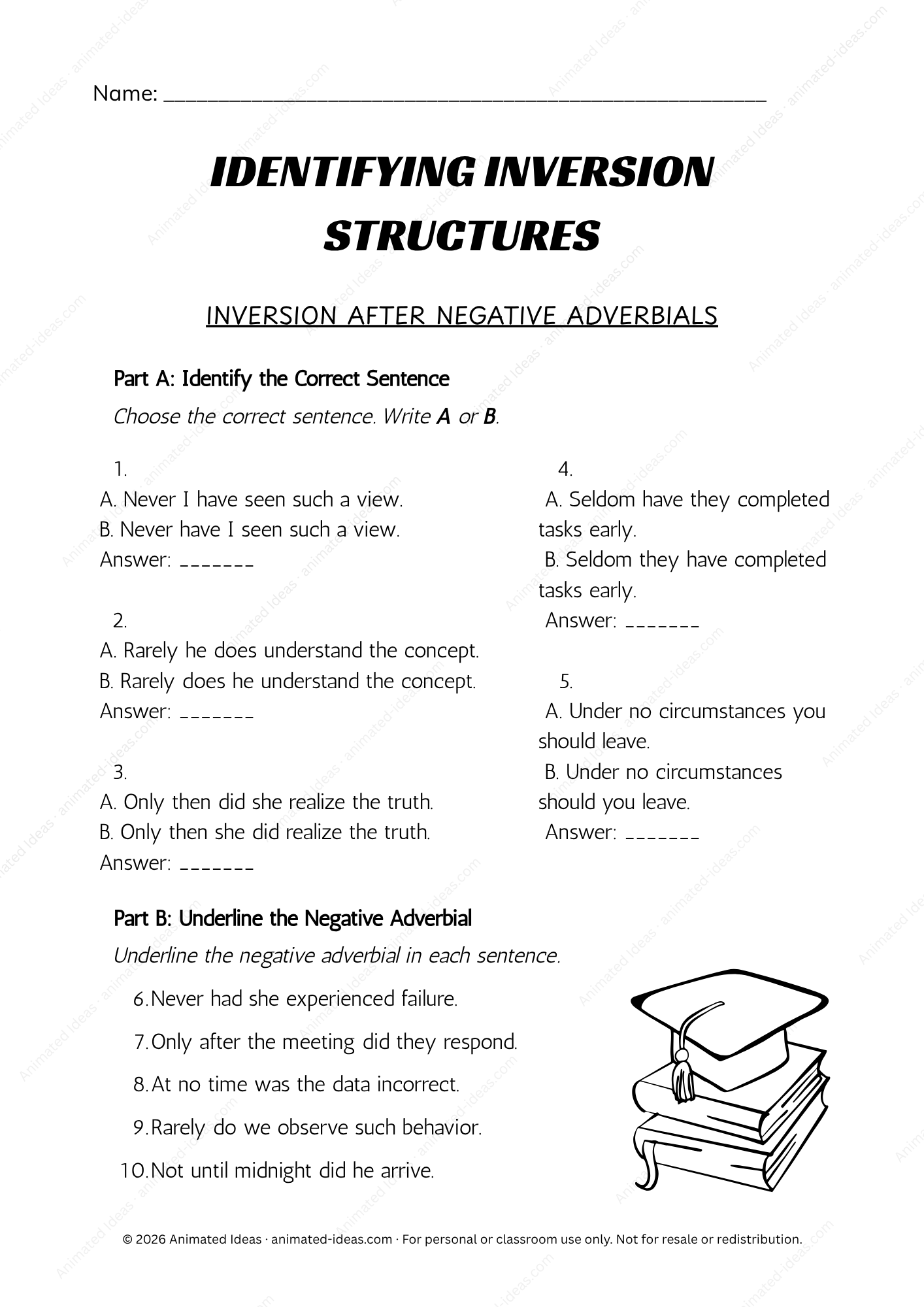
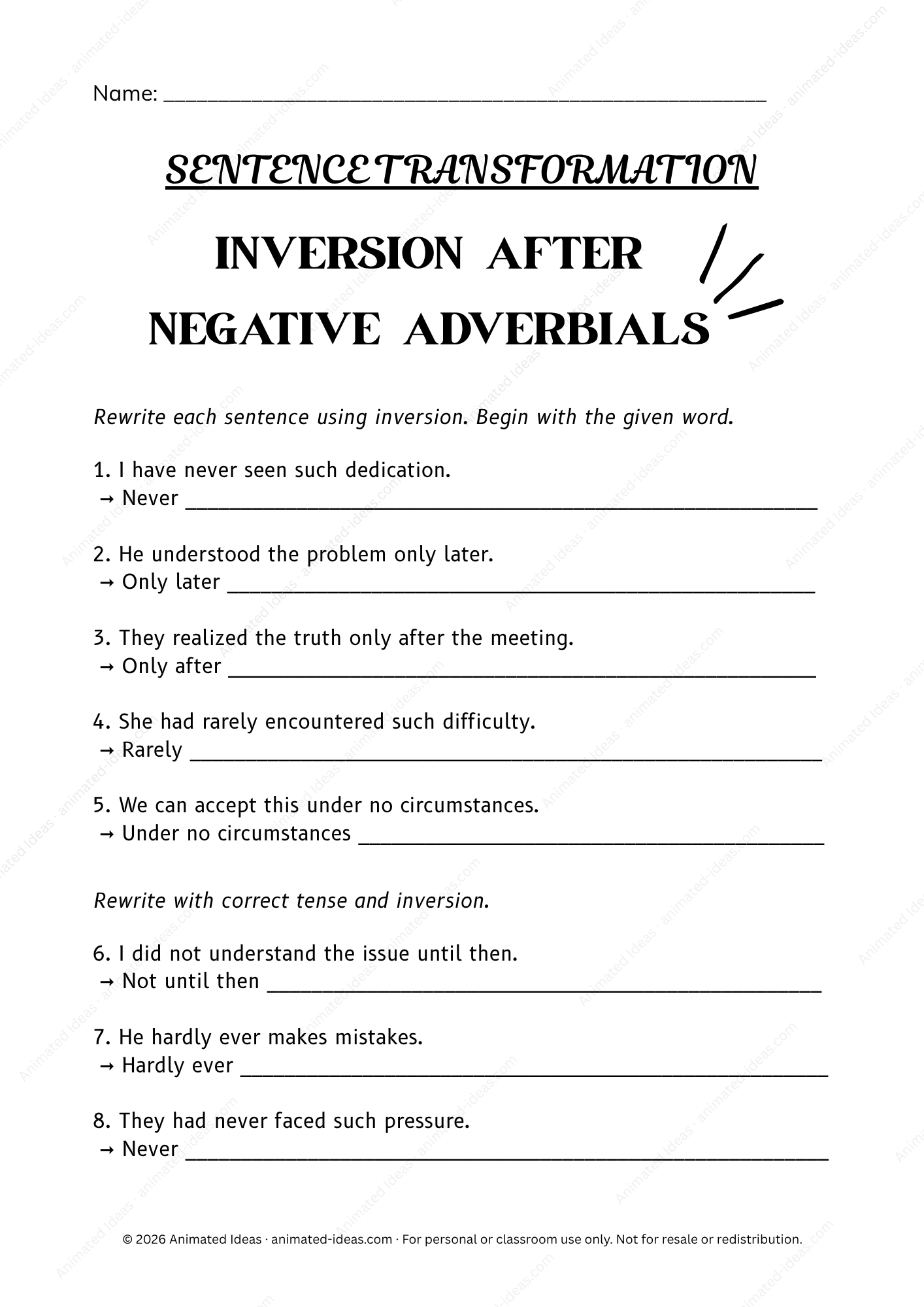
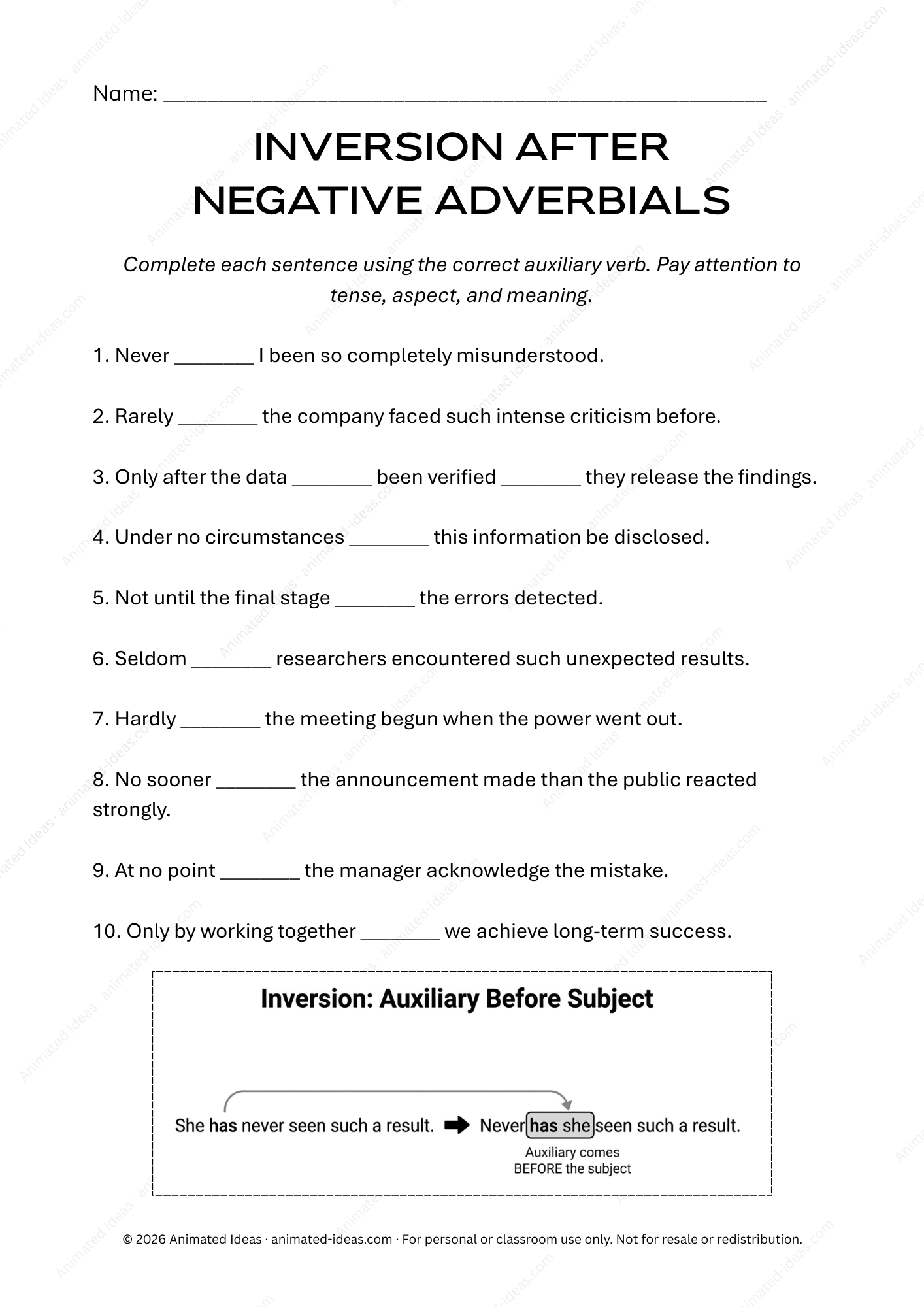
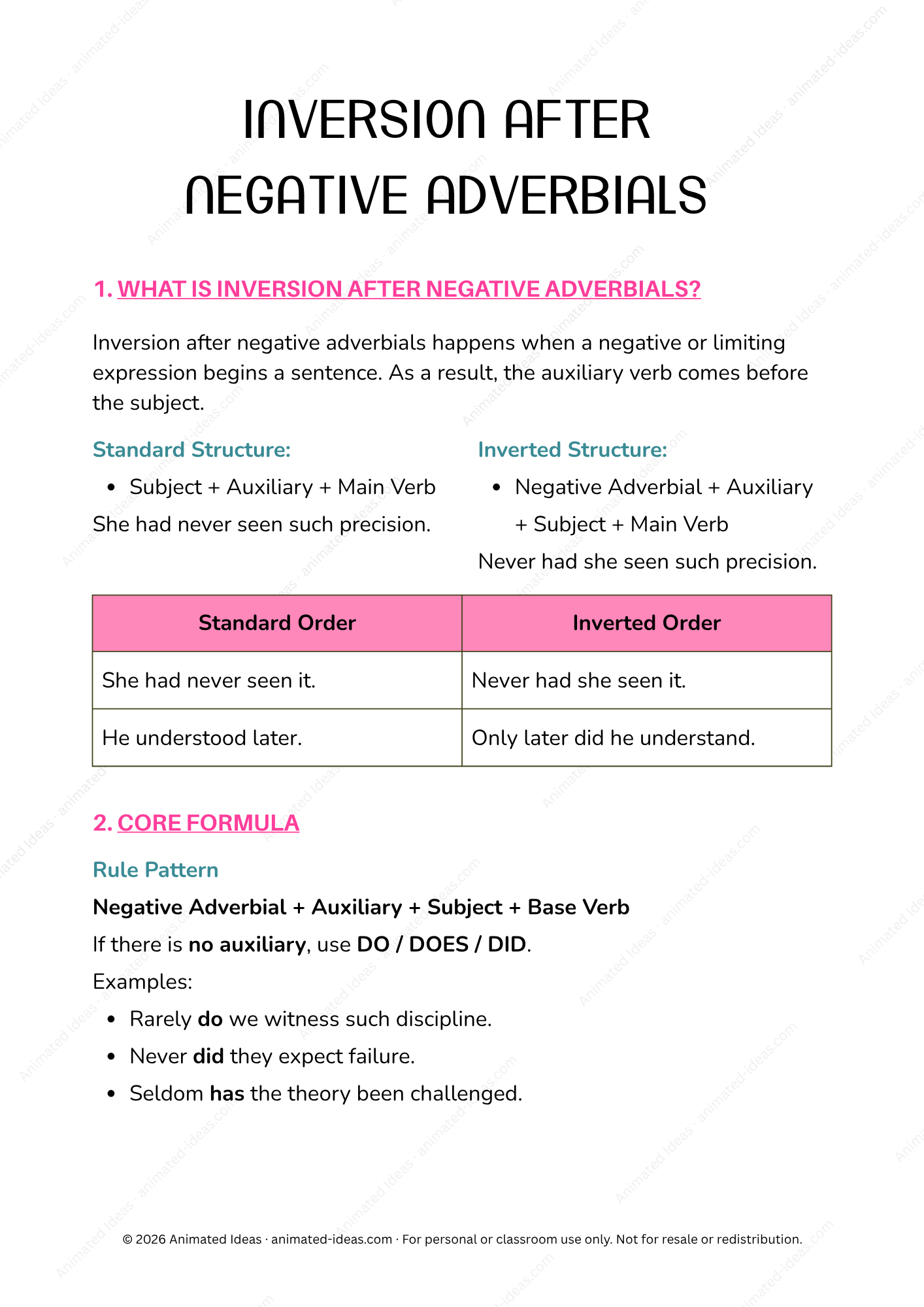
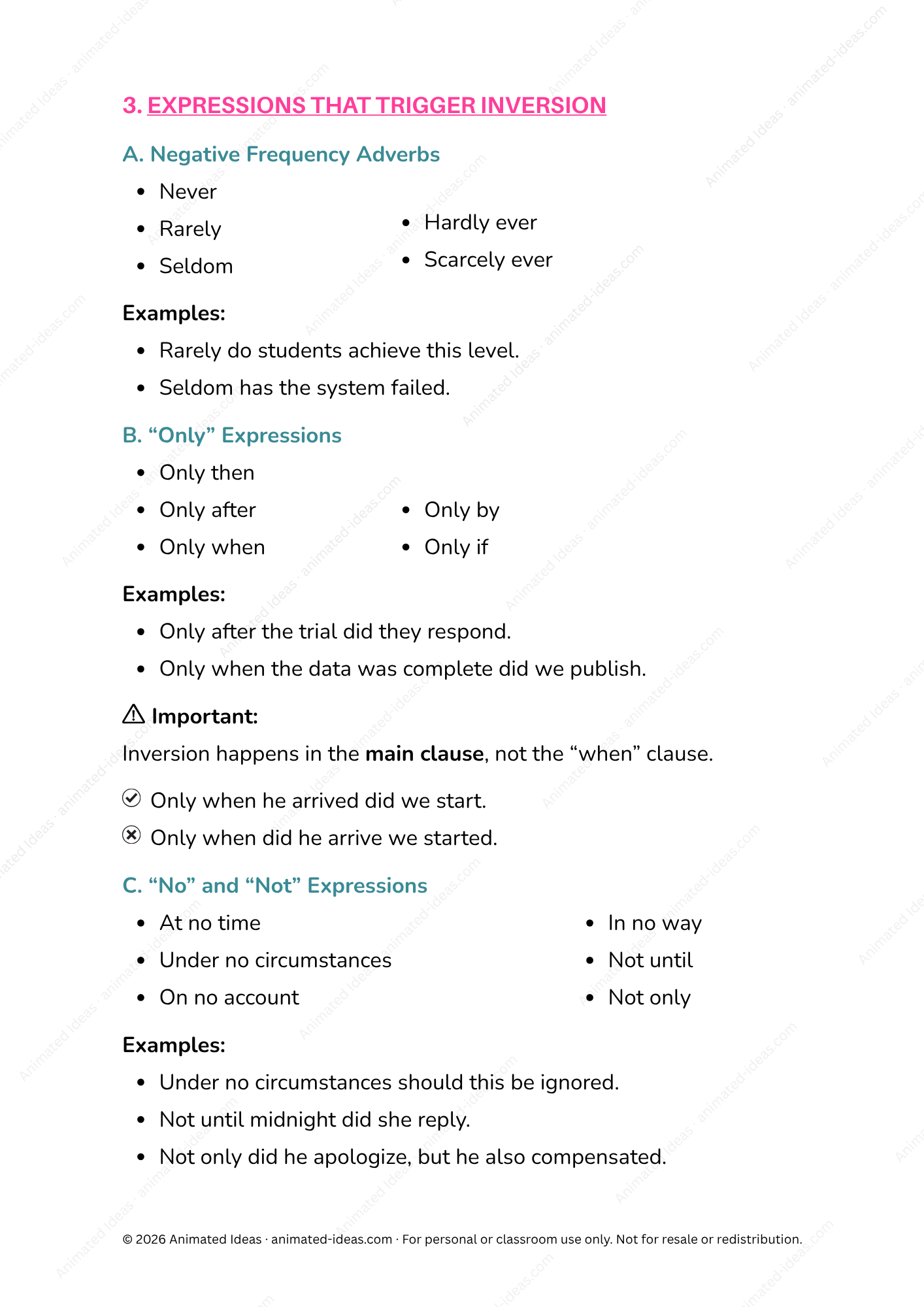
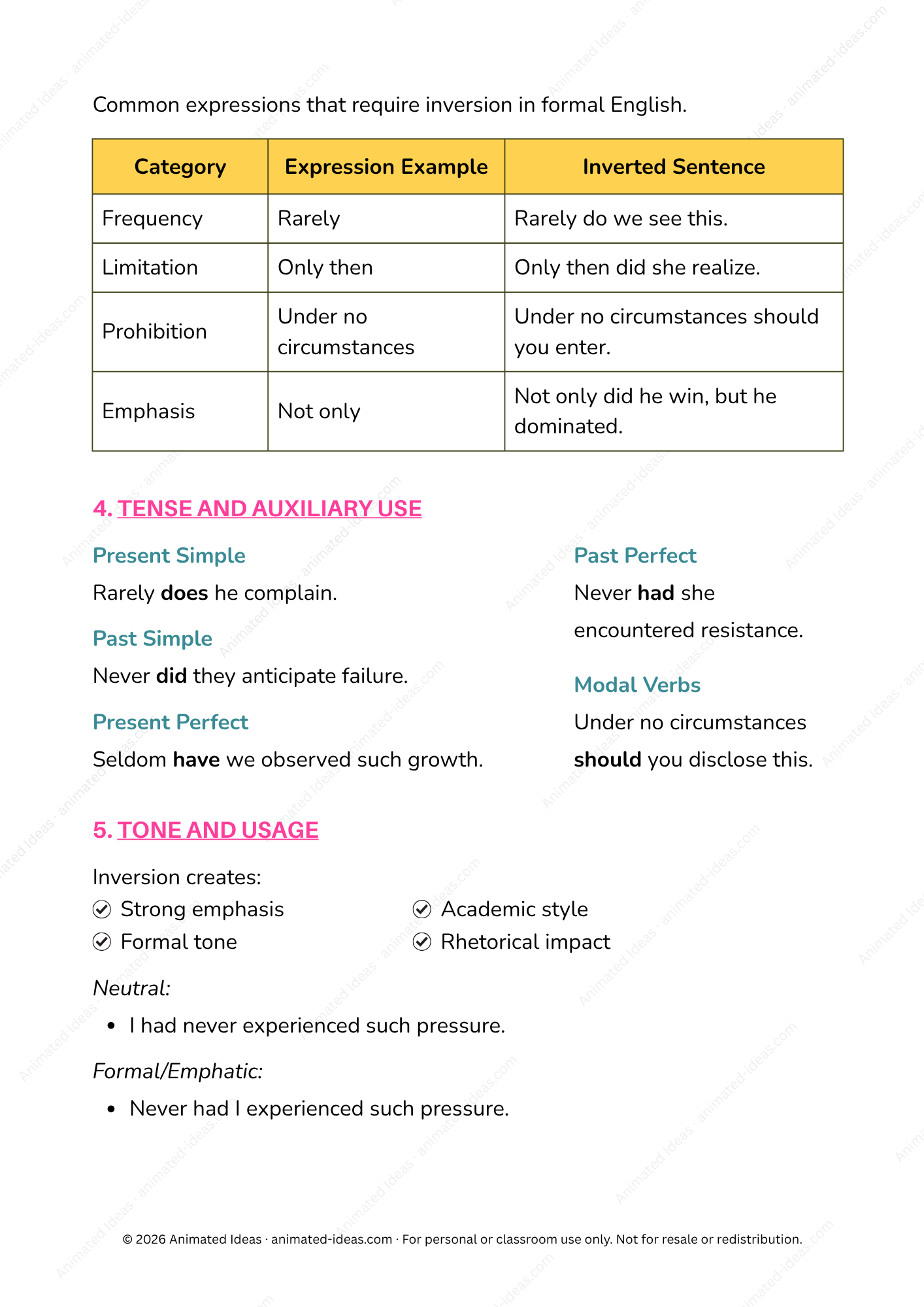
By studying the downloadable materials, learners can strengthen grammatical control. Consequently, they can produce more sophisticated and confident English.
What Is Inversion After Negative Adverbials?
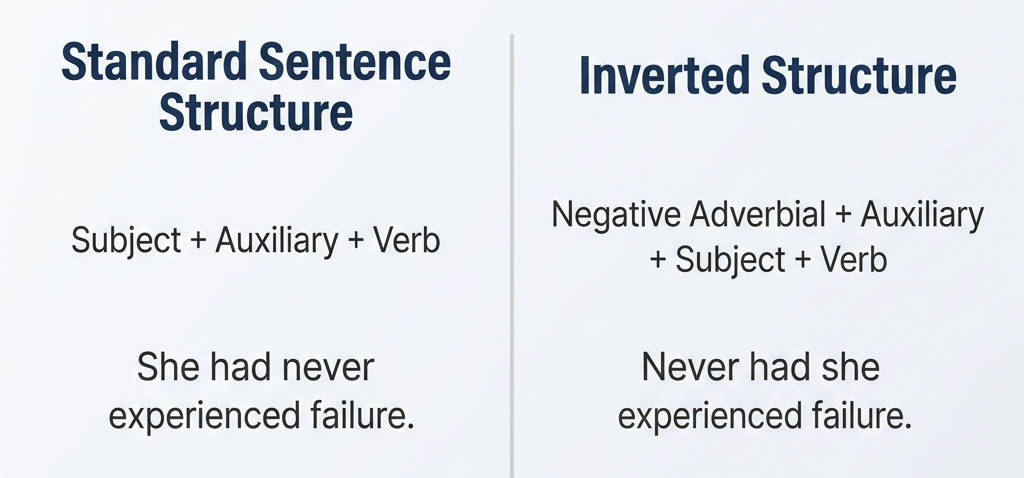
Inversion after negative adverbials occurs when:
- A negative or restrictive adverbial expression begins a sentence.
- The auxiliary verb comes before the subject.
The structure follows this pattern:
Negative Adverbial + Auxiliary + Subject + Main Verb
For example:
- Rarely do we encounter such precision.
- Under no circumstances should you reveal this information.
- Only then did she understand the consequences.
In each case, inversion follows immediately after the opening expression.
Why Does Inversion After Negative Adverbials Occur?
Emphasis and Rhetorical Impact
Inversion serves emphasis. It highlights the negative element. Therefore, the reader immediately focuses on the limitation or restriction.
For example:
- Never have I witnessed such dedication.
The speaker does not simply state information. Instead, the structure intensifies the meaning.
Furthermore, inversion increases dramatic effect. In speeches, this technique often strengthens persuasion. In academic writing, it enhances precision and authority.
Formal Register
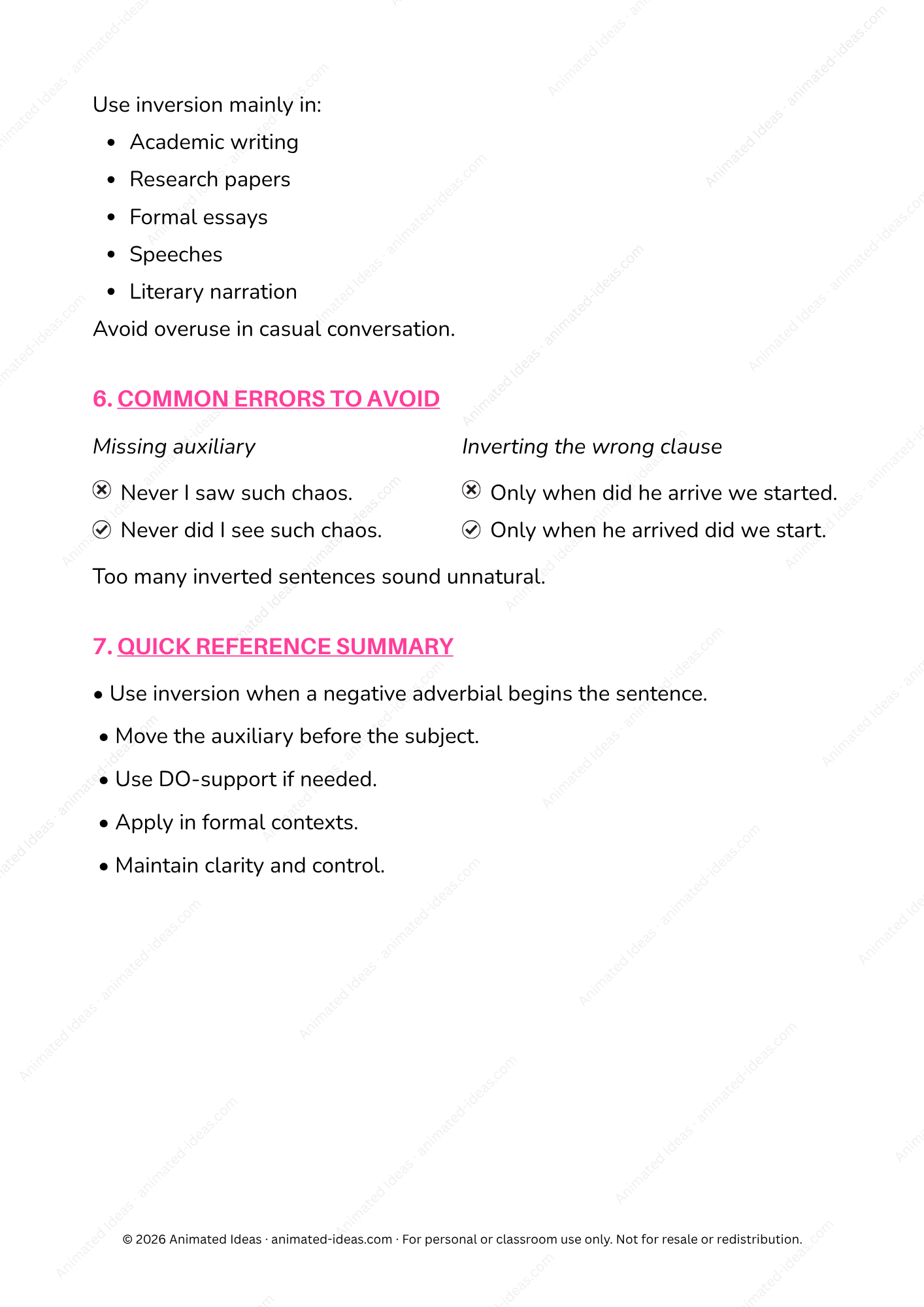
Inversion after negative adverbials appears primarily in formal contexts. It rarely appears in casual conversation.
Compare:
- Informal: I have never seen that before.
- Formal: Never have I seen that before.
The second sentence sounds elevated. Therefore, writers use it to create sophistication.
Categories of Negative Adverbials That Trigger Inversion
Now, let us examine the major categories that trigger inversion after negative adverbials.
1. Frequency Adverbs with Negative Meaning
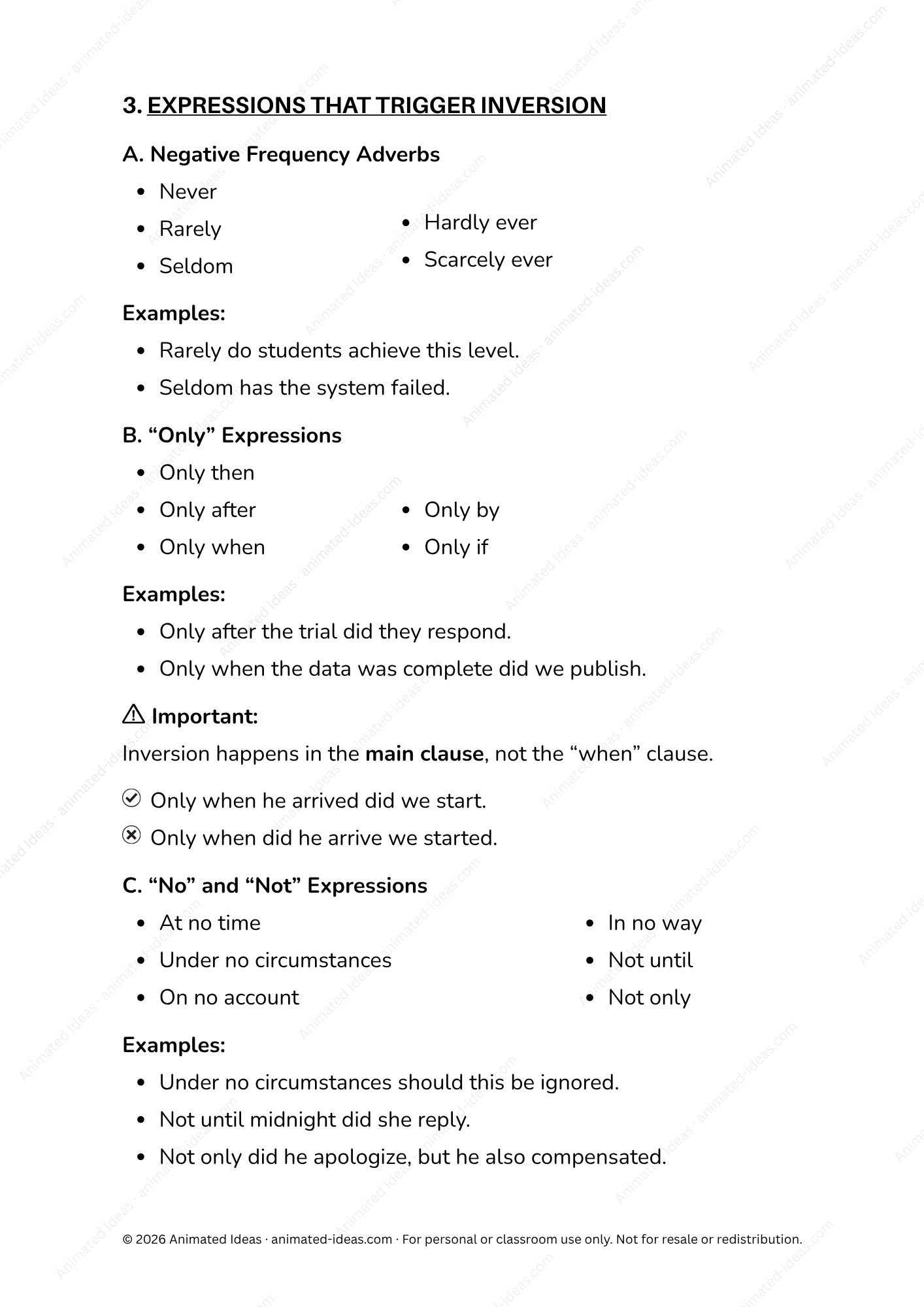
These include:
- Never
- Rarely
- Seldom
- Hardly ever
- Scarcely ever
Examples:
- Rarely do students achieve this level of mastery.
- Seldom has the theory been challenged so effectively.
These adverbs express low frequency. When placed at the beginning, they require inversion.
2. Expressions with “Only”
“Only” expressions limit time, condition, or manner. Therefore, they often trigger inversion.
Common structures include:
- Only then
- Only after
- Only when
- Only by
- Only if
Examples:
- Only after the experiment concluded did the researchers publish the data.
- Only when the evidence became undeniable did the committee respond.
Notice that inversion occurs in the main clause. However, it does not occur inside the subordinate clause.
Incorrect: Only when did the evidence become clear…
Correct: Only when the evidence became clear did they act.
This distinction is essential for advanced learners.
3. “No” and “Not” Expressions
Several expressions begin with “no” or “not.” These frequently trigger inversion.
Common examples include:
- At no time
- In no way
- Under no circumstances
- On no account
- Not until
- Not only
Examples:
- At no time was the data manipulated.
- Under no circumstances should this protocol be ignored.
- Not until the final chapter did the theme become clear.
These structures emphasize prohibition or restriction. Therefore, they sound strong and authoritative.
4. Negative Conjunctions and Correlative Structures
Certain paired structures also require inversion.
Not only … but also
When “not only” begins a sentence, inversion follows in the first clause.
- Not only did the policy fail, but it also caused unintended harm.
However, inversion does not occur in the second clause.
This asymmetry is common. Therefore, learners must pay attention to clause position.
| Category | Expression | Example Sentence (Inversion) |
|---|---|---|
| Frequency Adverbs (Negative Meaning) | Never | Never have scholars reached a consensus on this issue. |
| Rarely | Rarely do researchers encounter such consistent results across multiple trials. | |
| Seldom | Seldom has a theory generated such widespread debate within the field. | |
| Hardly ever | Hardly ever do policymakers consider the long-term implications of such decisions. | |
| Scarcely ever | Scarcely ever has the methodology produced outcomes of this magnitude. | |
| “Only” Expressions | Only then | Only then did the underlying assumptions become apparent to the researchers. |
| Only after | Only after extensive analysis did the flaws in the model become evident. | |
| Only when | Only when the variables were controlled did the experiment yield reliable data. | |
| Only by | Only by adopting a multidisciplinary approach can the problem be effectively addressed. | |
| Only if | Only if the criteria are strictly enforced will the results maintain their validity. | |
| “No” and “Not” Expressions | At no time | At no time was the integrity of the data compromised during the investigation. |
| In no way | In no way does this interpretation diminish the significance of the findings. | |
| Under no circumstances | Under no circumstances should the protocol be altered without prior approval. | |
| On no account | On no account must confidential information be disclosed to unauthorized parties. | |
| Not until | Not until the final phase did the researchers identify the critical variable. | |
| Not only | Not only did the intervention fail, but it also introduced additional complications. | |
| Negative Conjunctions / Correlative Structures | Not only … but also | Not only did the initial hypothesis prove incorrect, but it also required a complete revision of the research framework. |
Tense and Auxiliary Verb Behavior in Inversion
The Role of Auxiliary Verbs
In inversion after negative adverbials, the auxiliary verb moves before the subject. If the sentence has no auxiliary, we must use do-support.
Example:
Standard: She understood the implications.
Inverted: Only later did she understand the implications.
Because there is no auxiliary in the original sentence, we insert did.
Similarly:
Standard: He appreciates the complexity.
Inverted: Rarely does he appreciate the complexity.
This rule applies across tenses.
Inversion in Different Tenses
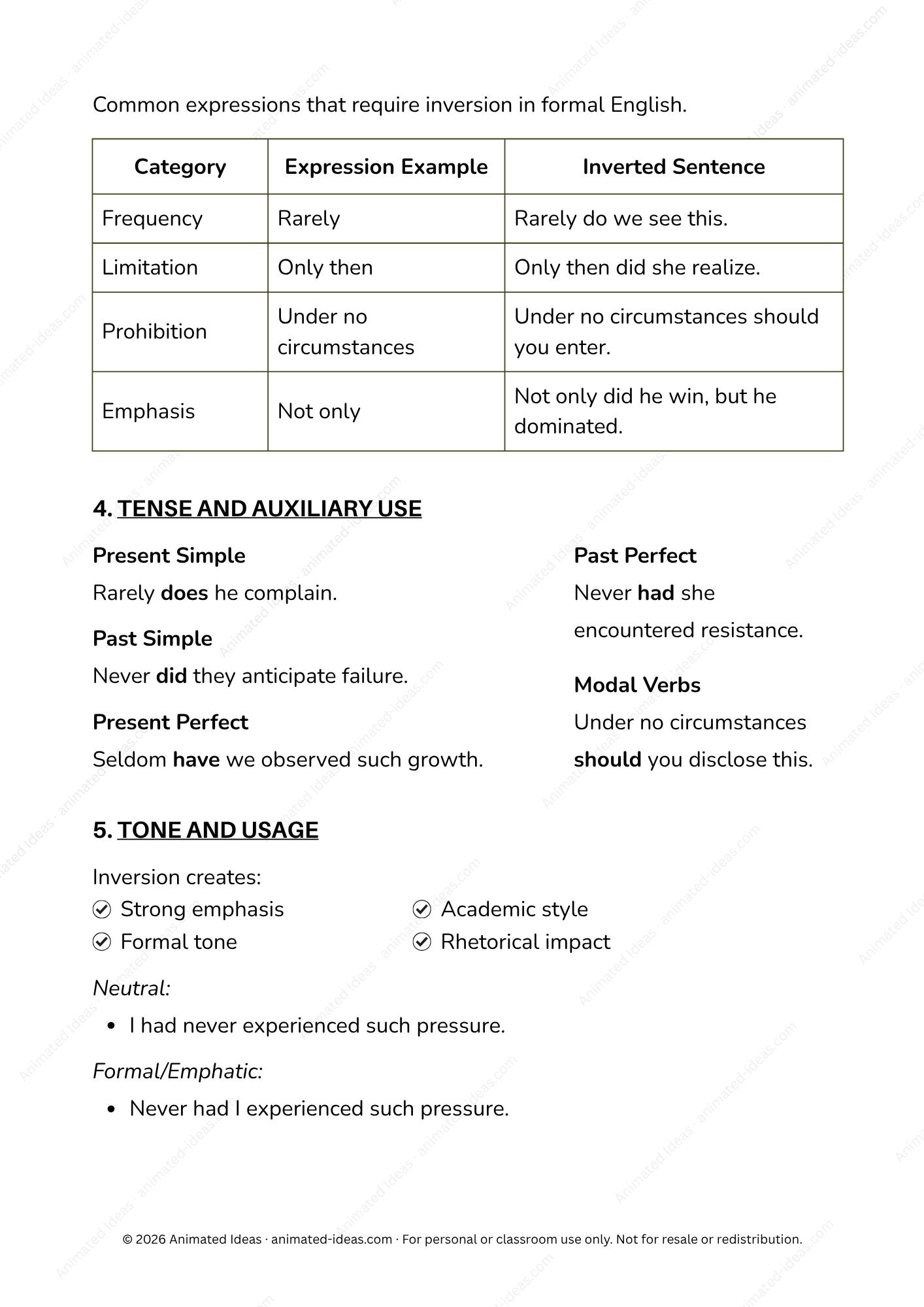
Present Simple
- Seldom does he arrive on time.
👉 Learn more about this tense in our Present Simple guide.
Past Simple
- Never did they anticipate such resistance.
Present Perfect
- Rarely have we observed this pattern.
👉 Practice this tense with our free Present Perfect printable worksheets.
Past Perfect
- Never had she encountered such difficulty.
Modal Verbs
- Under no circumstances should you intervene.
- At no time could the system function independently.
Modal verbs behave as auxiliaries. Therefore, they move directly before the subject.
Subtle Meaning Differences and Stylistic Nuance
Although inversion does not change factual meaning, it changes emphasis. Therefore, tone shifts significantly.
Compare:
- I had never considered that possibility.
- Never had I considered that possibility.
The second sentence sounds reflective. It also sounds more dramatic.
Furthermore, inversion often implies surprise, shock, or strong emotion.
For example: Never have I felt such relief.
The structure intensifies emotional expression.
Academic and Literary Usage of Inversion After Negative Adverbials
In academic writing, inversion often appears in research conclusions.
Example: Only then can we fully appreciate the implications of the findings.
In literature, authors use inversion to heighten suspense.
Example: Never had the silence seemed so oppressive.
In journalism, inversion strengthens headlines or commentary.
Example: Rarely has a decision sparked such controversy.
Therefore, mastering inversion allows advanced learners to write with authority and stylistic flexibility.
Conclusion: Mastering Inversion After Negative Adverbials
Inversion after negative adverbials is a hallmark of advanced English. It signals formality. It creates emphasis. Moreover, it enhances rhetorical power.
To summarize:
- It occurs when a negative or restrictive adverbial begins a sentence.
- The auxiliary verb moves before the subject.
- Do-support appears when no auxiliary exists.
- It functions across all major tenses.
- It strengthens tone in academic and formal writing.
Therefore, mastering this structure elevates writing from competent to sophisticated. With careful practice and awareness, advanced learners can use inversion precisely and confidently.
Ultimately, inversion after negative adverbials is not merely a grammatical rule. Instead, it is a stylistic tool. When used effectively, it transforms ordinary sentences into powerful statements.