
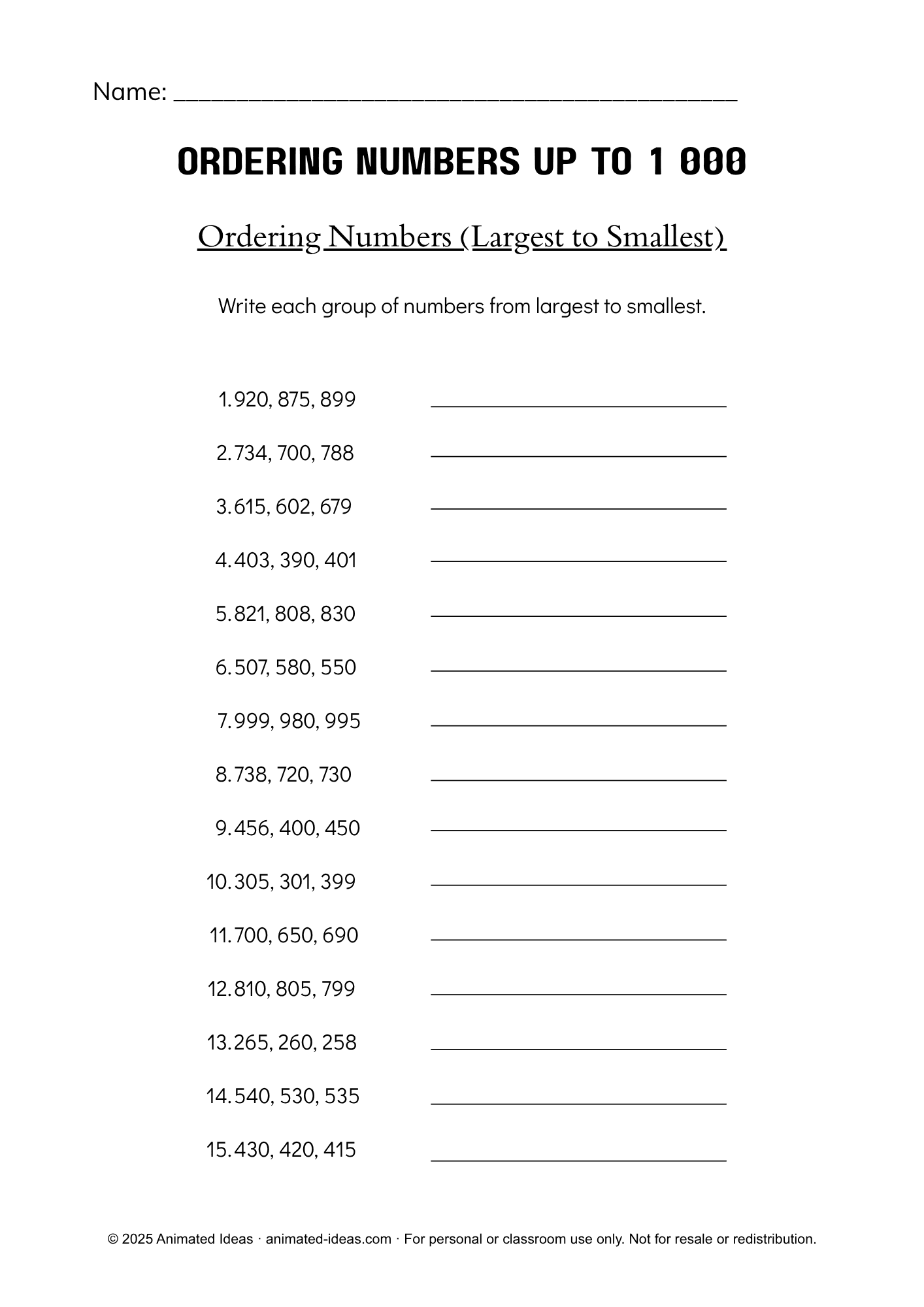
Ordering Numbers Up to 1000
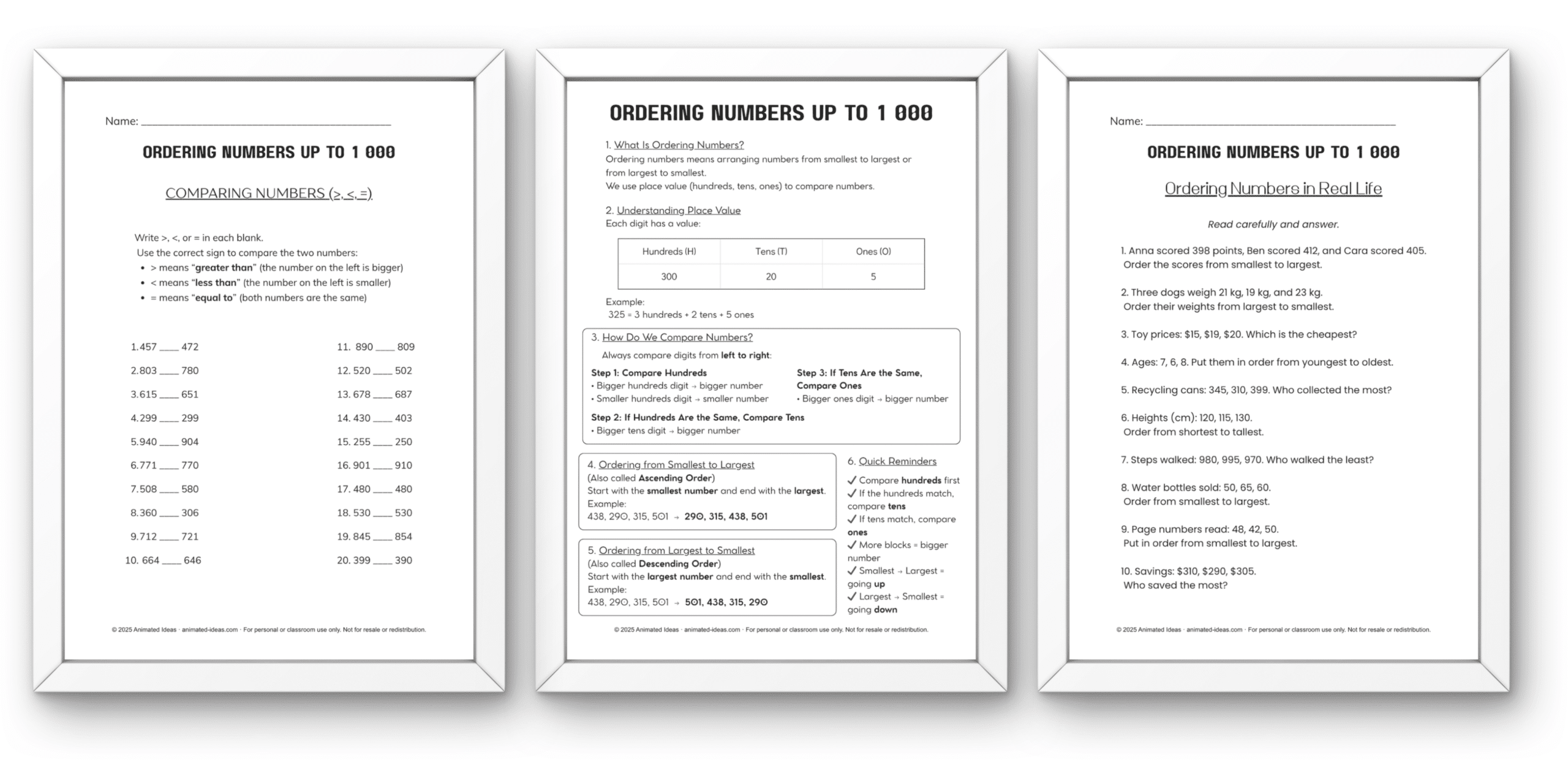
In this lesson, we will learn ordering numbers up to 1000. This means we will learn how to arrange numbers from smallest to largest and from largest to smallest. Ordering numbers helps us understand which number is bigger or smaller, and it makes reading, counting, and solving math problems easier.
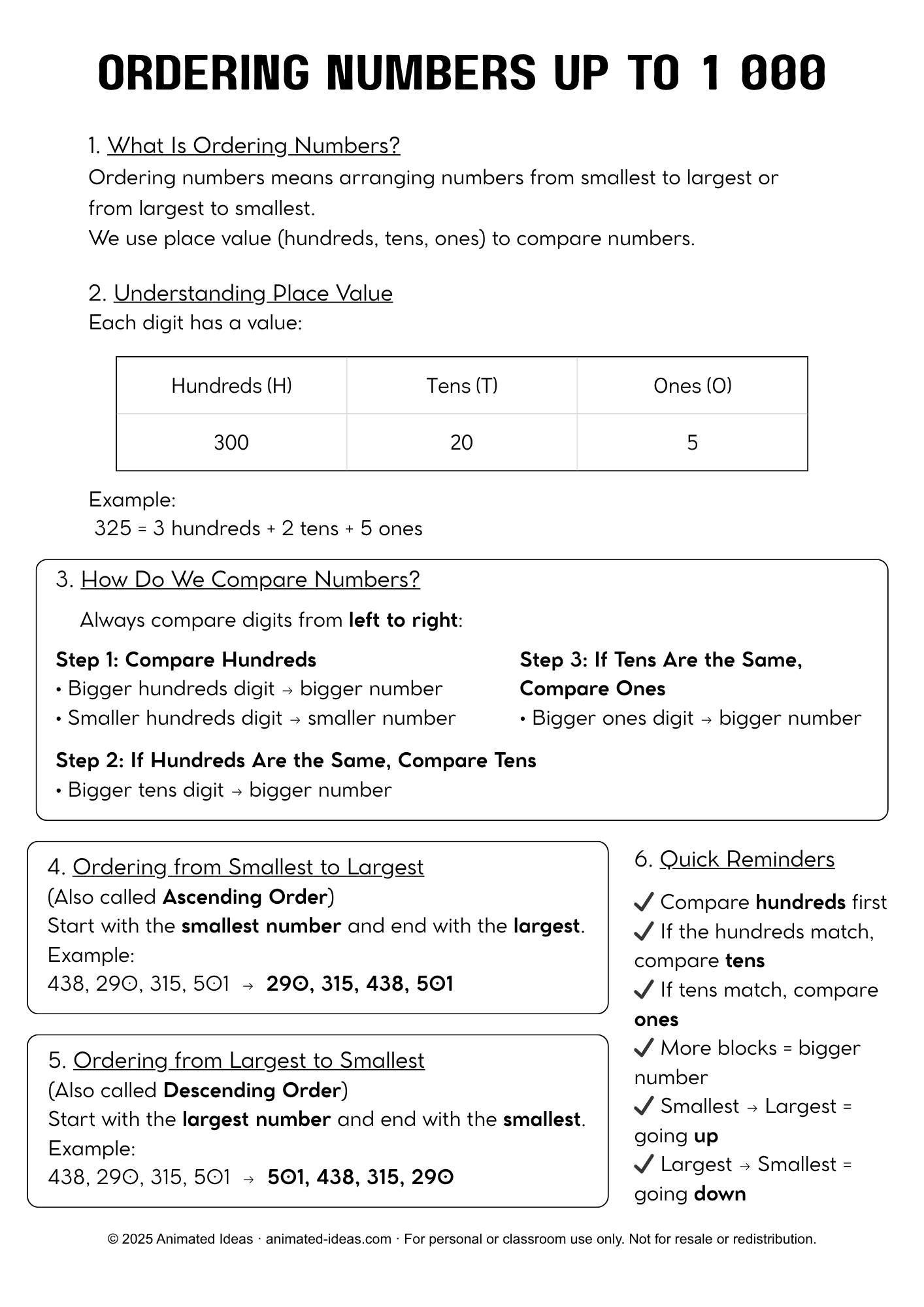
To order numbers correctly, we must understand and use place value—the value of each digit in a number.


Review of Place Value (Hundreds, Tens, and Ones)
Every number up to 1 000 has digits that stand for different values. These values are:
- Hundreds (H)
- Tens (T)
- Ones (O)
Let’s look at an example number:
Example: 325
We can break this number into:
- 3 hundreds
- 2 tens
- 5 ones
| Hundreds | Tens | Ones |
|---|---|---|
| 3 | 2 | 5 |
This means:
- 3 hundreds = 300
- 2 tens = 20
- 5 ones = 5
So, 325 = 300 + 20 + 5.
Understanding place value is the most important skill for comparing and ordering numbers.
Why Do We Need to Learn Ordering Numbers?
Ordering numbers helps us:
- Know which number is bigger or smaller
- Organize information
- Understand number patterns
- Make good decisions in everyday life (like checking prices, weights, time, and scores)
For example:
If you want to buy something, you need to know which item has the smallest price.
If you join a game, you want to know who has the biggest score.
These are all real-life examples of ordering numbers.
How Do We Compare and Order Numbers?
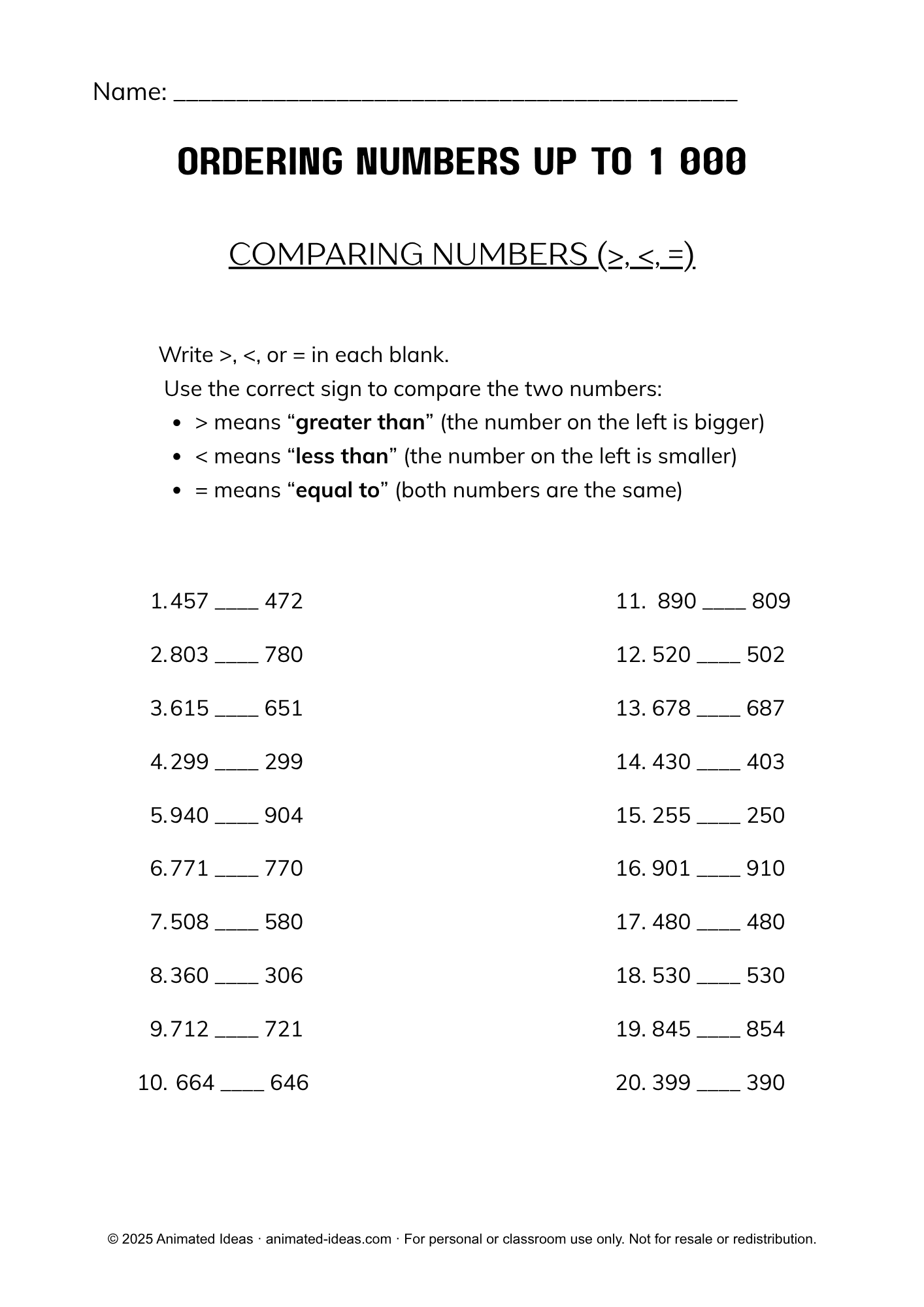
When we compare numbers up to 1 000, we follow this rule:
Rule for Comparing Numbers
- Look at the hundreds place first.
- The number with the bigger hundreds digit is the bigger number.
- The number with the smaller hundreds digit is the smaller number.
- If the hundreds place is the same, look at the tens place.
- The number with the bigger tens digit is bigger.
- The smaller tens digit means the number is smaller.
- If both hundreds and tens are the same, look at the ones place.
- The number with the bigger ones digit is bigger.
We always compare digits from left to right.
Step-by-Step Examples
Example 1: Compare 452 and 367
Step 1: Compare Hundreds
- 4 hundreds vs. 3 hundreds
Since 4 > 3,
452 is bigger than 367.
Example 2: Compare 481 and 489
Step 1: Hundreds
- Both numbers have 4 hundreds.
So we move to the tens place.
Step 2: Tens
- 8 tens (=80) vs. 8 tens (=80)
Still the same.
Step 3: Ones
- 1 one vs. 9 ones
Since 1 < 9,
481 is smaller than 489.
Example 3: Compare 760 and 706
Hundreds
- Both have 7 hundreds.
Tens
- 6 tens (60) vs. 0 tens (0)
Since 60 > 0,
760 is bigger than 706.
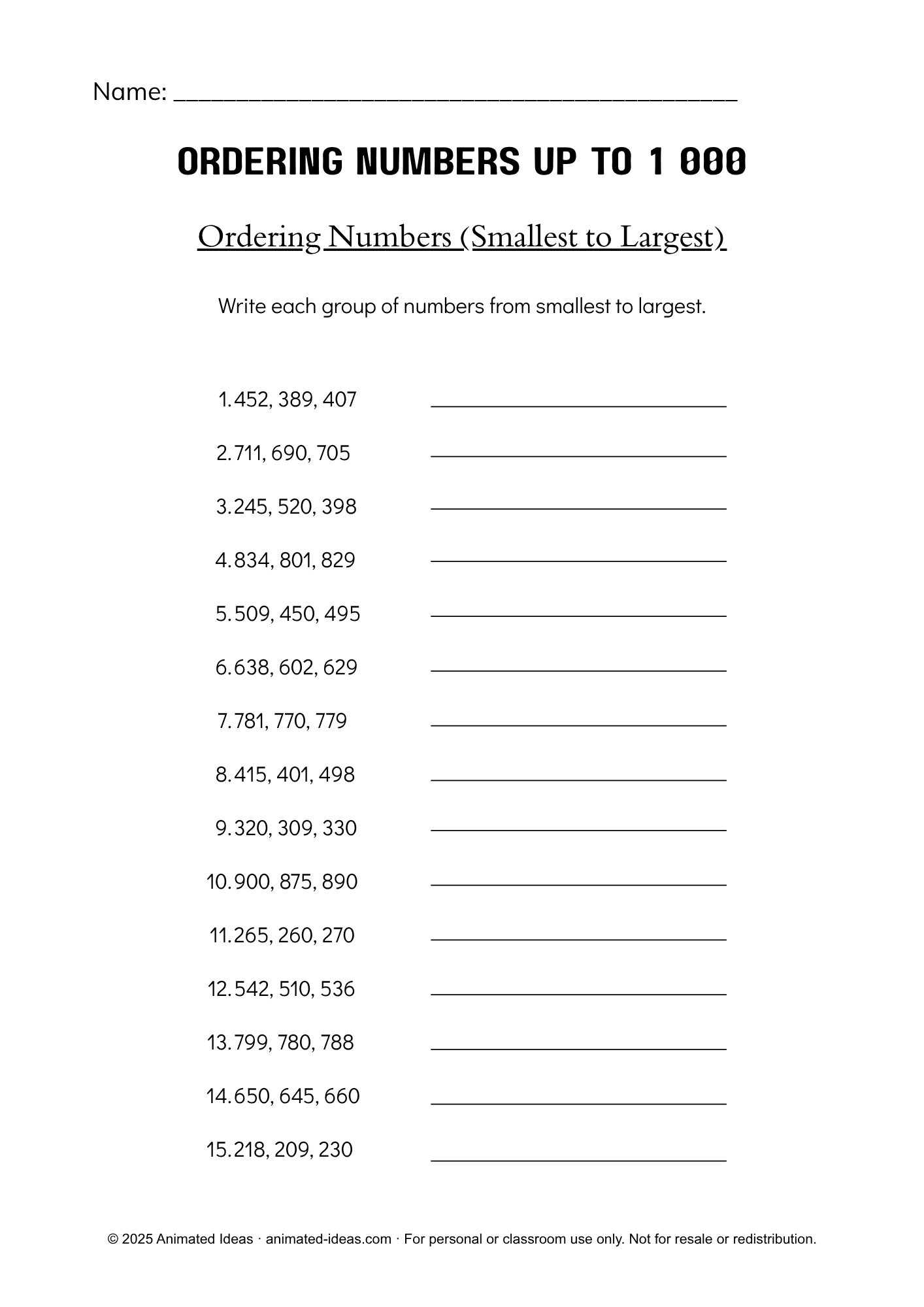
Ordering Numbers from Smallest to Largest (Ascending Order)
When we order numbers from smallest to largest, we start with the smallest number and end with the biggest number.
Let’s try an example:
Example Set:
438, 290, 315, 501
We will compare all numbers using hundreds, tens, and ones.
Step 1: Compare Hundreds Digits
- 438 → 4 hundreds
- 290 → 2 hundreds
- 315 → 3 hundreds
- 501 → 5 hundreds
Now arrange hundreds from smallest to largest:
2 (290)
3 (315)
4 (438)
5 (501)
So the numbers in order from smallest to largest are:
⭐ 290, 315, 438, 501
Ordering Numbers from Largest to Smallest (Descending Order)
Now let’s arrange the same numbers from largest to smallest.
We already know:
- 501 has the biggest hundreds digit
- 438 has 4 hundreds
- 315 has 3 hundreds
- 290 has 2 hundreds
So the order from largest to smallest is:
⭐ 501, 438, 315, 290
More Detailed Practice Examples
Example 4: Order 872, 689, 700, 645
Step 1: Look at hundreds
- 872 → 8 hundreds
- 689 → 6 hundreds
- 700 → 7 hundreds
- 645 → 6 hundreds
The hundreds in order:
6 hundreds → 689, 645
7 hundreds → 700
8 hundreds → 872
Now compare the two 6-hundred numbers:
689 vs. 645
- Hundreds are equal
- Compare tens: 8 tens > 4 tens → 689 is bigger than 645
So from smallest to largest:
⭐ 645, 689, 700, 872
From largest to smallest:
⭐ 872, 700, 689, 645
Example 5: Order 302, 320, 230, 203
Let’s compare hundreds:
- 302 → 3 hundreds
- 320 → 3 hundreds
- 230 → 2 hundreds
- 203 → 2 hundreds
Group them:
2 hundreds: 230, 203
3 hundreds: 302, 320
Compare 230 vs. 203
- Hundreds same
- Tens: 3 tens vs. 0 tens → 230 is bigger
Compare 302 vs. 320
- Hundreds same
- Tens: 0 tens vs. 2 tens → 320 is bigger
Smallest to Largest:
⭐ 203, 230, 302, 320
Largest to Smallest:
⭐ 320, 302, 230, 203
Key Tips
Here are simple reminders to help you:
✔ Always start comparing with hundreds.
✔ If hundreds are the same, compare tens.
✔ If tens are the same, compare ones.
✔ Think: Which number has more blocks?
- More hundreds → bigger
- More tens → bigger
- More ones → bigger
✔ Remember:
Smallest to Largest = going up
Largest to Smallest = going down
Real-Life Situations Where We Order Numbers
- Scores: Who got the highest score?
- Prices: Which item is the cheapest?
- Ages: Who is the oldest or youngest?
- Time: Which number comes first on the clock?
- Distances: Which path is the shortest?
Ordering numbers helps us make decisions every day.
Summary of the Lesson
In this lesson, we learned:
- How to compare and order numbers up to 1 000
- How to use hundreds, tens, and ones to decide which number is bigger or smaller
- How to arrange numbers from smallest to largest and from largest to smallest
- How ordering numbers up to 1000 helps us in real life
Now you know how to read, compare, and order numbers up to 1000 confidently!
Thank you for reading this lesson guide on ordering numbers up to 1000! We hope it helps your 2nd graders build confidence in comparing, arranging, and understanding numbers. To continue supporting your students’ learning, you can explore more related resources from Animated Ideas, including Understanding Half-Circles and Quarter-Circles, The Circle and Its Parts, and browse all math worksheets for 2nd graders by Animated Ideas.
You can also find additional teaching materials and tips on these platforms:
📌 YouTube: Animated Ideas
📌 Facebook: Animated Ideas
📌 Pinterest: Animated Ideas Worksheets
These resources are designed to make math fun, engaging, and easy to understand. Using these worksheets and guides together will help your learners strengthen their skills, reinforce concepts, and apply their knowledge in both classroom and home settings. Don’t forget to check back often for new lessons, worksheets, and activities to keep your students excited about learning!