
Singular and Plural Nouns
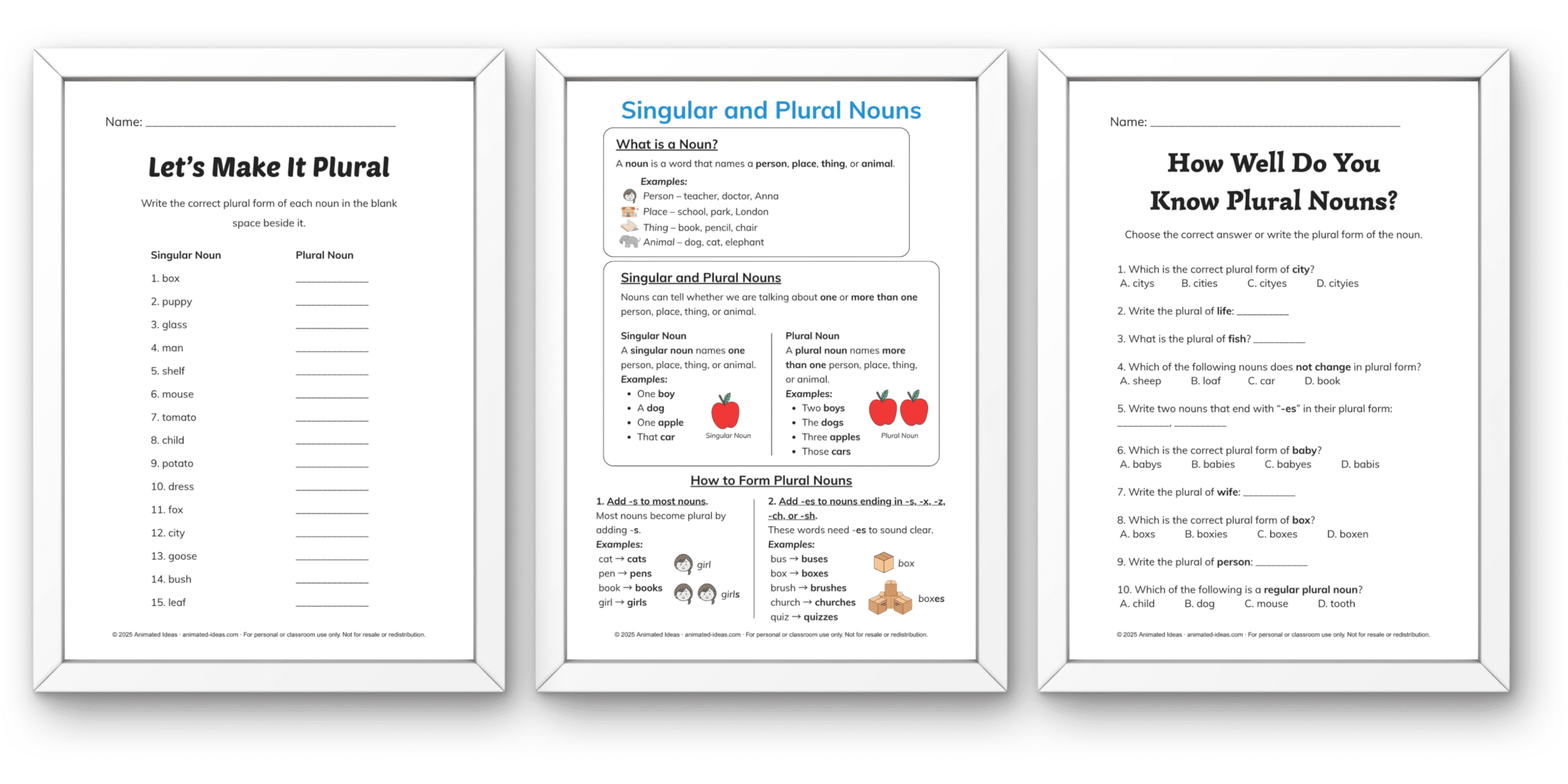
Singular and Plural Nouns made easy! Enjoy this lesson with free worksheets for kids to practice and learn confidently.
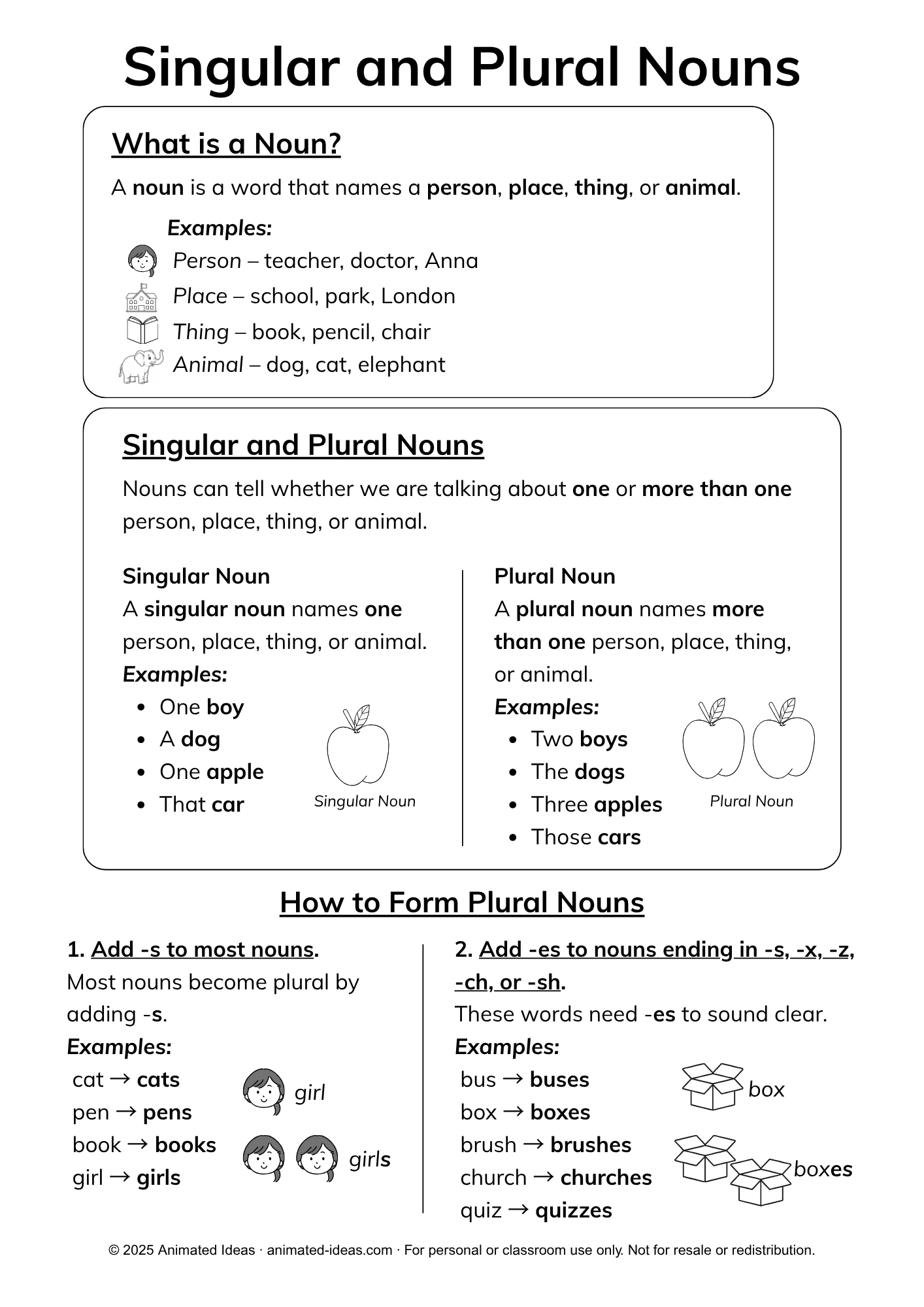
What Are Nouns?
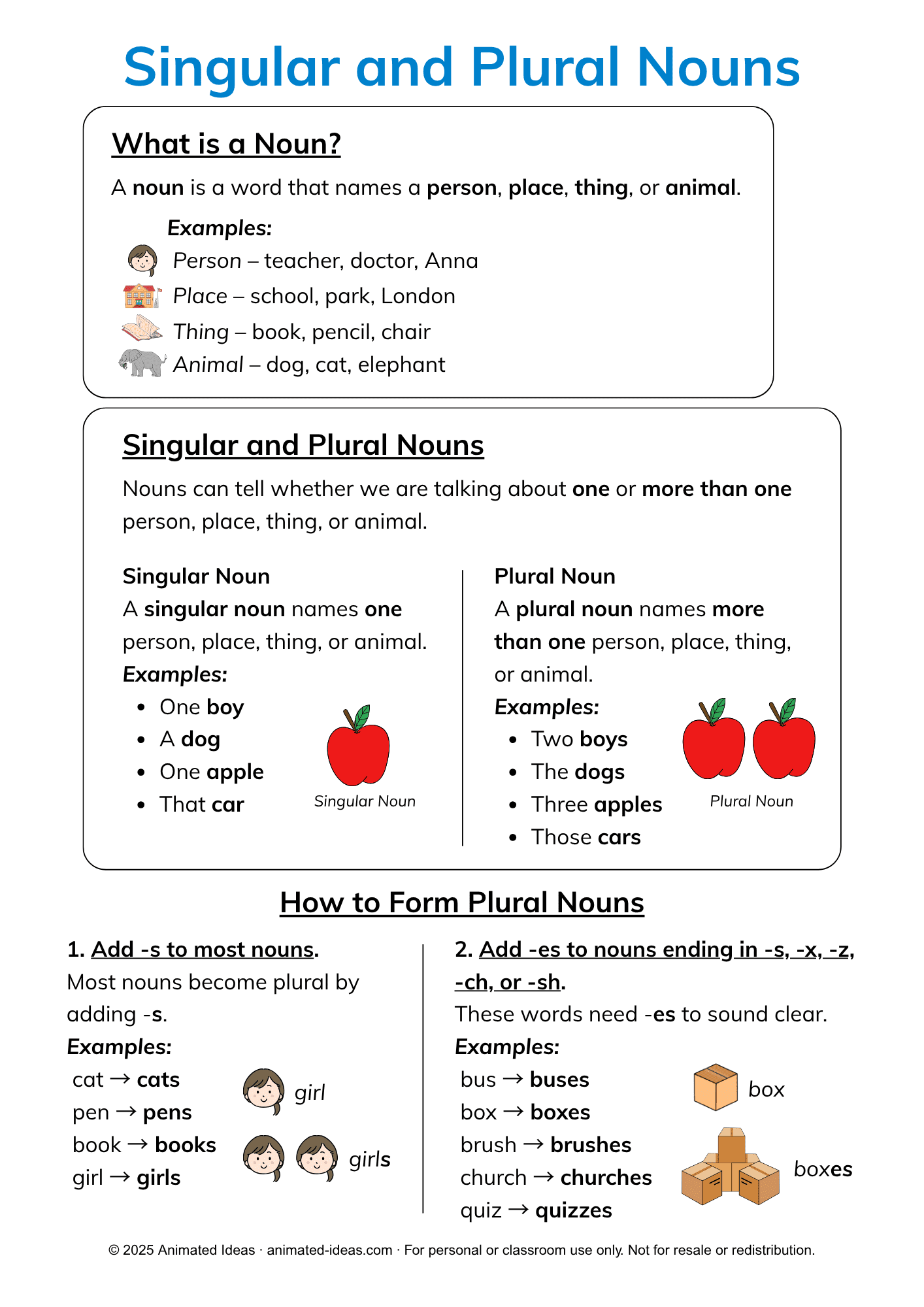
A noun is a word that names a person, place, thing, or animal.
For example:
- Person: teacher, doctor, Anna
- Place: school, park, London
- Thing: book, pencil, chair
- Animal: cat, dog, elephant
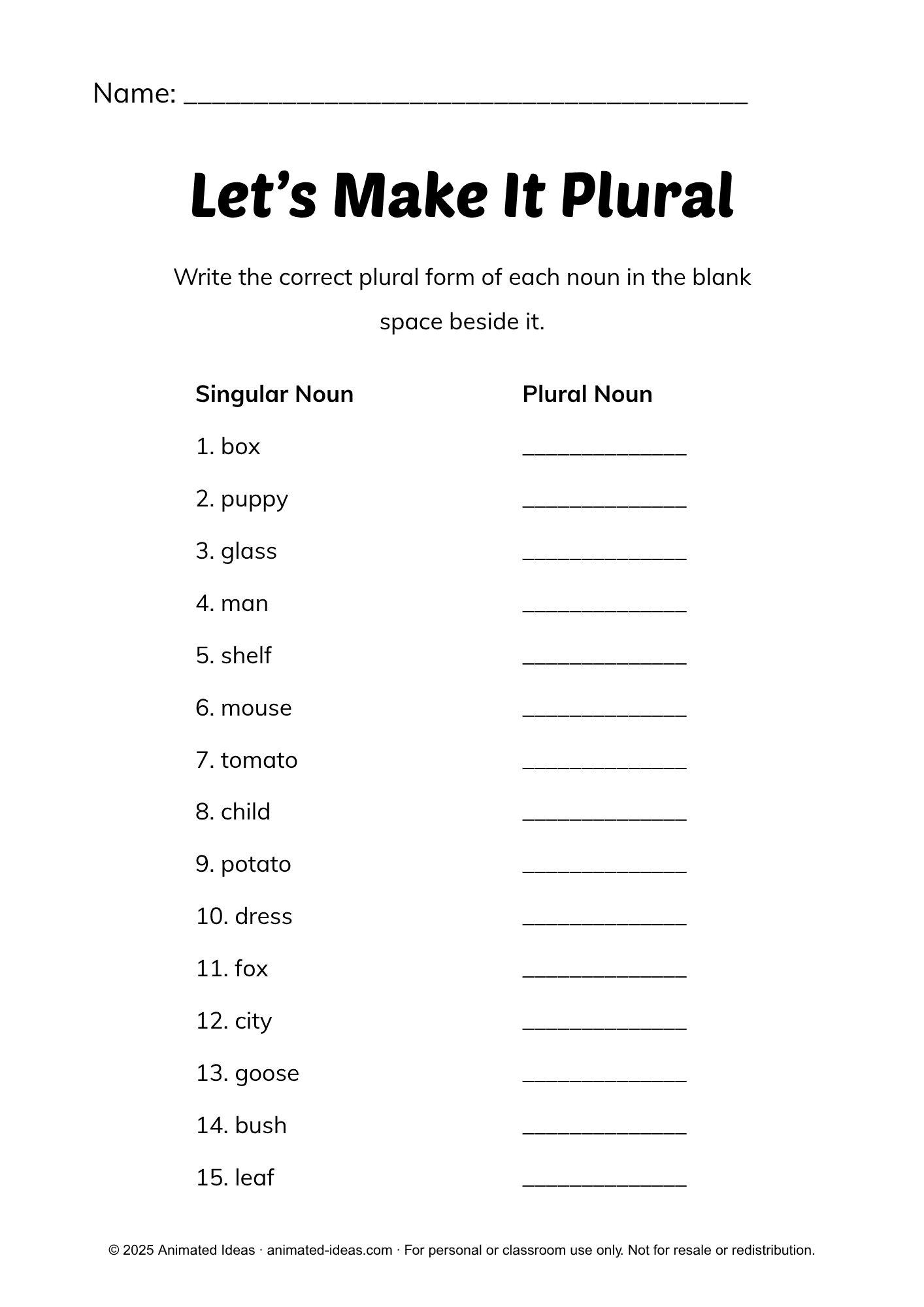
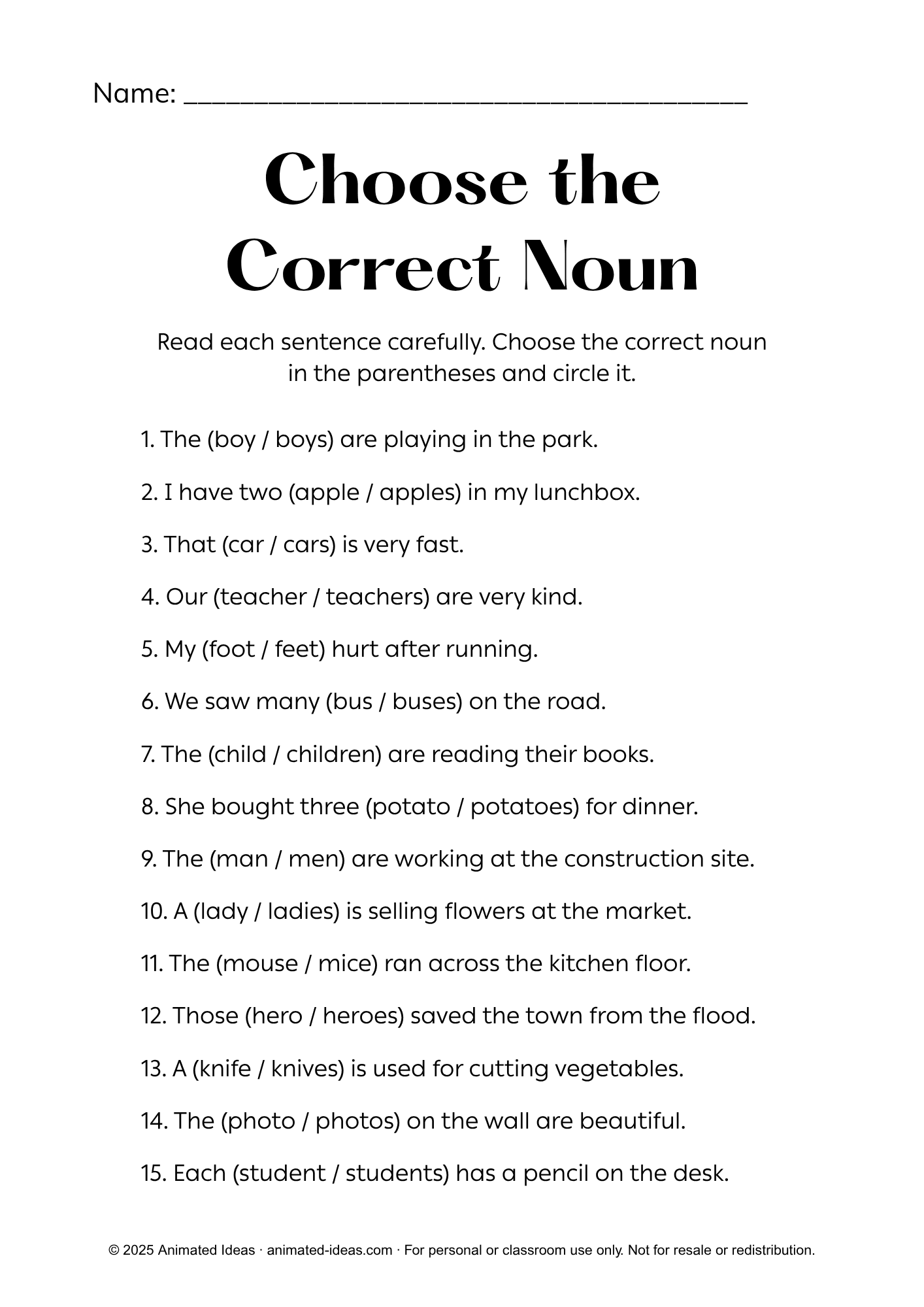
Every noun can refer to one or more than one person, place, thing, or animal. This is where singular and plural nouns come in.
What Is a Singular Noun?
A singular noun names only one person, place, thing, or animal.
Examples:
- One boy is playing.
- A dog is barking.
- I have one apple.
- That car is new.
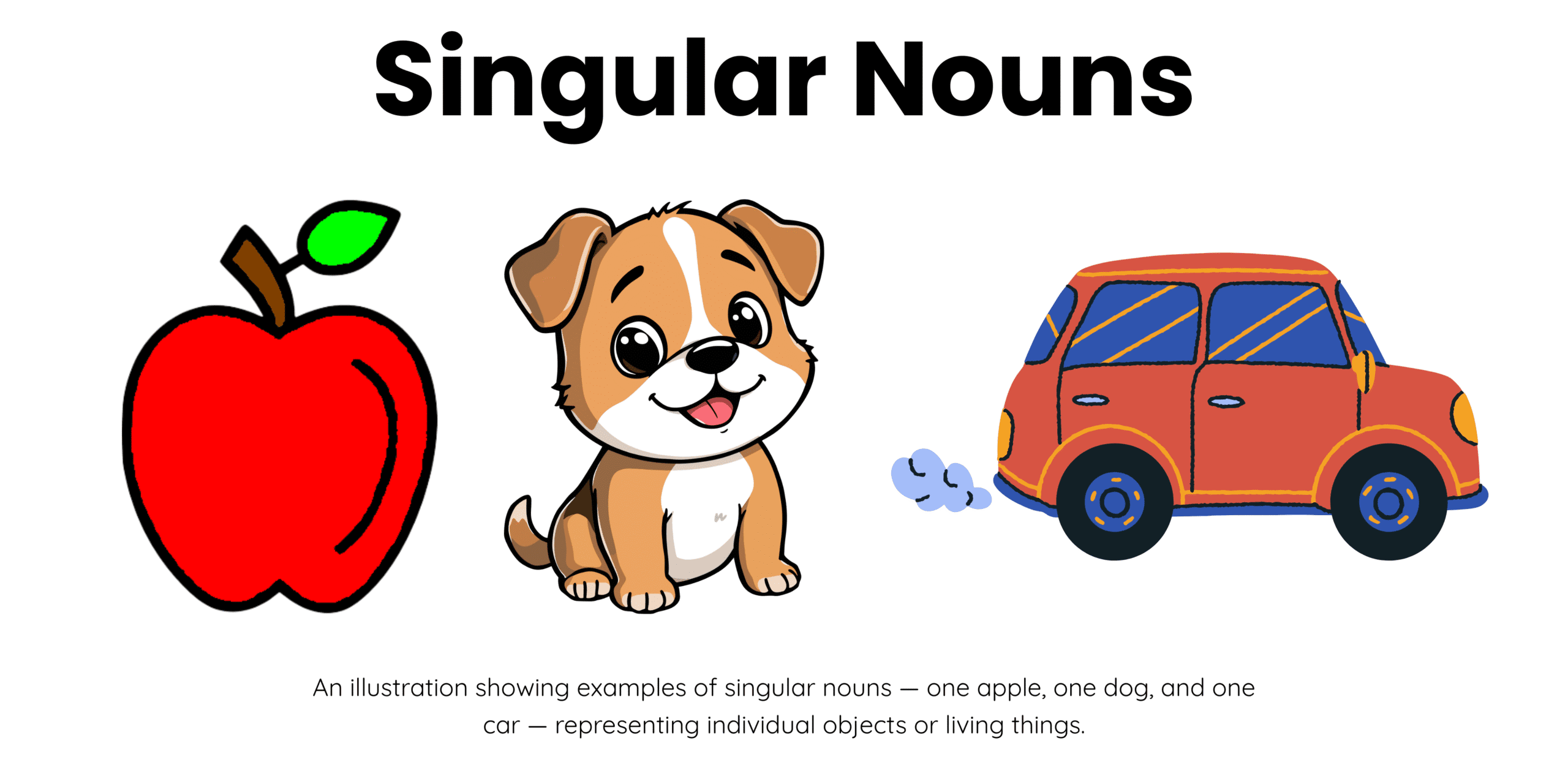
When you look at these examples, you can see that each noun refers to only one item or being.
What Is a Plural Noun?
A plural noun names more than one person, place, thing, or animal.
Examples:
- Two boys are playing.
- The dogs are barking.
- I have three apples.
- Those cars are new.

Plural nouns usually tell us that there is more than one of something.
How to Form Plural Nouns
Most nouns become plural by adding “-s” at the end.
But there are different spelling rules depending on how the word ends.
Let’s look at the common rules:
Rule 1: Add -s to most nouns.
If a noun ends in most letters, just add -s to make it plural.
Examples:
- cat → cats
- pen → pens
- girl → girls
- book → books
Rule 2: Add -es to nouns ending in -s, -x, -z, -ch, or -sh.
These words need -es because they already end in a sound that makes “s” difficult to pronounce.
Examples:
- bus → buses
- box → boxes
- brush → brushes
- church → churches
- quiz → quizzes
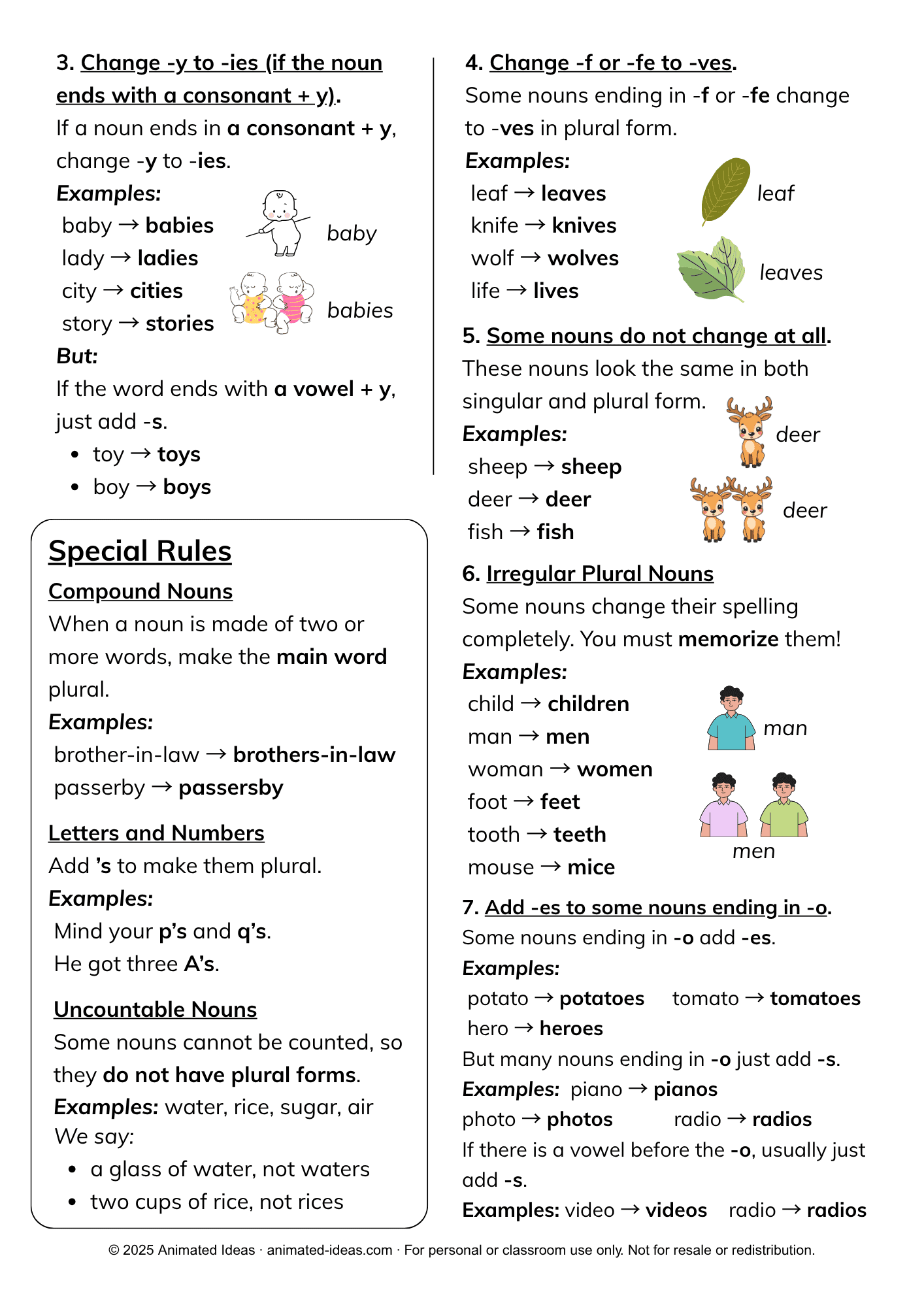
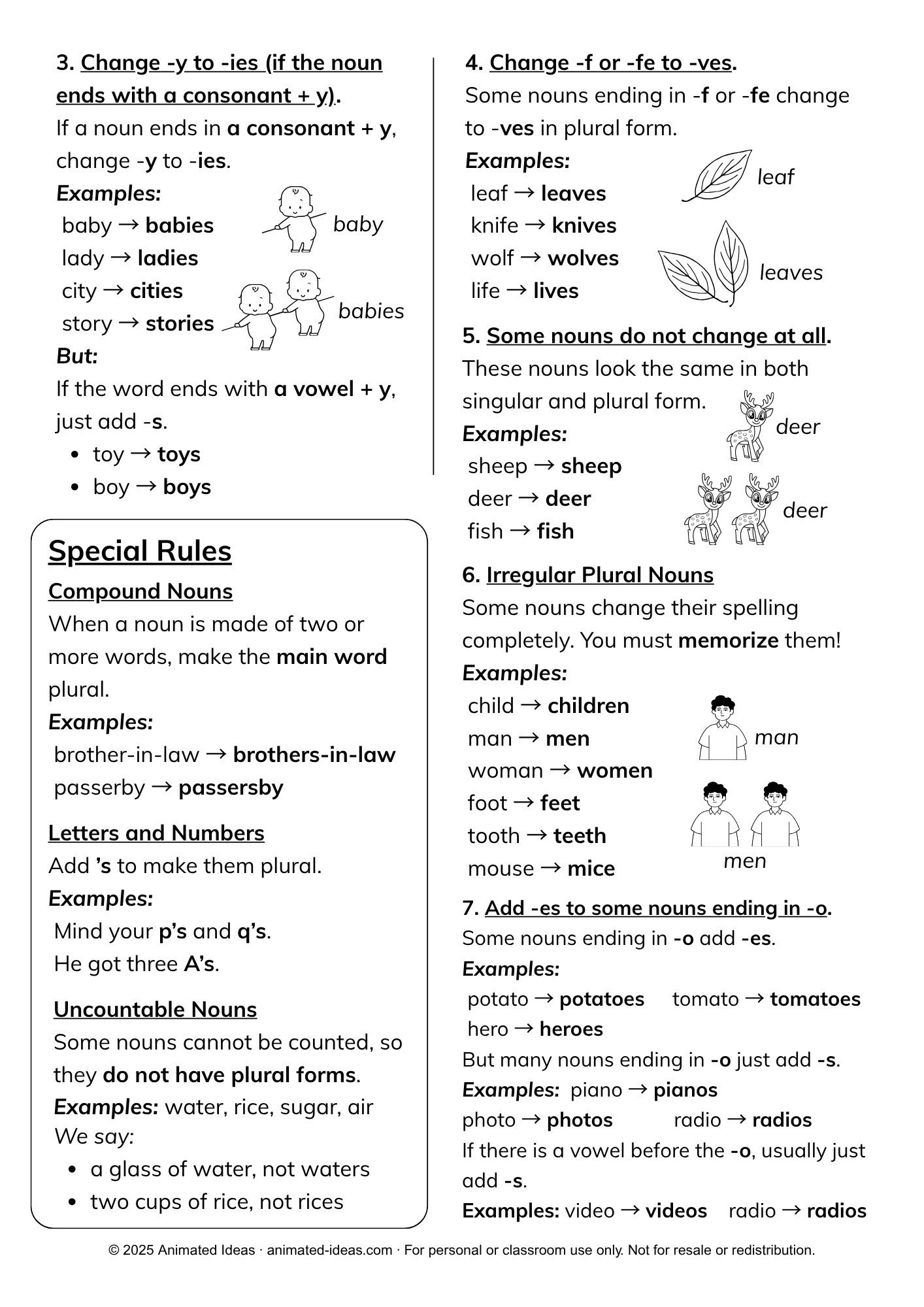
Rule 3: For nouns ending in a consonant + y, change -y to -ies.
When a noun ends in a consonant (like b, c, d, etc.) + y, change the -y to -ies.
Examples:
- baby → babies
- lady → ladies
- city → cities
- story → stories
Note:
If the word ends with a vowel + y (like toy, boy), just add -s.
- toy → toys
- boy → boys
Rule 4: For nouns ending in -f or -fe, change to -ves.
Some nouns ending in -f or -fe change to -ves in the plural form.
Examples:
- leaf → leaves
- knife → knives
- wolf → wolves
- life → lives
Rule 5: Add -es to some nouns ending in -o.
Some nouns that end in -o form the plural by adding -es.
Examples:
- potato → potatoes
- tomato → tomatoes
- hero → heroes
However, many nouns ending in -o just add -s.
Examples:
- piano → pianos
- photo → photos
- radio → radios
💡 Tip for learners:
If the letter before -o is a vowel (a, e, i, o, u), the noun usually adds -s.
Example: radio → radios, video → videos.
Rule 6: Some nouns do not change at all.
A few nouns have the same form in both singular and plural.
Examples:
- sheep → sheep
- deer → deer
- fish → fish
Rule 7: Some nouns have irregular plural forms.
These nouns change spelling completely when made plural. You need to memorize them.
Examples:
- child → children
- man → men
- woman → women
- foot → feet
- tooth → teeth
- mouse → mice
Special Notes About Plural Nouns
1. Compound nouns (words made of two or more parts) usually form the plural in the main word.
Examples:
- brother-in-law → brothers-in-law
- passerby → passersby
2. Numbers and letters are made plural by adding ’s (apostrophe + s).
Examples:
- Mind your p’s and q’s.
- He got three A’s on his test.
3. Uncountable nouns (like water, sugar, and rice) don’t have plural forms.
We say “a glass of water” or “two cups of rice,” not “waters” or “rices.”
Why Learning Singular and Plural Nouns Matters
Knowing how to use singular and plural nouns helps you:
- Write correctly in English.
- Speak more clearly.
- Understand when we talk about one or many things.
When you read, listen, or write, remember to check if the noun is one or more than one. It makes your grammar strong and your sentences clear.
Summary
| Type | Rule | Example (Singular → Plural) |
|---|---|---|
| Add -s | Most nouns | cat → cats |
| Add -es | Ends in -s, -x, -z, -ch, -sh | box → boxes |
| Change -y to -ies | Consonant + y | baby → babies |
| Add -s only | Vowel + y | toy → toys |
| Change -f/-fe to -ves | Some nouns | leaf → leaves |
| No change | Same form | fish → fish |
| Irregular | Change spelling | foot → feet |
- Singular noun: names one person, place, thing, or animal.
- Plural noun: names more than one person, place, thing, or animal.
- Most plurals are formed by adding -s or -es.
- Some nouns change spelling or stay the same.
Thank you for reading this lesson guide!
You can also explore related resources from Animated Ideas, such as:
- Pronouns – Words that Replace Nouns
- Talking About Myself I, Me, My, Mine Printables for Kids
- Pronoun Worksheets – I, Me, My, Mine Activities
Don’t forget to check the video lesson below about Singular and Plural Nouns.
You can also follow me on YouTube, Facebook, and Pinterest for more learning activities