
Stative vs Action Verbs: A Complete Grammar Lesson
Understanding the difference between stative vs action verbs is a crucial step for anyone learning English. This distinction influences not only the choice of tense but also the clarity, accuracy, and naturalness of a sentence. Although many intermediate learners can form grammatically correct tenses, they often make errors because they do not consider whether a verb expresses a state or an action. Consequently, sentences may sound unnatural or incorrect, even when the tense itself appears to be correct.
For this reason, this lesson provides a detailed and structured explanation of stative and action verbs in a clear, professional style. It examines verb meaning, categories, tense usage, exceptions, common learner errors, and practical guidelines for correct application. By the end of the lesson, readers will develop a deeper understanding of this important grammatical distinction, enabling them to communicate more accurately, confidently, and fluently in English.
Download Free Worksheets and Notes
To help intermediate ESL learners strengthen their understanding of stative and action verbs, we offer free downloadable worksheets and notes. These resources are carefully designed to challenge your skills while reinforcing correct usage.
- Detailed explanations of stative and action verbs with examples suitable for intermediate learners
- Targeted exercises to identify, categorize, and use verbs correctly in context
- Practice with dual-meaning verbs to improve accuracy in forming sentences
- Answer keys to check your work and track improvement
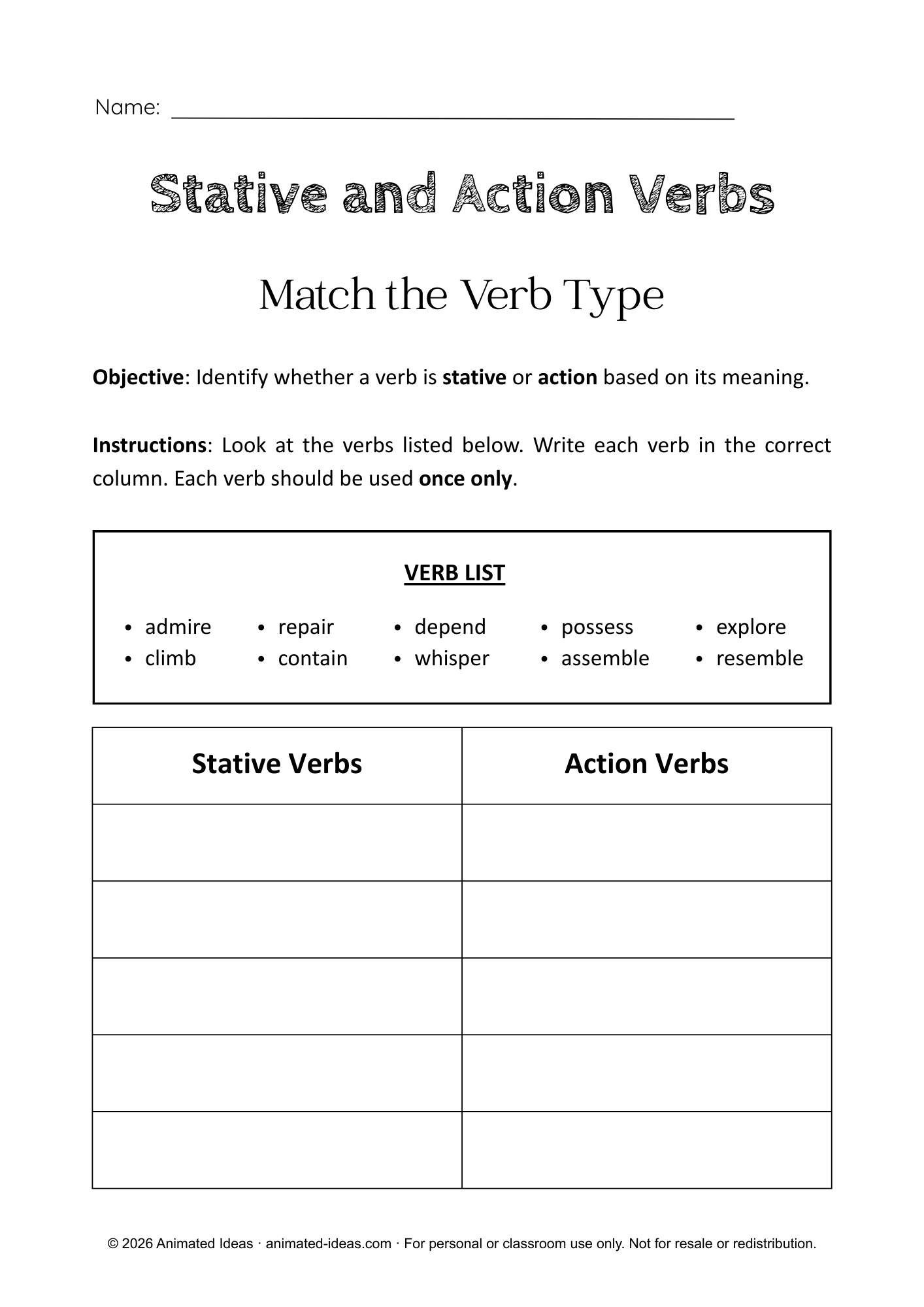
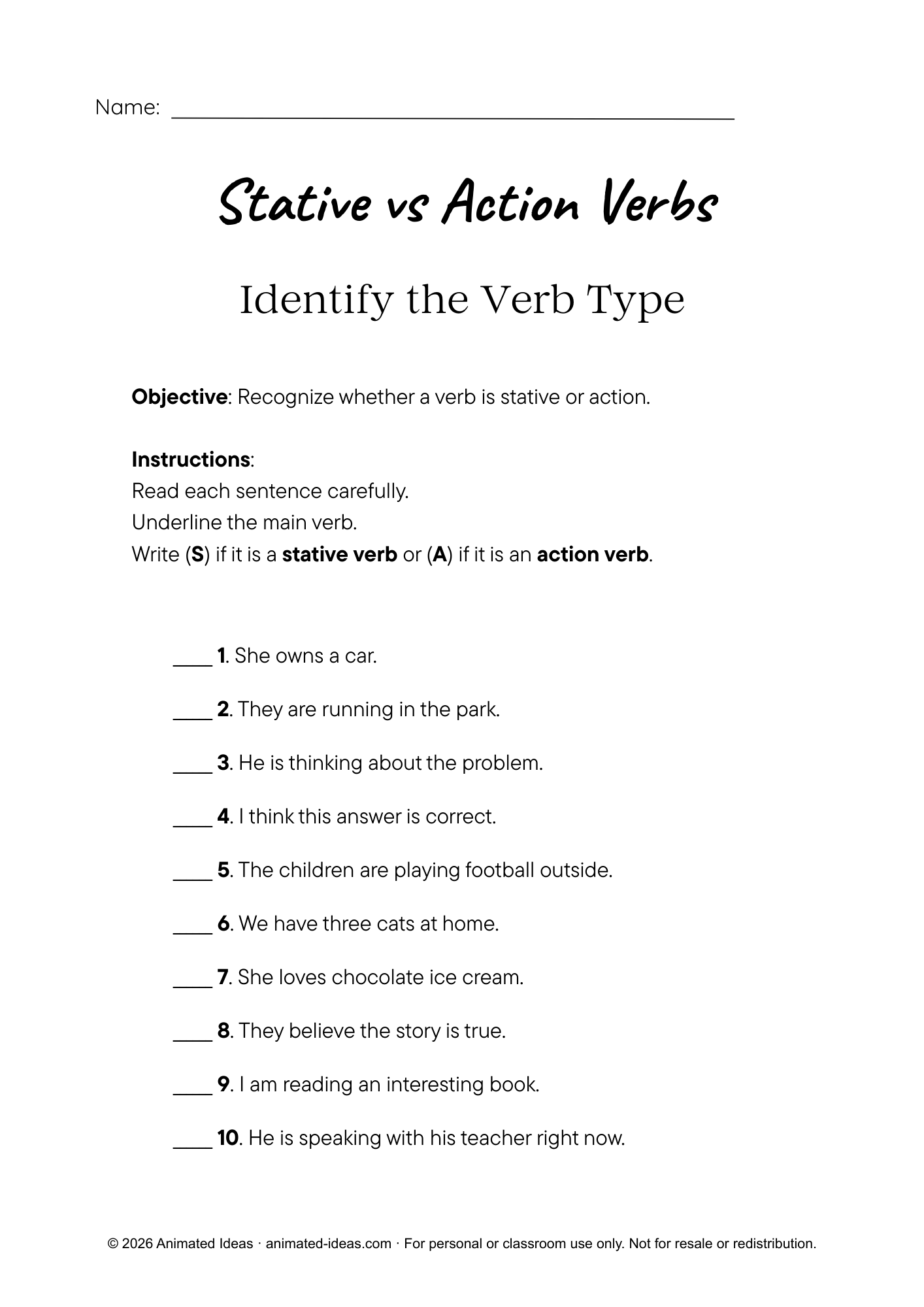
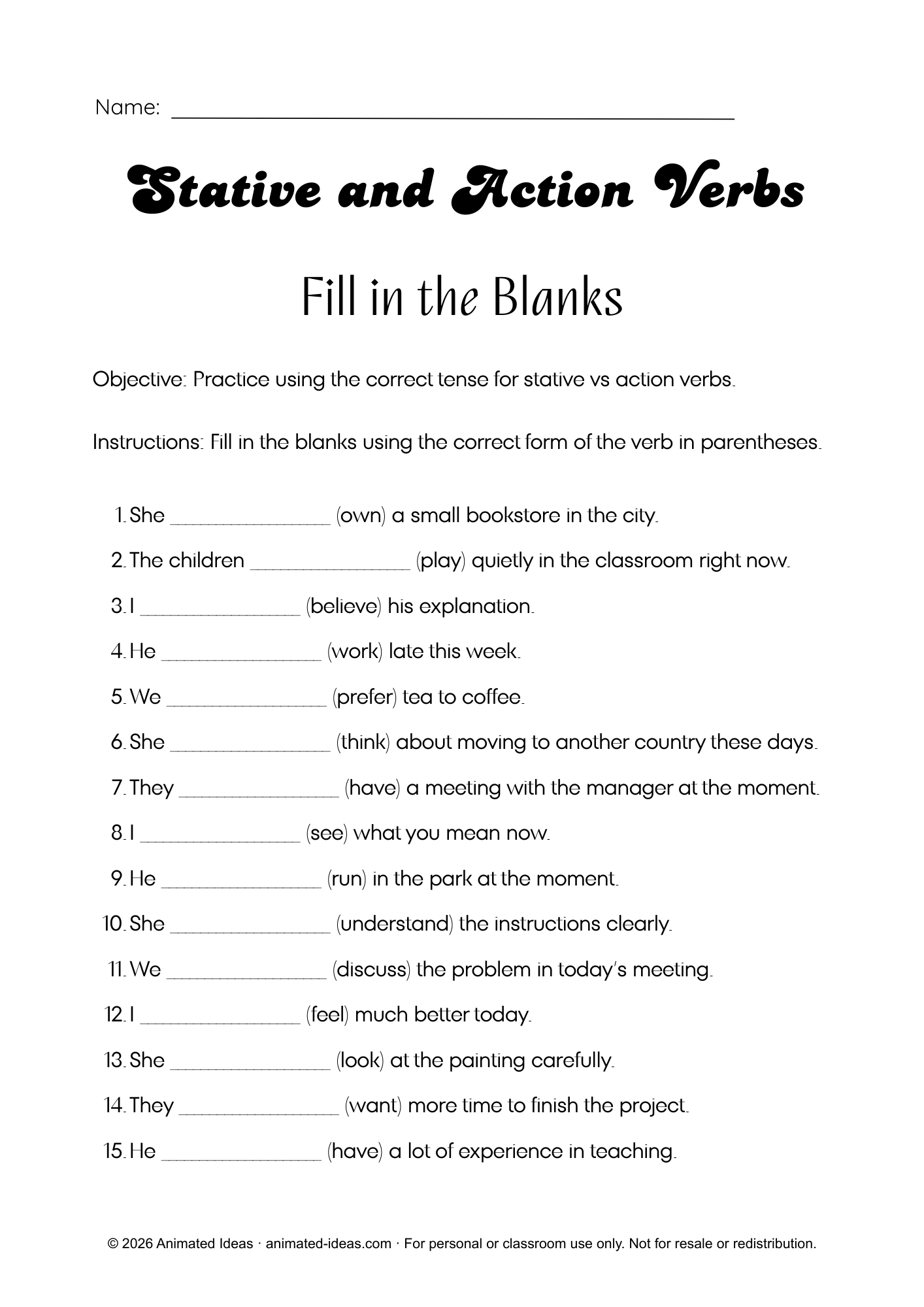
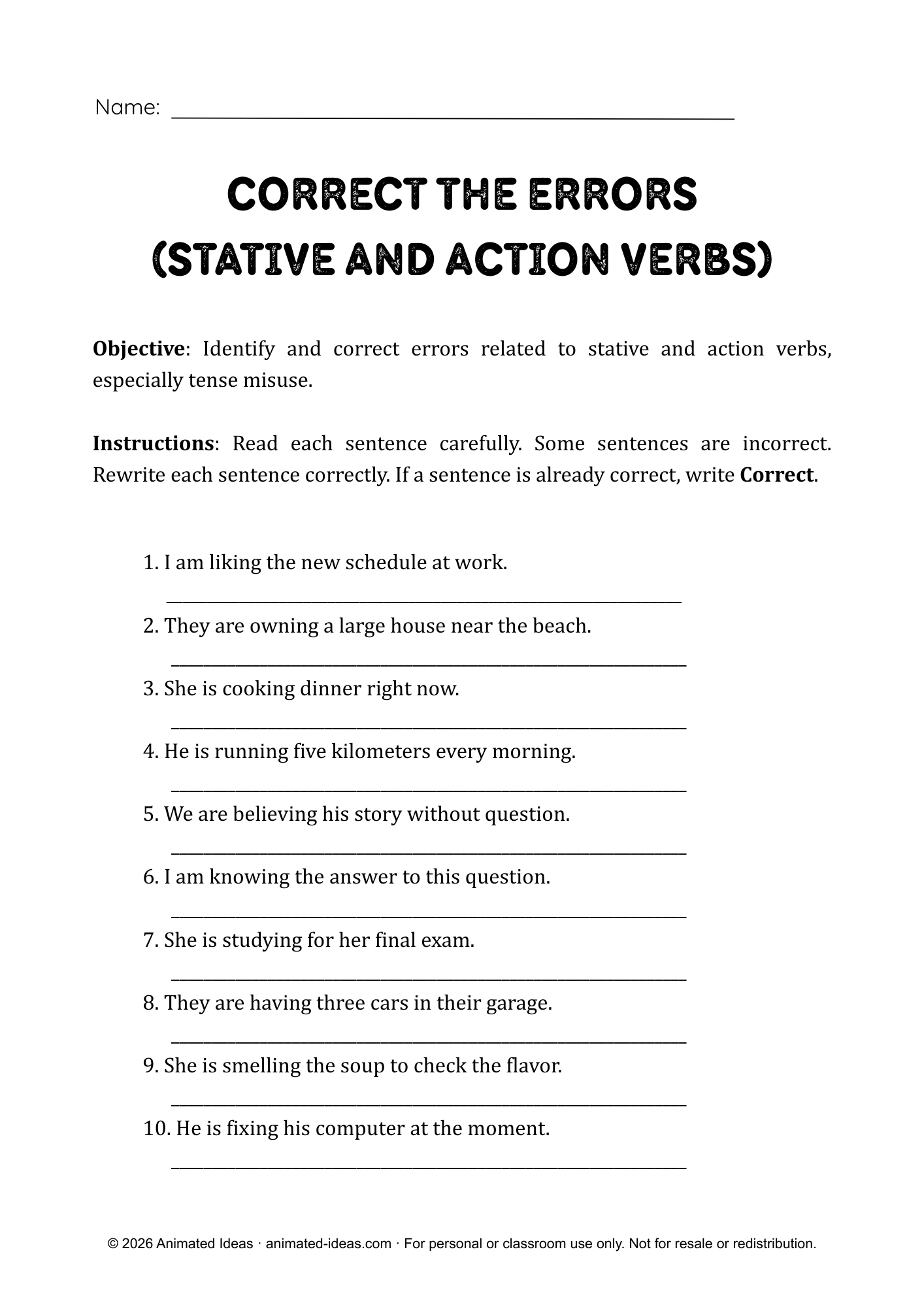
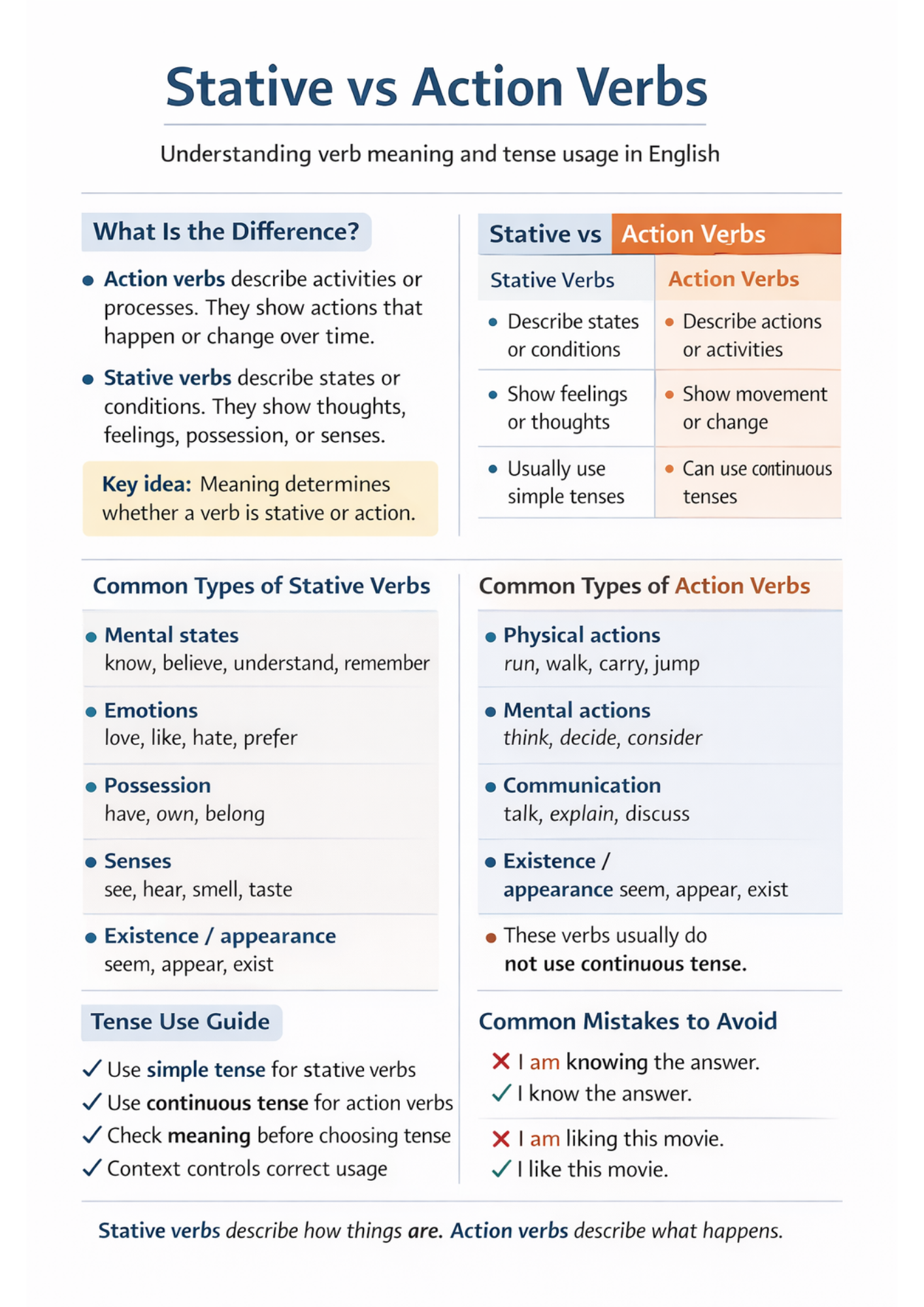
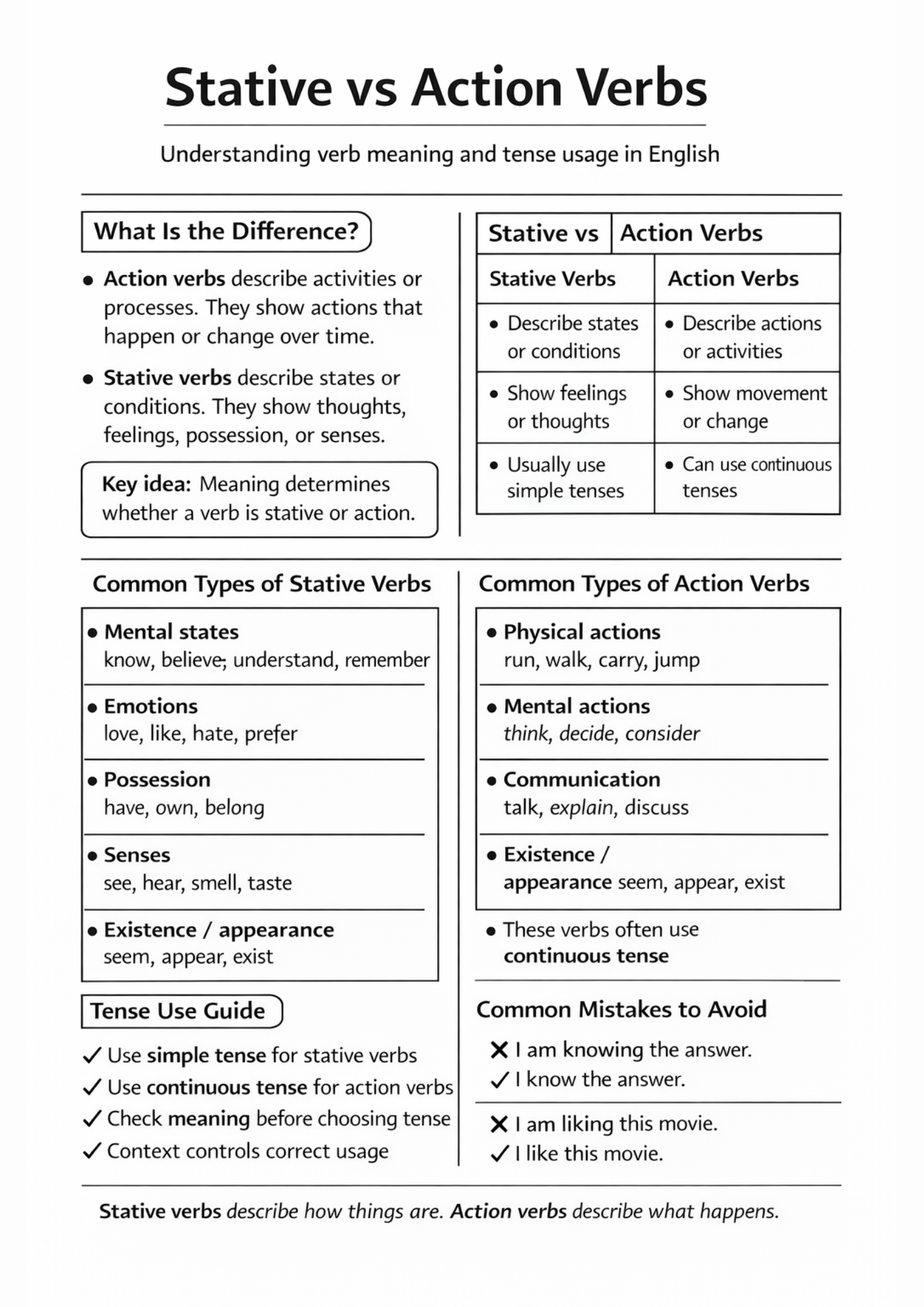
By using these intermediate-level worksheets and notes, you can practice confidently, avoid common mistakes, and build more natural, fluent English sentences.
Definitions of Stative vs Action Verbs
Before learning detailed rules, it is important to understand the difference between action verbs and stative verbs.
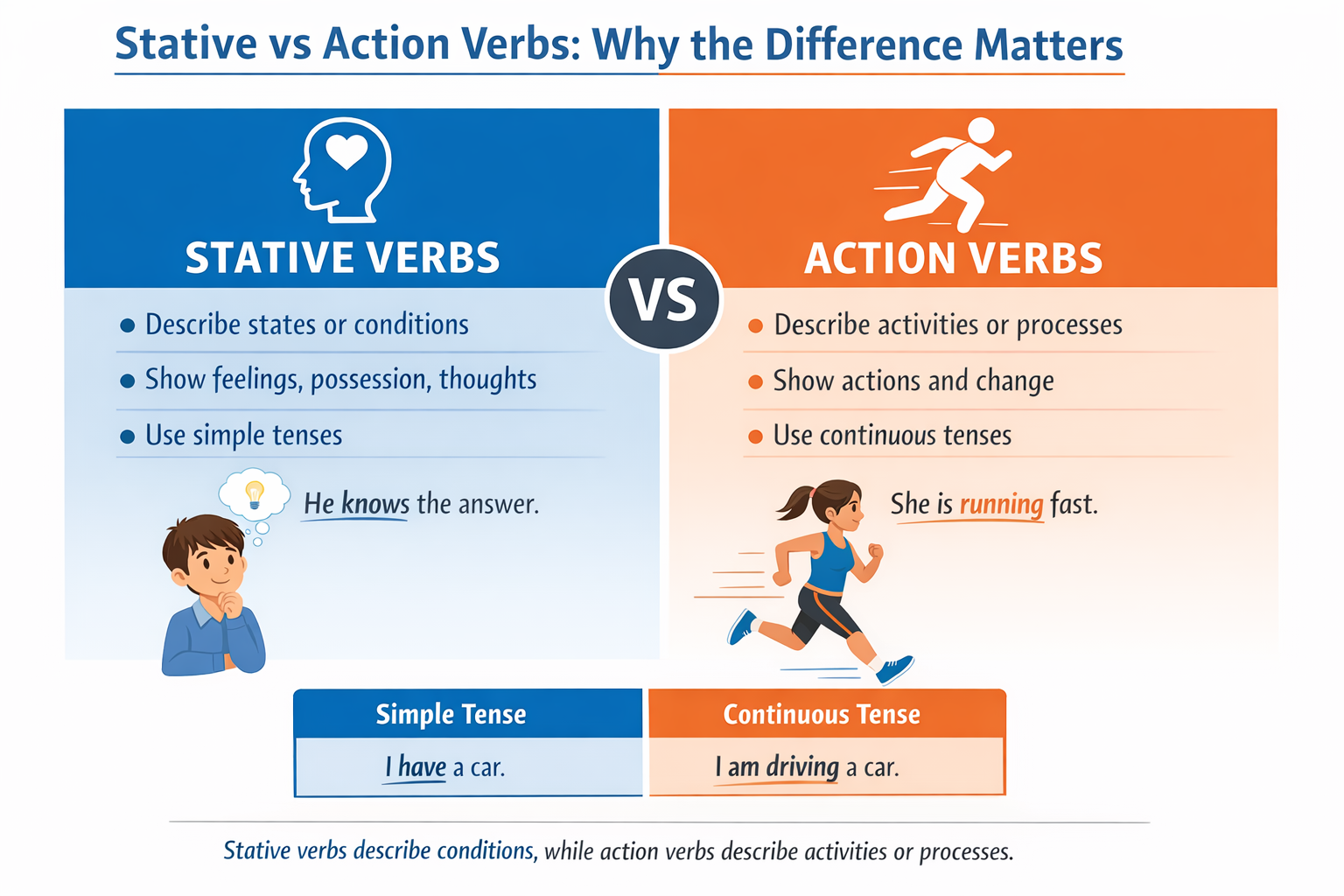
Action verbs describe activities or processes that involve movement or change. These actions can begin, continue, and end, which is why action verbs work in both simple and continuous tenses. Common examples include run, write, eat, and talk. For example, “She is writing a report” shows an action happening now.
Stative verbs, on the other hand, describe states, feelings, thoughts, possession, senses, or existence. They express conditions rather than actions and are usually used in simple tenses. Common stative verbs include know, love, believe, and own. For example, “He knows the answer” describes a mental state, not an action in progress.
Understanding this distinction helps learners choose the correct tense and avoid common mistakes in English.
| Feature | Action Verbs | Stative Verbs |
|---|---|---|
| Definition | Express an activity, event, or process someone performs. | Describe states, feelings, thoughts, possession, senses, or existence. |
| Examples | run, write, eat, build, talk | know, believe, love, own, seem |
| What they show | Actions that start and stop, or happen over time | Conditions, states, or situations that are stable |
| Tense usage | Can be used in simple and continuous tenses | Usually used in simple tenses, rarely in continuous |
| Movement/change | Often involve movement or change | Do not involve movement or change |
| Example sentence | She is writing a report. | He knows the answer. |
Categories of Stative Verbs
To better understand stative verbs, they can be grouped by meaning, which makes them easier to identify. Recognizing these categories is essential for correct usage.
1. Mental State Verbs
These verbs describe knowledge, beliefs, and understanding. Common examples: know, believe, understand, remember, forget.
Example: “She knows the rules.”
These verbs rarely appear in continuous forms because they represent stable mental conditions.
2. Emotion Verbs
Emotion verbs describe feelings or preferences. Examples include love, like, hate, enjoy, prefer.
Example: “I love this song.”
Continuous forms usually sound unnatural because the feeling is ongoing rather than an activity.
3. Possession Verbs
These verbs describe ownership or relationships. Examples: have, own, possess, belong.
Example: “She owns a car.”
Since ownership is a state, these verbs remain in simple tenses.
4. Sense Verbs
Sense verbs express perception: see, hear, taste, smell, feel.
Example: “I hear music.”
They describe perception, not an ongoing activity, so continuous tense is rarely used.
5. Existence and Appearance Verbs
Verbs such as seem, appear, exist, consist describe conditions or appearances.
Example: “She seems tired.”

Categories of Action Verbs
Similarly, action verbs can also be categorized by type, which helps learners understand their usage.
1. Physical Action Verbs
These involve visible movement. Examples: run, walk, jump, carry.
Example: “They are walking home.”
2. Mental Action Verbs
These describe active thinking processes rather than static mental states. Examples: think, consider, analyze, decide.
Example: “I am thinking about the problem.”
3. Communication Verbs
These verbs describe active verbal or written communication. Examples: talk, speak, explain, discuss.
Example: “He is explaining the rules.”

Stative vs Action Verbs: Verbs with Dual Meaning
However, some verbs can be either stative or action verbs, depending on context. Misunderstanding these verbs is a common learner challenge.
Think
- Stative: “I think this answer is correct.”
- Action: “I am thinking about the answer.”
Have
- Stative: “She has a car.”
- Action: “She is having lunch.”
See
- Stative: “I see the mountains.”
- Action: “I am seeing a doctor.”
Feel
- Stative: “I feel happy.”
- Action: “I am feeling the fabric.”
Common Mistakes Learners Make with Stative vs Action Verbs
Learners often make predictable mistakes when using stative and action verbs. In most cases, these errors occur because learners do not fully understand the meaning of the verb or how it functions in different tenses. As a result, they may choose a tense that looks correct but does not match the verb’s actual use. By recognizing these common mistakes, learners can improve their verb choices, avoid unnatural sentence patterns, and sound more natural and accurate in English.
- Using Continuous Tense with Stative Verbs
Stative verbs describe states, feelings, or conditions, not actions. Using them in continuous forms is usually incorrect.
- Incorrect: “I am liking this movie.”
- Correct: “I like this movie.”
- Ignoring Context for Dual-Meaning Verbs
Some verbs can act as both stative and action verbs, depending on meaning. Learners often make errors by ignoring context.
- Incorrect: “I think about you now.” (if referring to ongoing thinking as an activity, this is correct; if referring to mental state, continuous is wrong)
- Correct: “I am thinking about you now.” (for an active process of thinking)
- Misclassifying Verbs by Appearance Alone
In many cases, learners assume a verb is action or stative based on how it looks, rather than on its meaning. For example, “have” functions as a stative verb when it shows possession (“I have a car”), but it becomes an action verb when it describes an activity (“I am having lunch”). - Other Typical Errors
- Using action verbs in simple tense when continuous is more natural: “I eat breakfast now” → “I am eating breakfast now.”
- Mixing stative verbs in stories requiring dynamic actions.
Practical Guidelines
To use stative vs action verbs correctly:
- Determine if the verb describes a state or action.
- Decide whether the situation is temporary or permanent.
- Use simple tense for stative verbs and continuous tense for action verbs.
- Pay attention to dual-meaning verbs and their context.
Conclusion
Mastering the difference between stative verbs and action verbs is essential for achieving accuracy and fluency in English. To begin with, learners must understand that this distinction is not based on verb form alone, but on meaning and usage in context. When learners clearly recognize what a verb expresses, they are better equipped to choose the correct tense and structure.
In general, stative verbs describe stable conditions rather than actions. These include mental states, emotions, senses, possession, and existence. Because these verbs express situations that do not usually change or happen actively, they are most often used in simple tenses. As a result, using them in continuous forms can sound unnatural or grammatically incorrect.
In contrast, action verbs describe activities, processes, or communication that involve movement, effort, or change. Since these actions can begin, continue, and end, action verbs work naturally in both simple and continuous tenses. Therefore, learners can clearly express what is happening now, what happens regularly, or what will happen in the future.
Moreover, understanding dual-meaning verbs is especially important. Some verbs can function as stative or action verbs depending on context. For this reason, learners must look beyond memorized rules and focus on what the speaker intends to express. When meaning is correctly identified, tense choice becomes clearer and more natural.
As learners improve their ability to identify verb types, they also reduce common errors, increase grammatical accuracy, and express ideas with greater confidence. Over time, consistent practice and careful attention to meaning allow learners to internalize this distinction. Ultimately, by mastering stative and action verbs, learners develop clearer communication skills and move closer to natural, fluent English use.