

Mass and Count Nouns
What Are Nouns?
Before we talk about mass and count nouns, let’s remember what nouns are.
Nouns are words that name a person, place, thing, or idea.
Examples:
👩 teacher, 🏫 school, 🐕 dog, 🍎 apple, 💭 happiness
Now, not all nouns are the same. Some nouns can be counted, while others cannot.
That’s why nouns are divided into two main groups — Count Nouns and Mass Nouns.

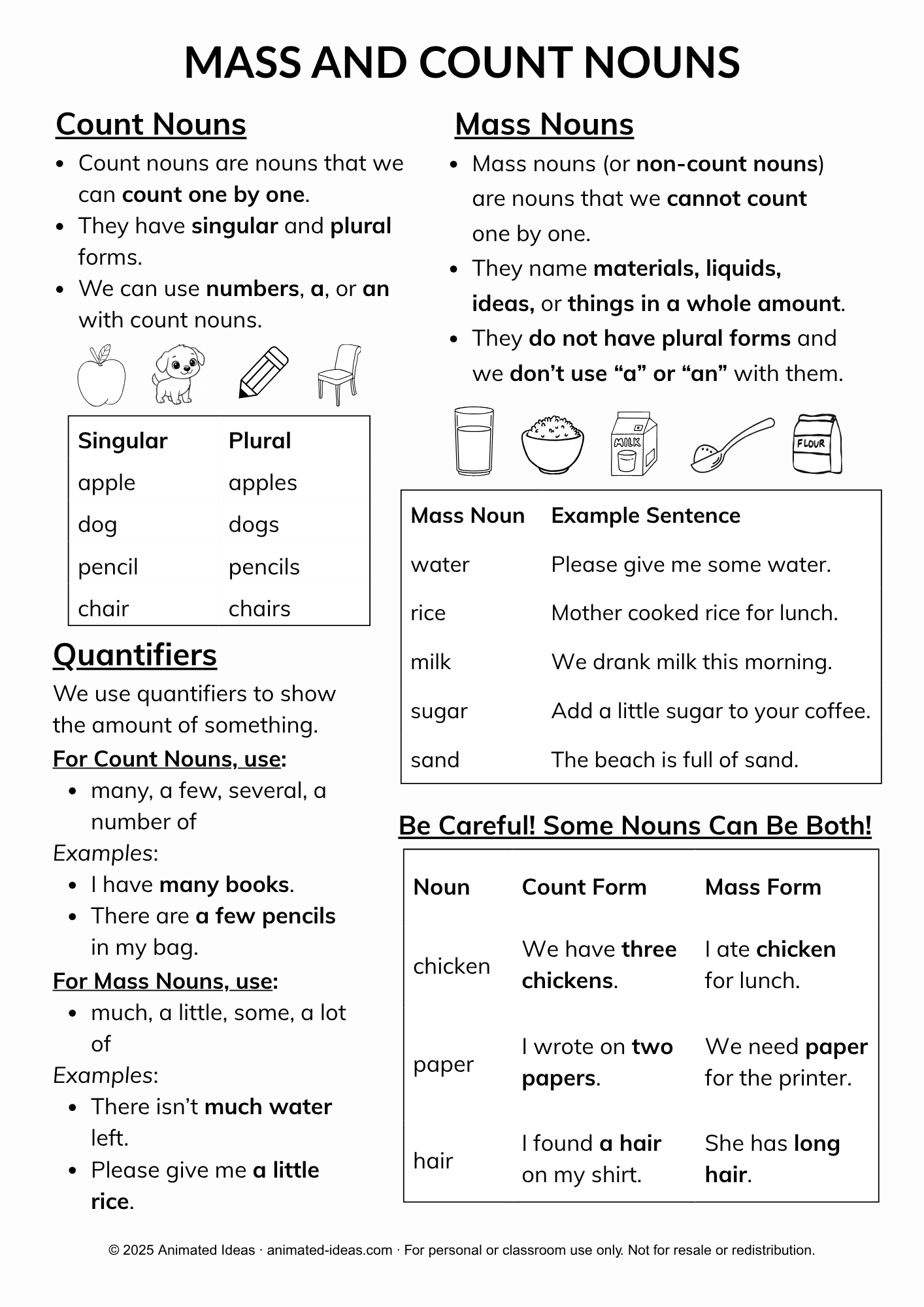
What Are Count Nouns?
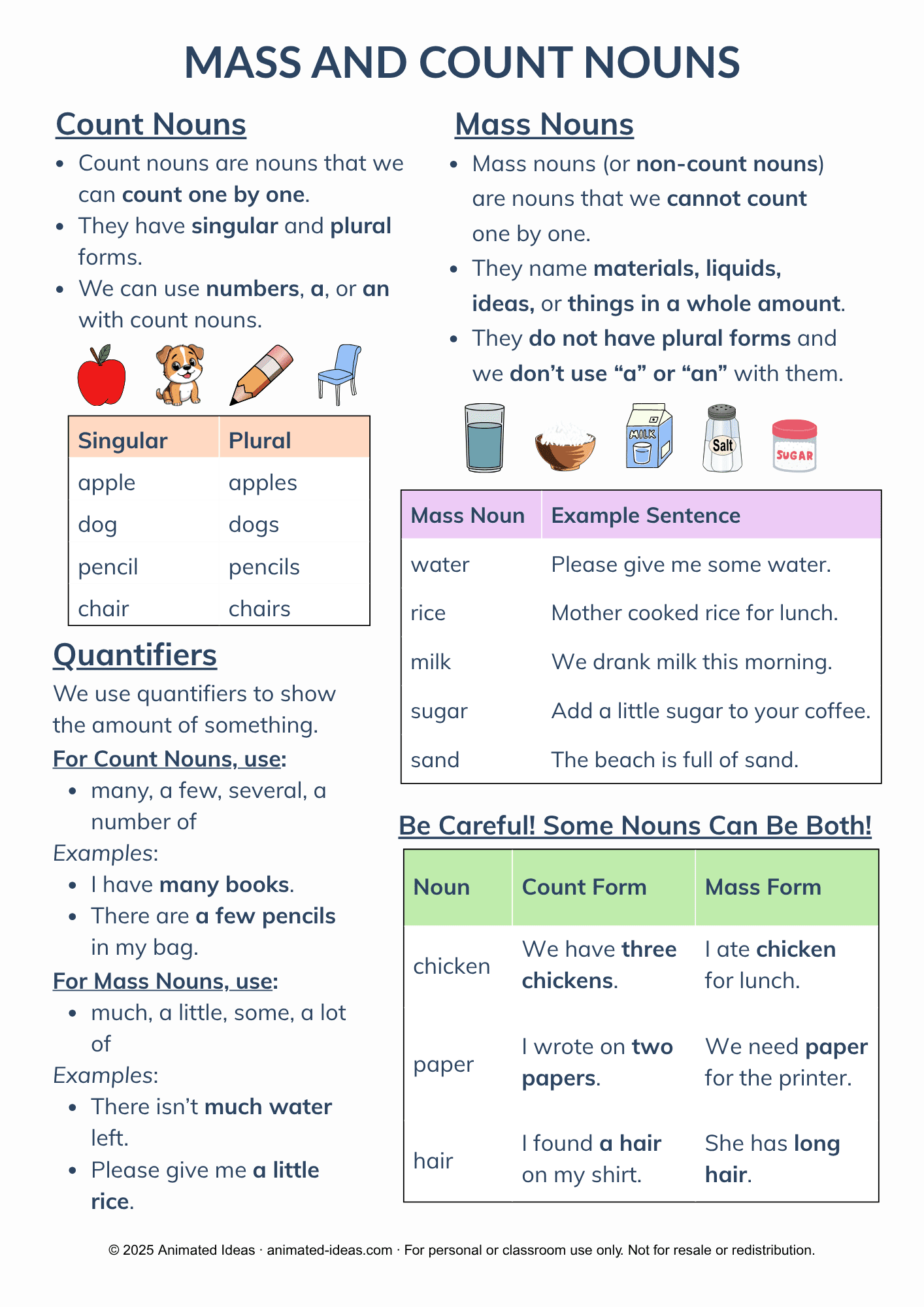
Count nouns are nouns that can be counted one by one.
They have singular and plural forms.
Singular means one, and plural means more than one.
| Singular | Plural |
|---|---|
| book | books |
| apple | apples |
| cat | cats |
| chair | chairs |
| pencil | pencils |
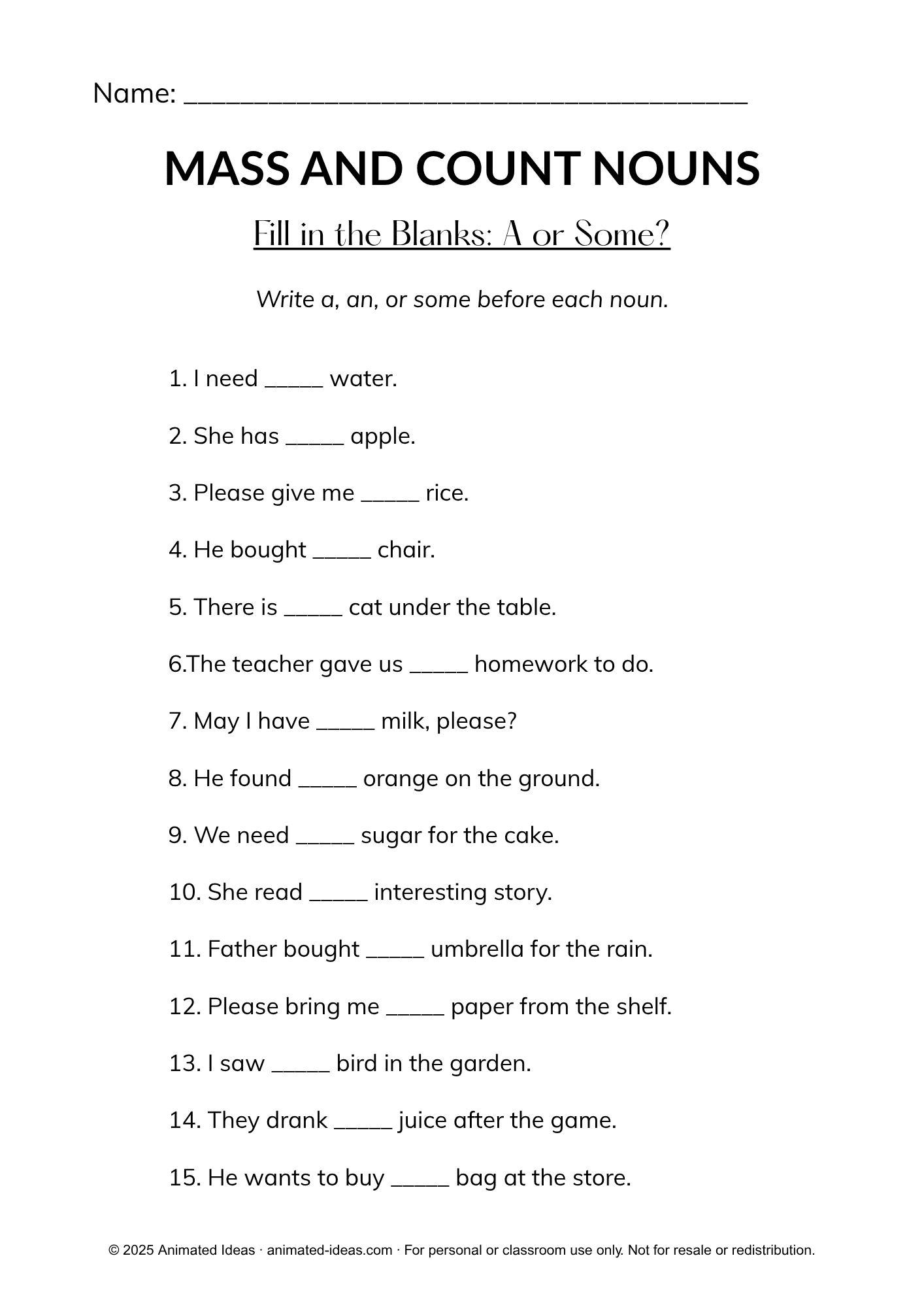
We can use numbers and a/an with count nouns.
Examples in sentences:
- I have one apple. 🍎
- She bought two pencils. ✏️✏️
- There is a dog in the yard. 🐕
- They have five chairs in the room. 🪑🪑🪑🪑🪑
Notice that we can count each noun easily.
We can say one, two, three, or many of them.
What Are Mass Nouns?
Mass nouns, also called non-count nouns, are nouns that cannot be counted individually.
We use them to name materials, liquids, ideas, or things that come in a whole mass.
They do not have plural forms and we don’t use “a” or “an” before them.
Examples:
- water 💧
- rice 🍚
- milk 🥛
- sugar 🍬
- sand 🏖️
- music 🎵
- money 💰
- air 🌬️
Examples in sentences:
- Please give me some water.
- There is sand on the beach.
- My mother bought rice for dinner.
- We need money to buy new books.
- I love listening to music.
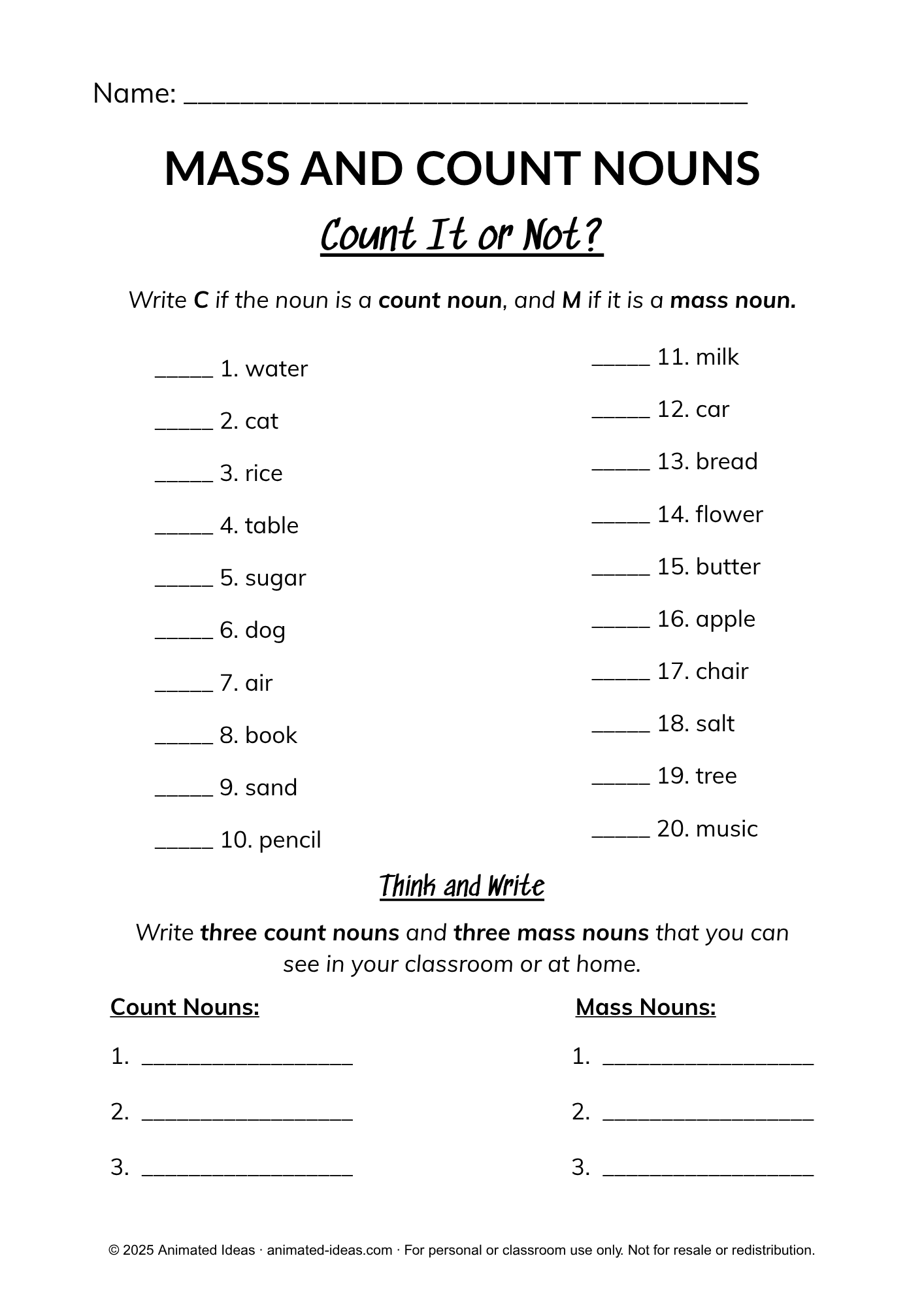
We cannot say “two waters” or “three sugars” unless we mean different types or containers of them (for example, “two bottles of water”).
How to Identify Count and Mass Nouns
Here are some easy tips to help you know if a noun is count or mass:
| Clue | Count Nouns | Mass Nouns |
|---|---|---|
| Can you count it with numbers? | ✅ Yes | ❌ No |
| Does it have plural form? | ✅ Yes | ❌ No |
| Can you use “a” or “an”? | ✅ Yes | ❌ No |
| Do you use “some” or “much”? | Sometimes | ✅ Yes |
| Examples | apples, chairs, books | rice, milk, air |
Visual Example:
Count Nouns: 1 apple 🍎, 2 apples 🍎🍎, 3 apples 🍎🍎🍎
Mass Noun: some water 💧 (we can’t say “one water”)
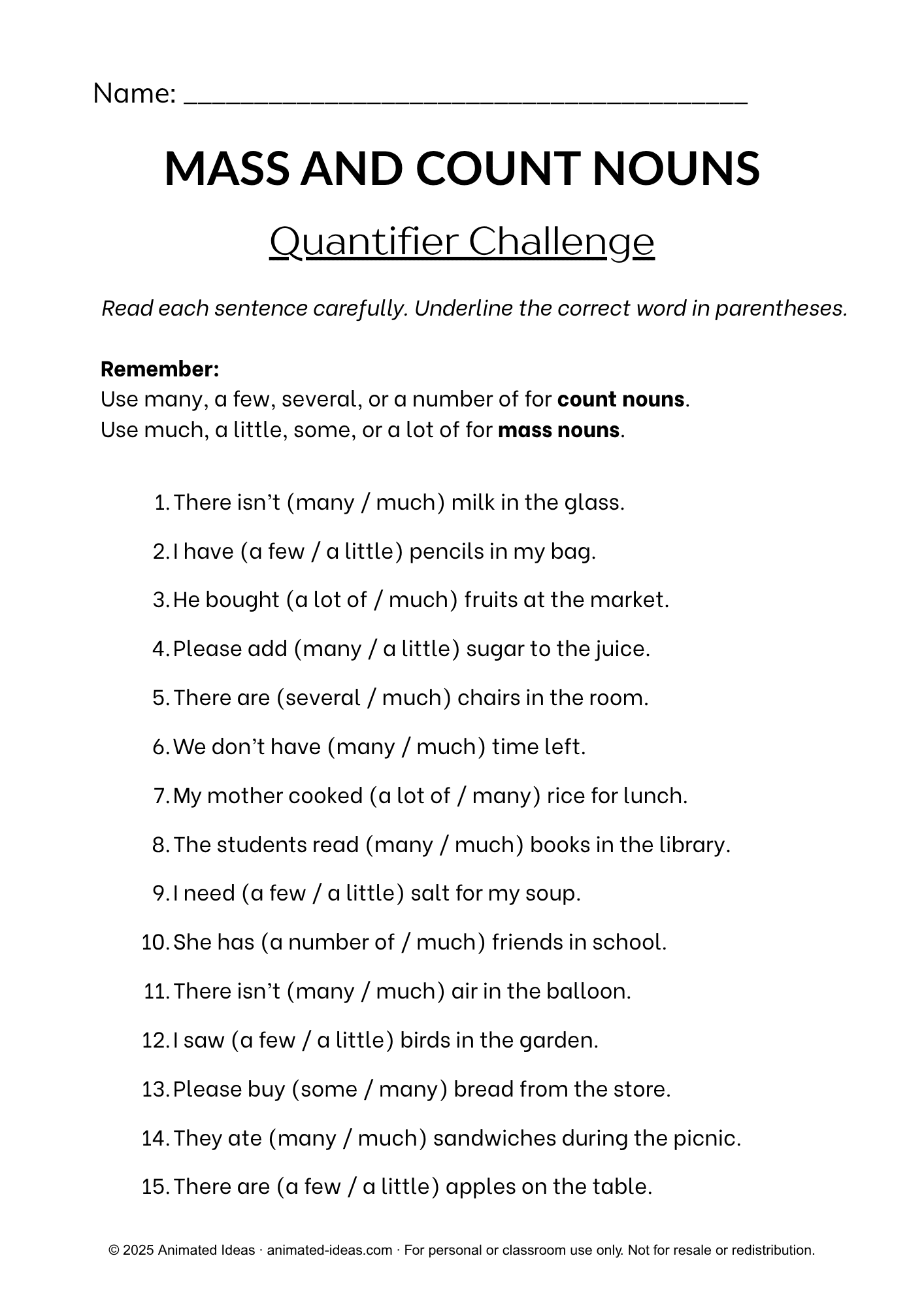
How to Use Quantifiers
We can use quantifiers to show amount when we talk about nouns.
For Count Nouns, use:
- many, a few, several, a number of
Examples:
- I have many books.
- She bought a few pencils.
- There are several apples in the basket.
For Mass Nouns, use:
- much, a little, some, a lot of
Examples:
- There isn’t much water left.
- We need a little sugar for the cake.
- He has a lot of money in the bank.
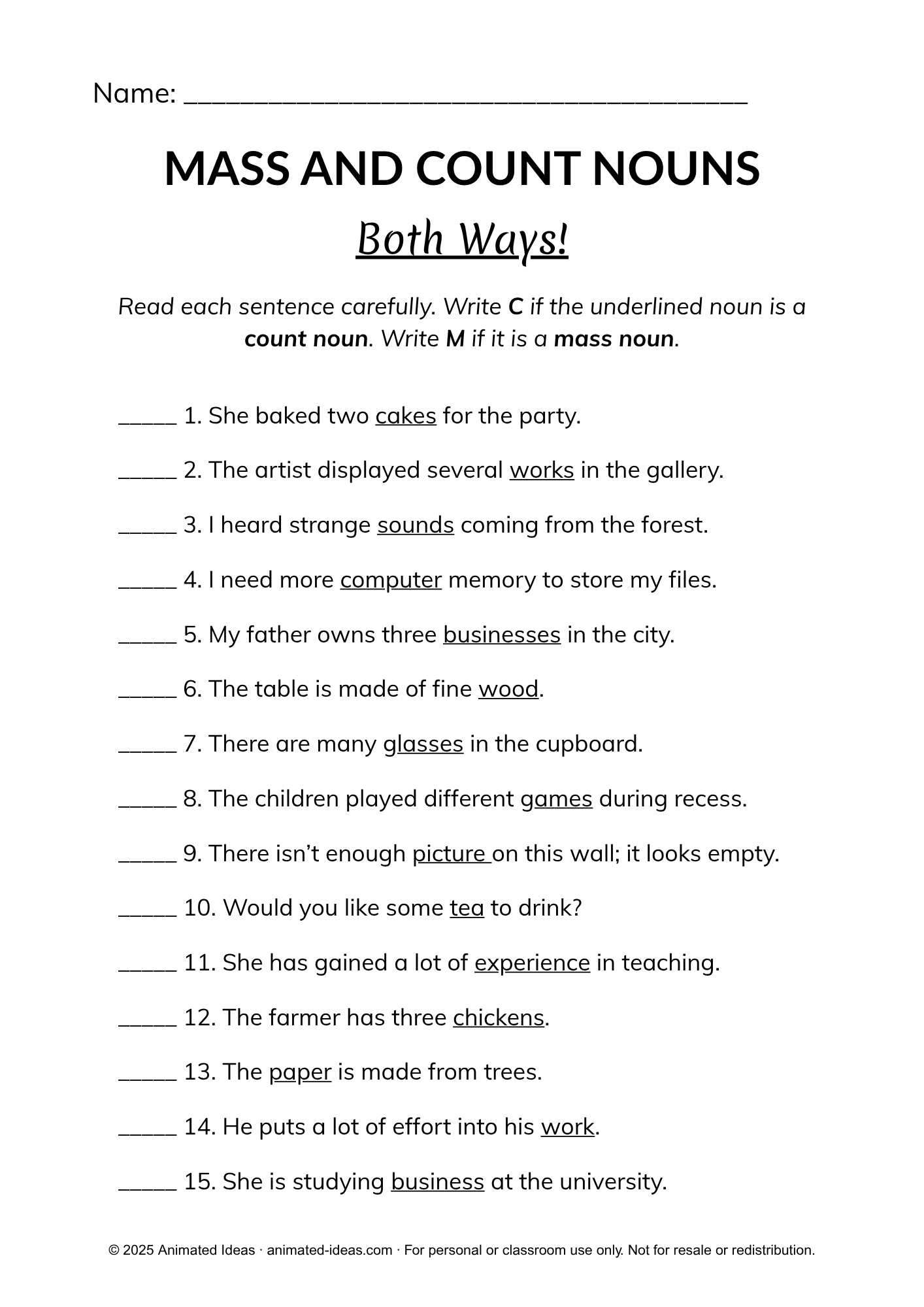
Be Careful! Some Nouns Can Be Both!
Some nouns can be count or mass, depending on how they are used.
| Noun | Count Form | Mass Form |
|---|---|---|
| chicken | I bought three chickens. (animals) | I ate chicken for lunch. (meat) |
| paper | I need two papers for my project. (documents) | We need paper to print the report. (material) |
| hair | I found a hair on my shirt. (one strand) | She has long hair. (all hair in general) |
So, always check the meaning of the noun in the sentence.
Let’s Review
Count nouns can be counted. They have singular and plural forms.
➤ Use a/an, numbers, or many, few, several with them.
Mass nouns cannot be counted. They do not have plural forms.
➤ Use some, much, a little, or a lot of with them.
Examples at a Glance
| Count Nouns | Mass Nouns |
|---|---|
| apple 🍎 | water 💧 |
| dog 🐕 | air 🌬️ |
| book 📘 | rice 🍚 |
| pencil ✏️ | milk 🥛 |
| chair 🪑 | sugar 🍬 |
Conclusion
Understanding mass and count nouns helps you write and speak English correctly.
It makes your sentences clear and grammatically correct.
Remember:
If you can count it, it’s a count noun.
If you can’t count it, it’s a mass noun.
With this knowledge, you’ll be more confident when describing things around you — whether you’re talking about apples or water, books or music.
Thank you for reading this lesson guide! 🎉
If you’d like to continue learning and exploring, we recommend checking out more materials from Animated Ideas, including:
You can also find more helpful content and updates on our social media channels:
- YouTube – Animated Ideas
- Facebook – Animated Ideas
- Pinterest – Animated Ideas
Keep learning and have fun with English!