
Segmenting Syllables: A Complete Guide for Early Readers
Segmenting syllables is a fundamental skill for young readers. A syllable is a unit of sound in a word, usually containing a vowel sound. For Grade 1 learners, understanding syllables helps break down words into smaller, manageable parts.
When children can identify and segment syllables, they gain the ability to read fluently, spell accurately, and expand vocabulary. For example, the word “pencil” can be broken down into two syllables: “pen-cil.” Recognizing this division makes it easier for learners to read unfamiliar words.
Syllable awareness is also closely linked to phonemic awareness, which is the ability to hear and manipulate individual sounds in words. Phonemic awareness is one of the strongest predictors of reading success in early learners.
Download Free Worksheets and Notes
These worksheets are perfect for Grade 1 learners, early readers, ESL students, and even teachers and parents who want structured resources to support learning. They provide a clear and organized way for children to practice breaking words into syllables while keeping the activities fun and interactive.
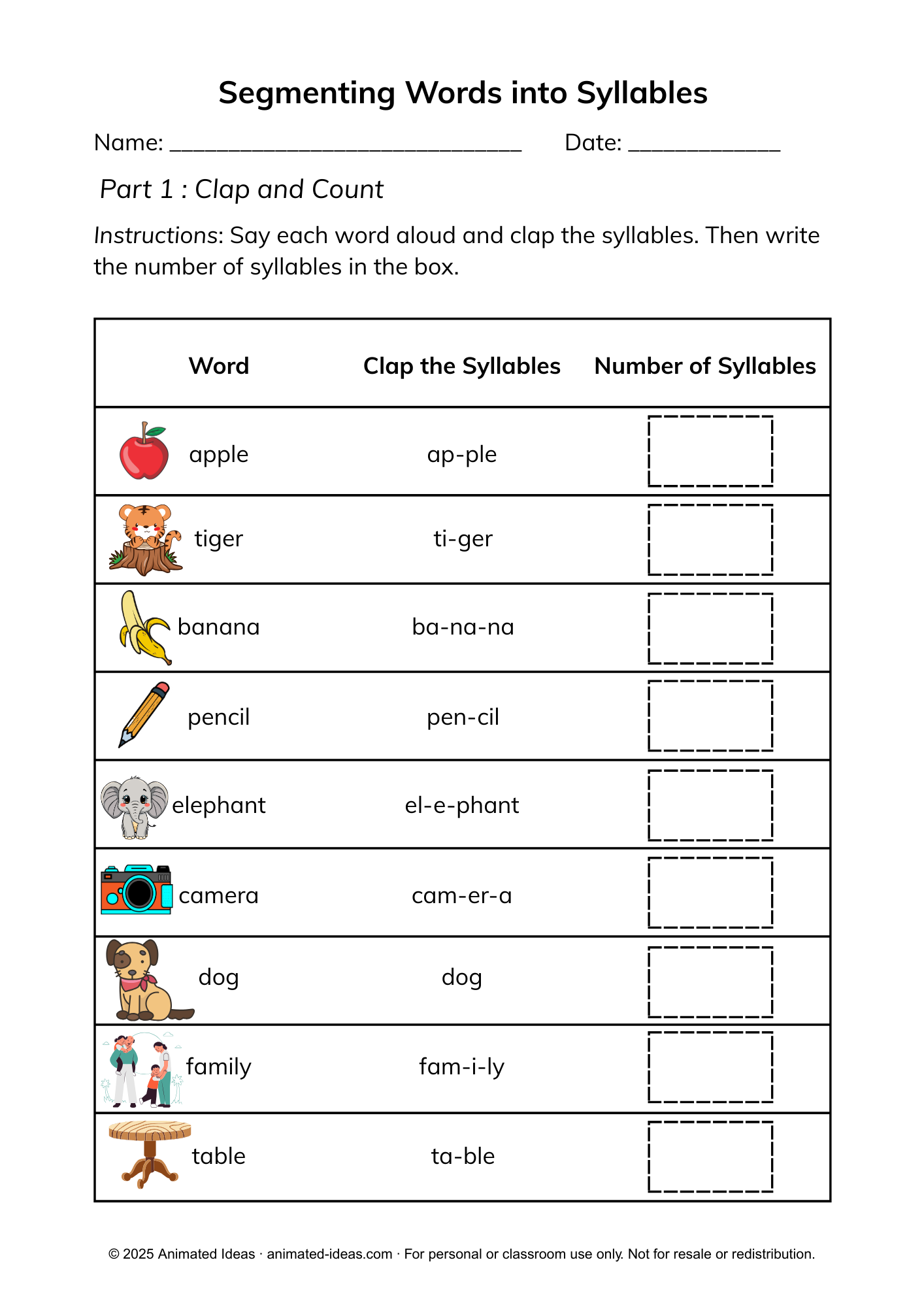
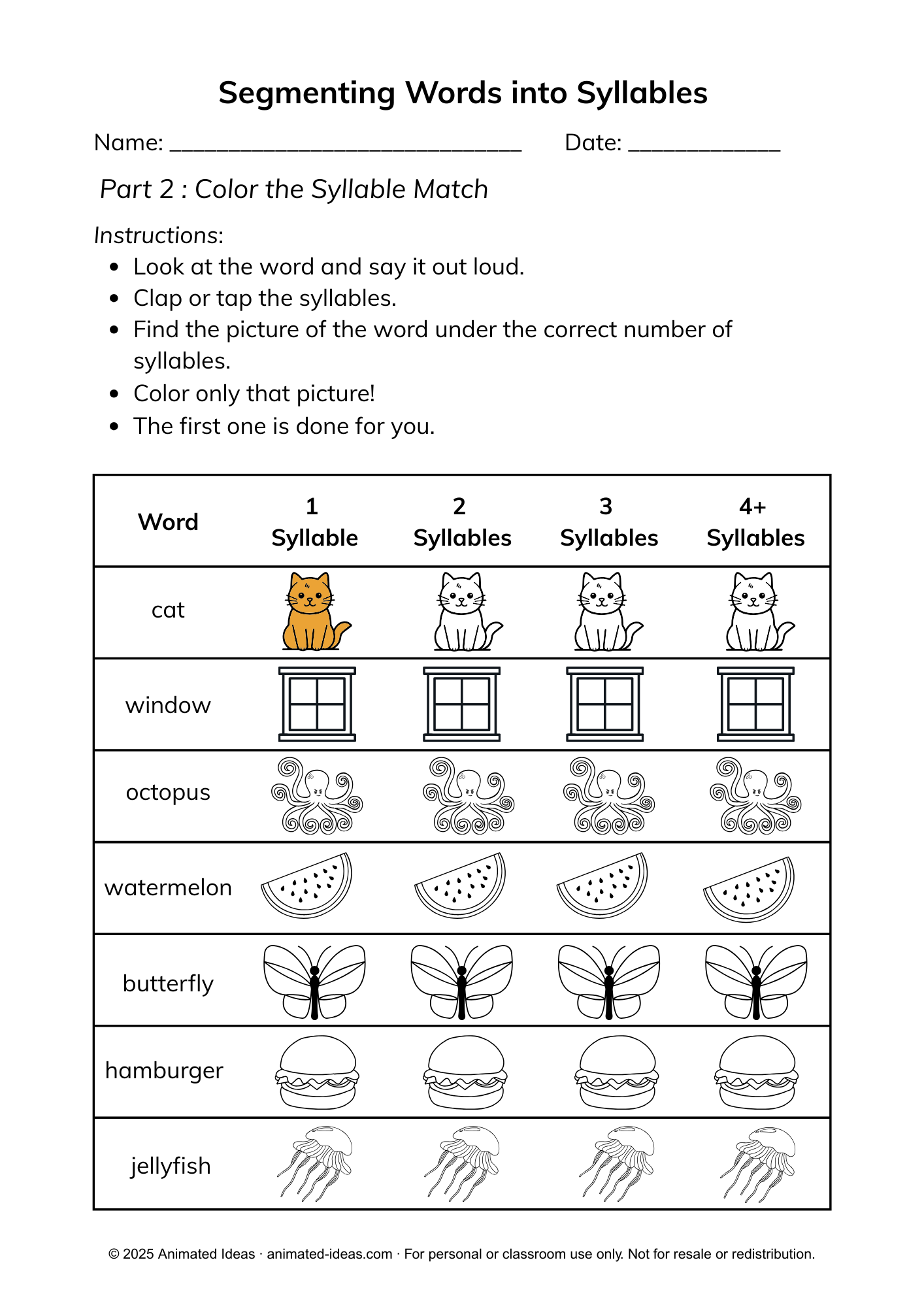
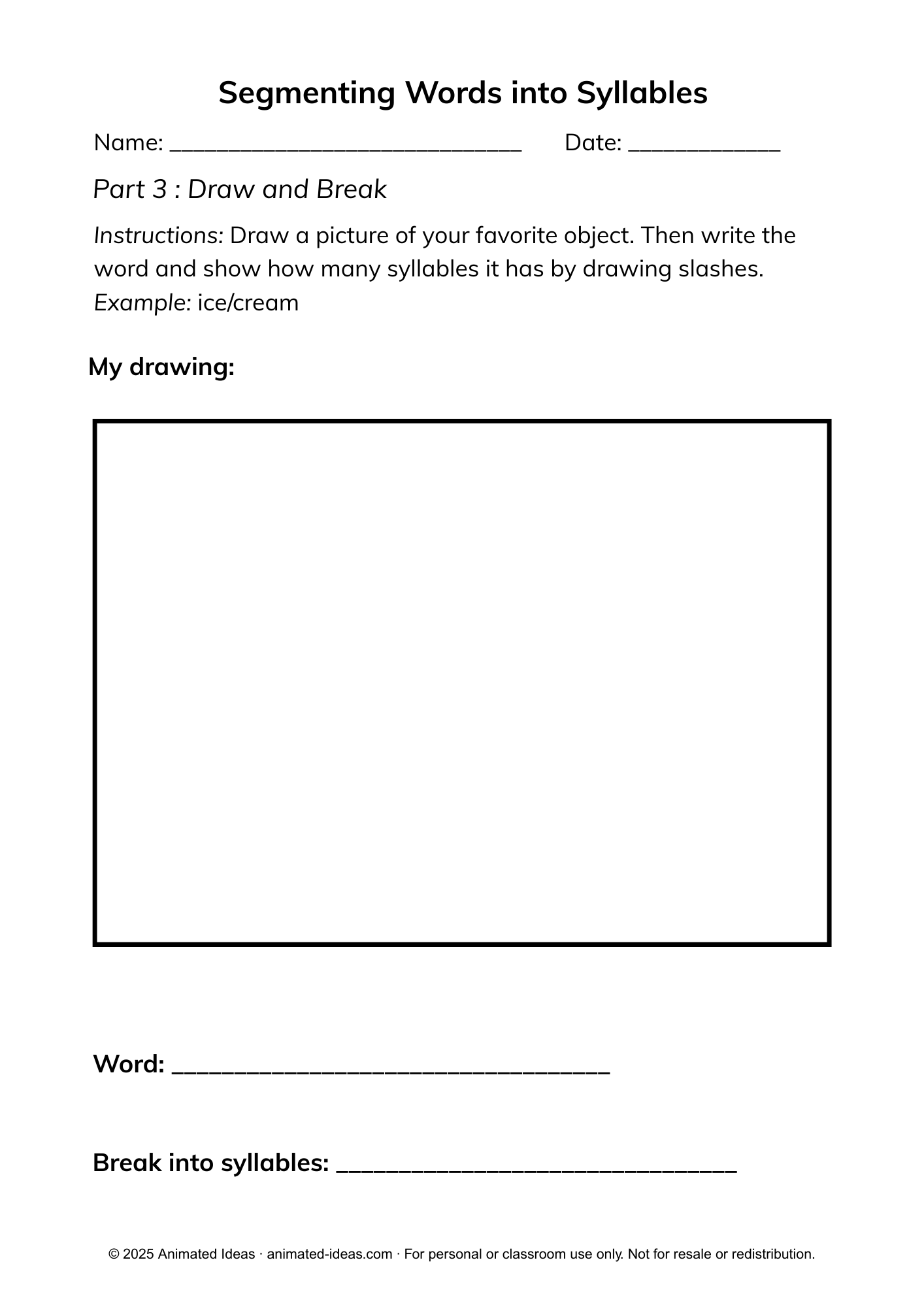
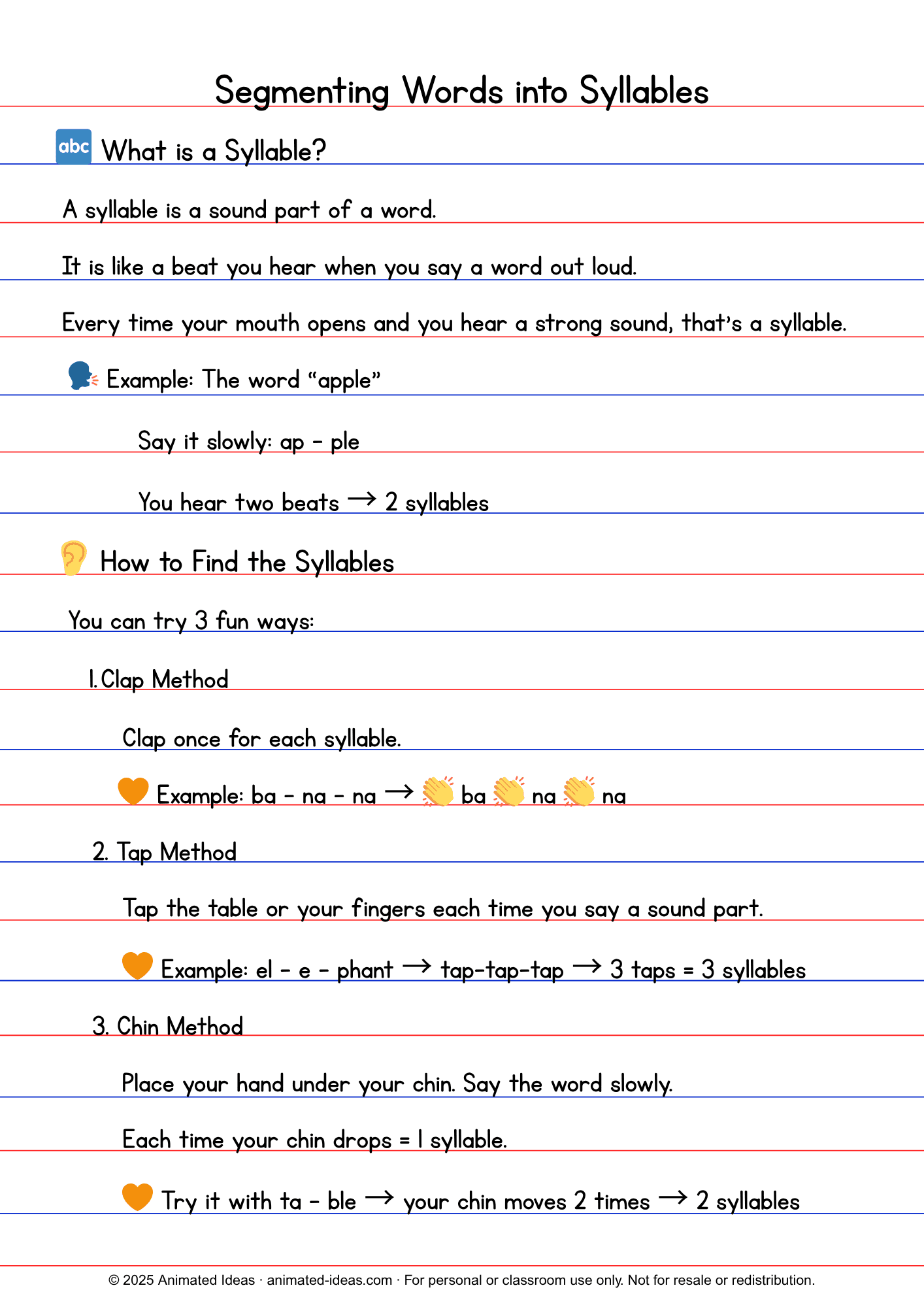
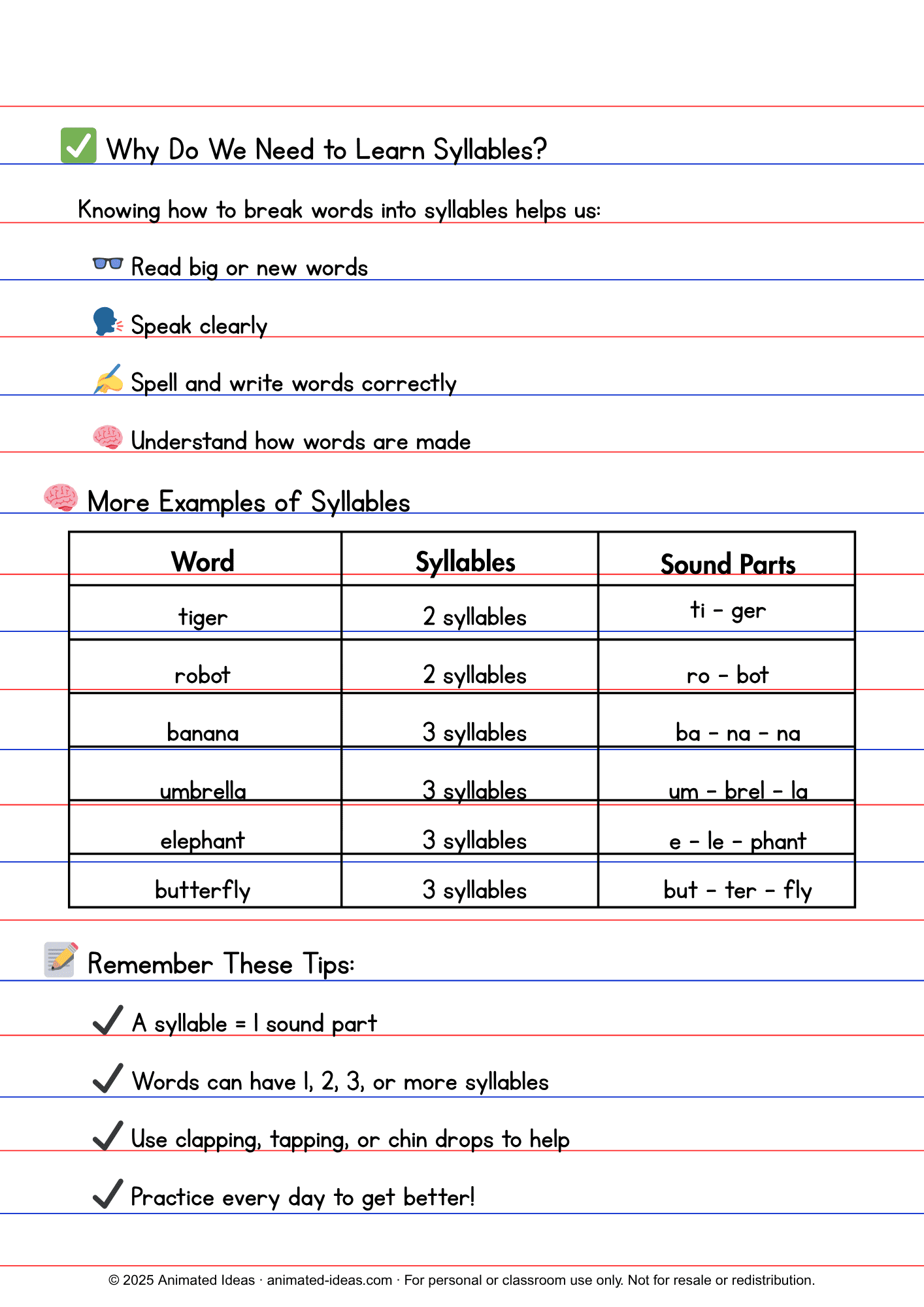
Each worksheet includes exercises for clapping, tapping, and identifying syllables, along with helpful notes for teachers on strategies and methods. The word lists are carefully categorized by syllable count, allowing learners to progress step by step. These worksheets can be used in classroom lessons, at home, or during tutoring sessions, making it easy to reinforce learning in a variety of settings.
Strategies to Teach Segmenting Syllables in Grade 1
Helping children learn to segment words into syllables is a key step in developing strong reading skills. A segmenting words into syllables worksheet can guide this process, but pairing it with hands-on strategies makes learning even more effective. By using auditory, visual, and kinesthetic methods, children can explore syllables in ways that suit their learning style, making the activity engaging and memorable.
Clapping or Tapping Method
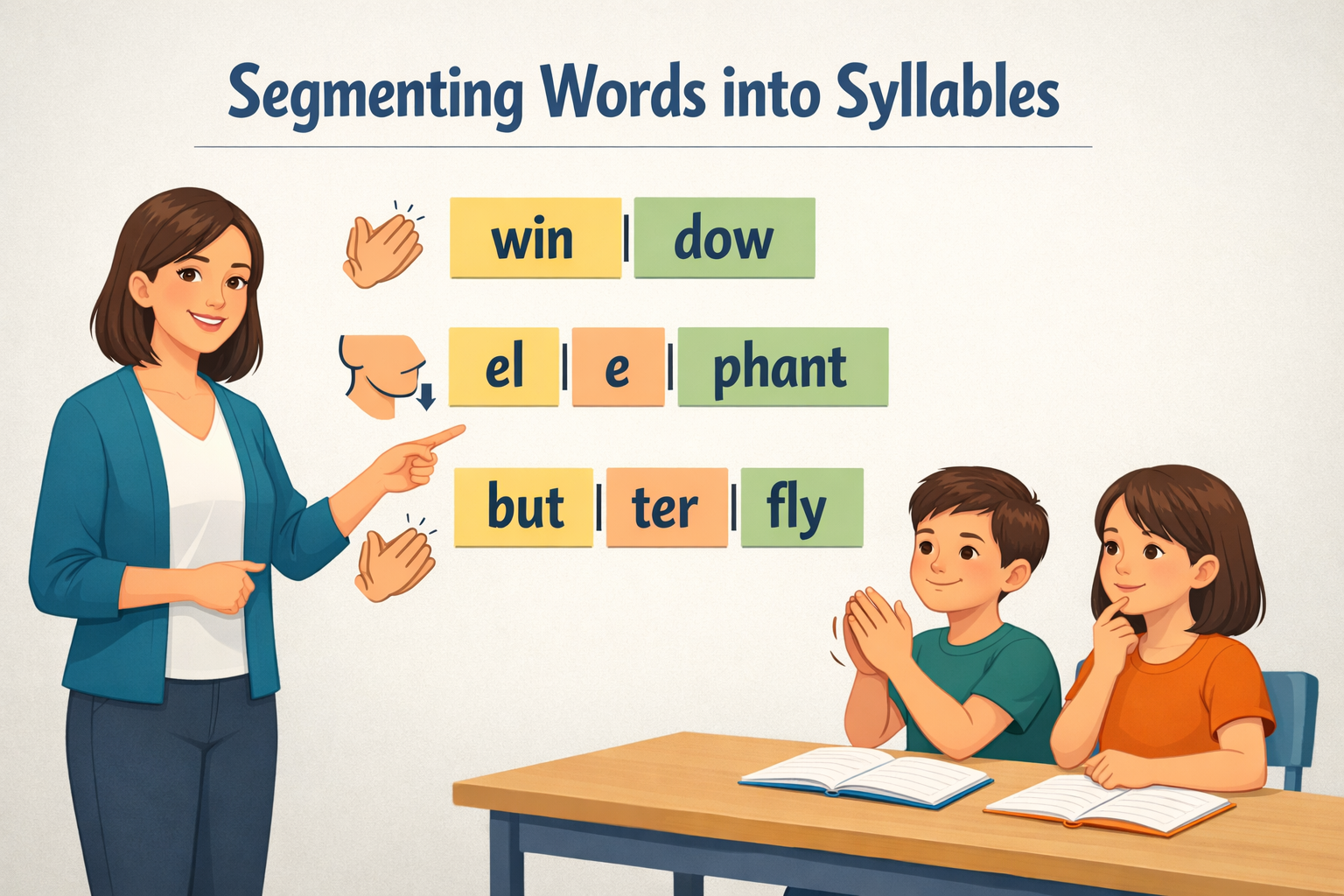
One of the most interactive strategies is the clapping or tapping method. Children clap their hands or tap a table for each syllable they hear in a word. For example, the word “window” has two claps: win-dow. This method strengthens auditory and kinesthetic skills while keeping learning playful.
Examples for early learners:
- 1 syllable: cat, dog, sun, hat, fish
- 2 syllables: window (win-dow), rabbit (rab-bit), pencil (pen-cil), apple (ap-ple), happy (hap-py)
- 3 syllables: elephant (el-e-phant), butterfly (but-ter-fly), dinosaur (di-no-saur), computer (com-pu-ter), tomato (to-ma-to)
Jaw Drop Method
The jaw drop method is another effective technique. Children open their mouths for each syllable, allowing them to feel the natural breaks in words. For instance, “elephant” has three jaw drops: el-e-phant. This adds a tactile element to learning and helps young readers internalize syllable structure.
Examples for early learners:
- 1 syllable: ball, tree, star, book, hat
- 2 syllables: baby (ba-by), table (ta-ble), paper (pa-per), tiger (ti-ger), window (win-dow)
- 3 syllables: family (fam-i-ly), chocolate (cho-co-late), animal (an-i-mal), computer (com-pu-ter), elephant (el-e-phant)
Using Visual Cards
Visual aids can further reinforce syllable segmentation. Flashcards with words divided into syllables help learners see and point to each part as they read. For example, a card showing “butterfly” divided as but-ter-fly supports visual and auditory recognition simultaneously.
Examples for early learners:
- 1 syllable: sun, car, dog, bed, cup
- 2 syllables: cookie (cook-ie), garden (gar-den), rocket (roc-ket), puppy (pup-py), river (riv-er)
- 3 syllables: butterfly (but-ter-fly), alligator (al-li-ga-tor), tomato (to-ma-to), octopus (oc-to-pus), dinosaur (di-no-saur)
Syllable Sorting
Syllable sorting is a practical way to reinforce learning. Children group words based on the number of syllables, such as one-syllable, two-syllable, or three-syllable words. This encourages pattern recognition, critical thinking, and active participation. Teachers and parents can even turn sorting into a fun game to keep learners engaged.
Examples for early learners:
- 1 syllable: cat, pen, hat, bus, ship
- 2 syllables: napkin (nap-kin), pillow (pil-low), basket (bas-ket), summer (sum-mer), doctor (doc-tor)
- 3 syllables: elephant (el-e-phant), strawberry (straw-ber-ry), computer (com-pu-ter), butterfly (but-ter-fly), chocolate (cho-co-late)
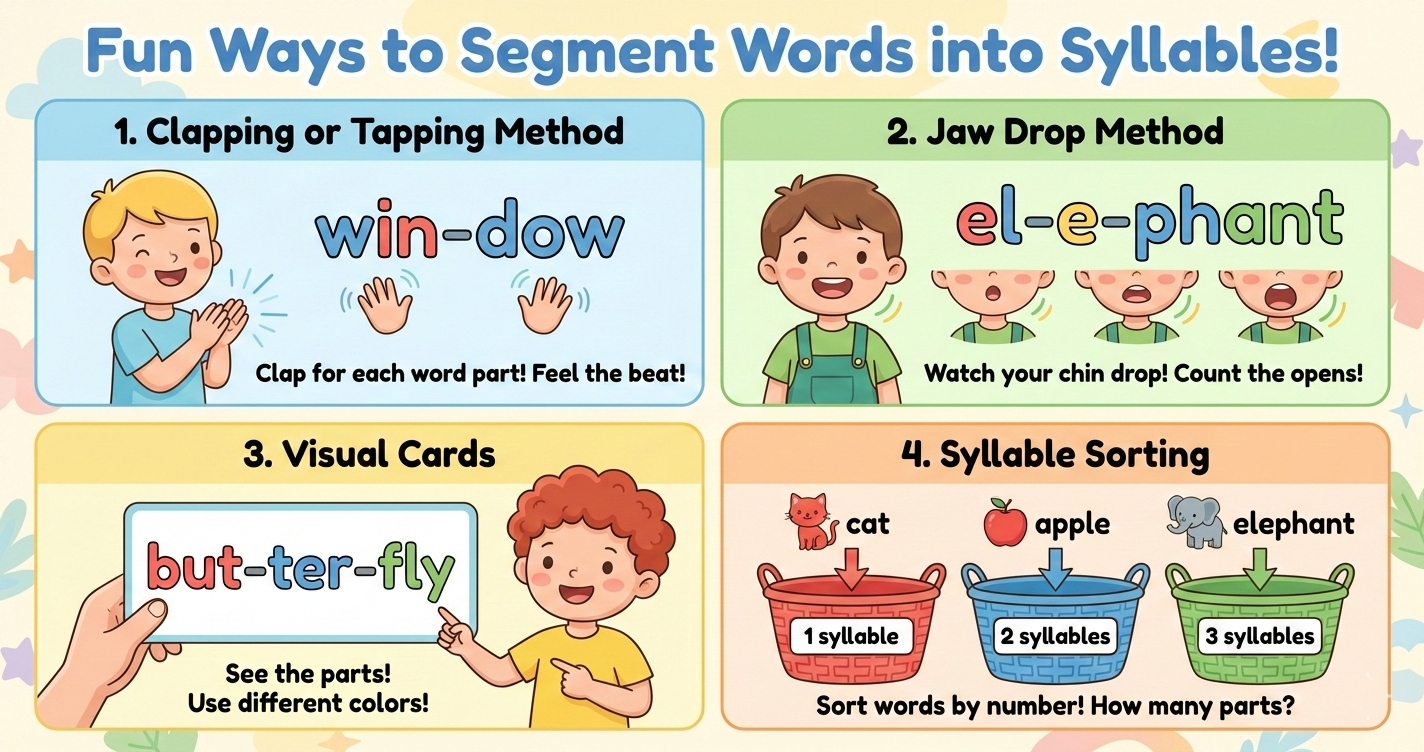
By combining these strategies with a segmenting words into syllables worksheet, children gain multiple ways to explore words and develop confidence in reading. Transitioning between clapping, jaw drops, visual aids, and sorting ensures that every learner can engage with the material in a way that suits them best, making the process both educational and fun.
Common Challenges in Segmenting Syllables and How to Overcome Them
While teaching syllables is an essential part of early reading instruction, some learners may experience difficulties. Fortunately, these challenges can be addressed with the right strategies and gradual support. Below are some common issues and practical ways to overcome them.
- Difficulty recognizing syllables in longer words
To begin with, longer words can feel overwhelming for young learners. Therefore, it is best to start with short, familiar words that children already recognize. As their confidence grows, teachers and parents can slowly introduce longer words, allowing learners to transition naturally without frustration. - Confusing vowel sounds or silent letters
In addition, English vowel sounds and silent letters may make syllable segmentation more challenging. To support learners, model each syllable clearly and pronounce words slowly. Repeating the syllables aloud together helps children hear the correct breaks and strengthens their listening skills. - Lack of attention during syllable exercises
Moreover, some learners may lose focus during repetitive activities. To maintain engagement, interactive methods such as clapping, tapping, using visual cards, or movement-based activities can be introduced. These strategies keep learners active and make practice more enjoyable.
As learners overcome these challenges, they become more comfortable with segmenting syllables. Eventually, they can move on to more complex words, which helps improve reading fluency and builds long-term confidence in their reading abilities.
Practical Tips for Teaching Syllable Segmentation
Supporting children beyond the classroom plays a vital role in helping them master segmenting syllables. When parents and teachers work together, learners receive consistent practice and reinforcement, which leads to stronger reading and spelling skills.
- Model syllable segmentation regularly
To begin with, reading aloud provides an excellent opportunity to demonstrate how words are broken into syllables. By clearly modeling each syllable, children learn to listen carefully and imitate correct word segmentation. - Use everyday words for practice
In addition, practicing with familiar words from home and school makes learning more meaningful. Words such as “kitchen,” “playground,” or “homework” help children connect syllable segmentation to their daily experiences. - Praise effort and progress
Moreover, celebrating small improvements encourages learners to stay motivated. Positive feedback builds confidence and helps children feel successful as they develop new reading skills. - Encourage writing activities
Finally, asking learners to write segmented words reinforces spelling and deepens their understanding of word structure. Writing syllables strengthens memory and supports long-term retention.
As a result, these strategies prepare learners for more advanced reading and spelling skills, allowing them to approach longer and unfamiliar words with greater confidence.
Segmenting Words into Syllables Video Lesson
To further support learning, this segmenting words into syllables video provides a clear and engaging visual demonstration for young learners. The video models how to break words into syllables using simple, child-friendly techniques such as clapping, chin drops, and slow pronunciation. By seeing and hearing the process in action, students can better understand how words are divided.
In addition, the video reinforces the skills practiced in the worksheet by using familiar Grade 1 vocabulary and step-by-step examples. This makes it especially helpful for early readers, ESL learners, and students who benefit from repeated visual instruction. Teachers and parents can use the video during classroom lessons, small-group instruction, or independent practice at home.
Overall, this video serves as an effective supplement to hands-on activities and printable resources, helping learners build confidence and fluency as they continue developing their syllable segmentation skills.
Conclusion
Segmenting syllables is a critical early literacy skill for Grade 1 learners. By learning how to break words into smaller parts, children:
- Read fluently and confidently
- Spell accurately
- Expand vocabulary
- Build a foundation for long-term literacy success
Using interactive strategies, daily practice, and free worksheets ensures learners develop syllable awareness in a structured, engaging, and effective manner. Early mastery of syllables is not just a reading skill—it’s a stepping stone to academic success.