

Skip Counting and Number Order: A Complete Lesson for 1st Graders
Understanding numbers is one of the most important skills for young learners. Two key concepts in early mathematics are skip counting and number order. Both are foundational skills that help 1st graders read, write, and understand numbers confidently.
Skip counting is counting forward by numbers other than one, such as by twos, fives, or tens. Number order is understanding the sequence of numbers, knowing which comes first, next, or last. Together, these skills strengthen early number sense, patterns recognition, and prepare children for addition, subtraction, and multiplication in the future.
This lesson explains skip counting and number order clearly. It provides examples, visuals, and strategies that are easy for 1st graders to follow.
Download Free Worksheets and Notes
To support learning skip counting and number order, we provide free worksheets and notes.
These resources are ideal for:
- 1st-grade students practicing number order and skip counting
- Teachers seeking ready-to-use classroom materials
- Parents helping children at home


These worksheets reinforce lesson content and help children confidently master counting patterns and sequences.
Understanding Number Order: From Smallest to Largest
Number order is the way numbers are arranged in a sequence from the smallest to the largest. Learning number order helps children understand how numbers grow, compare, and relate to each other. This skill is very important because it forms the foundation for addition, subtraction, and other math concepts.
Children first learn to count in order from 1 to 100. Recognizing the pattern in number sequences helps them see how each number comes after another.
Examples:
- 1, 2, 3, 4, 5 …
- 10, 11, 12, 13, 14 …
- 90, 91, 92, 93, 94 …
Notice that each number has its specific place in the sequence. When children understand this, they can easily identify which number comes before or after a given number.
A number line is a helpful visual tool for learning number order. It allows children to see numbers in a straight line, making it easier to recognize the pattern.
What is Skip Counting?
Skip counting is a way of counting numbers faster by skipping some numbers in a regular pattern instead of counting one by one. It is a fun and easy method to recognize number patterns and helps children become confident in math.
Examples of skip counting:
- Counting by 2s: 2, 4, 6, 8, 10 …
- Counting by 5s: 5, 10, 15, 20 …
- Counting by 10s: 10, 20, 30, 40 …
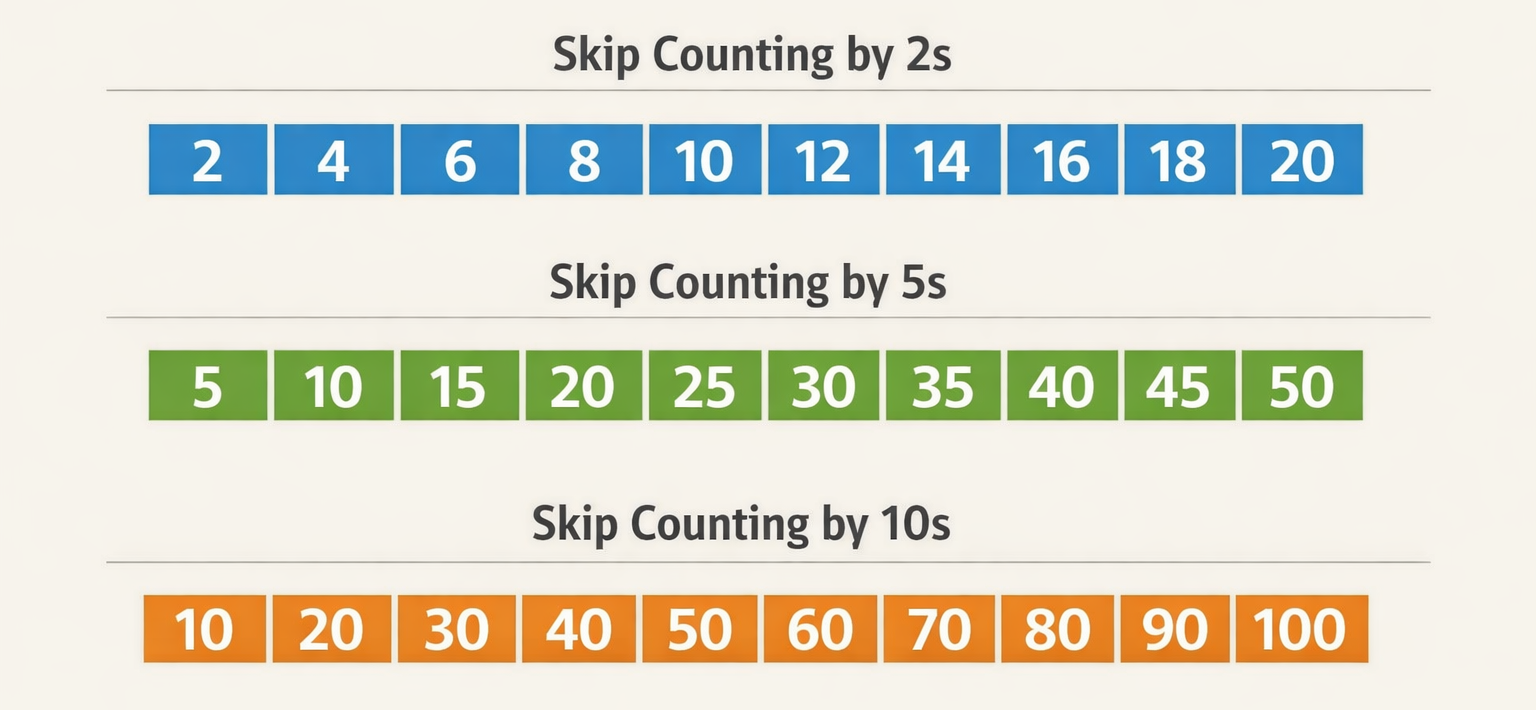
In skip counting, each number is a fixed amount more than the previous number. For example, when counting by 2s, each number is 2 more than the number before it.
Why Skip Counting is Important
Skip counting helps children:
- Recognize patterns in numbers
- Children can see that numbers grow in a predictable way.
- Example: Counting by 5s – 5, 10, 15, 20 … the pattern is always adding 5.
- Count efficiently
- Skip counting is faster than counting one by one, especially with many objects.
- Example: Counting 50 beads by 10s: 10, 20, 30, 40, 50.
- Prepare for multiplication tables
- Multiplication is basically repeated addition. Skip counting by a number is a perfect way to understand this.
- Example: Counting by 3s (3, 6, 9, 12 …) is the same as 3 × 1, 3 × 2, 3 × 3 …
- Understand addition and subtraction with larger numbers
- Skip counting builds the skill to add or subtract quickly.
- Example: Counting by 10s helps add 10 + 20 + 30 without counting each number individually.
Counting Objects Using Skip Counting
One of the best ways to teach skip counting is by using real objects. Children understand numbers better when they can see and touch them. Instead of counting one object at a time, they learn to count in groups, which makes counting faster and easier.
For example, if we have 20 apples, we can group them in sets of five. Instead of counting 1, 2, 3, 4, 5…, children count like this:
5, 10, 15, 20
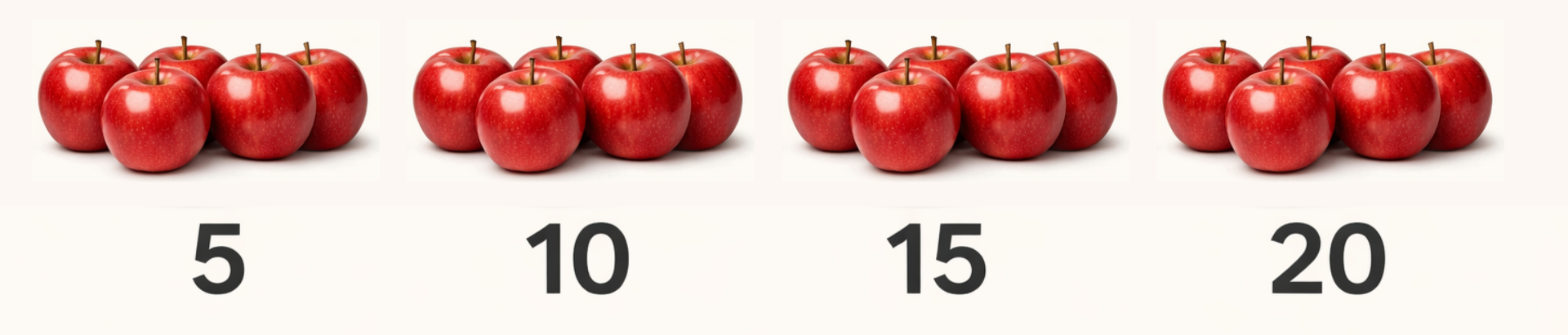
- One group of apples = 5
- Two groups of apples = 10
- Three groups of apples = 15
- Four groups of apples = 20
This method shows children that each group adds the same number every time. As a result, children begin to understand that skip counting is repeated addition.
Counting Backward Using Number Order
Number order is also essential for counting backward. Children can practice skip counting backward to reinforce understanding of number sequences.
Examples:
- Backward by 2s: 20, 18, 16, 14 …
- Backward by 5s: 50, 45, 40, 35 …
- Backward by 10s: 100, 90, 80, 70 …
Counting backward reinforces the concept of sequences and prepares students for subtraction.
Supporting Skip Counting and Number Order with Video Learning
In addition to hands-on activities and visuals, educational videos about skip counting and number order can further support children’s understanding. Videos provide movement, sound, and repetition, which help reinforce number patterns in an engaging way.
Through video lessons, children can:
- Watch numbers increase in order through clear animations
- Hear skip counting aloud by 2s, 5s, and 10s
- Follow along with number lines and grouped objects
- Practice counting together with guided prompts
As a result, videos help children connect visual patterns with spoken numbers, making skip counting easier to remember.
To reinforce this lesson, students can watch the video below to see skip counting and number order explained step by step. Watching the video together with a teacher or parent can also help children practice counting aloud.
Videos are especially helpful for:
- Visual and auditory learners
- Independent practice at home
- Reviewing skip counting skills after class
When used alongside daily practice and hands-on activities, video learning strengthens understanding and builds confidence in skip counting and number order.
Summary of Skip Counting and Number Order
Skip counting and number order are important math skills for 1st graders. These skills help children understand how numbers work and how they are connected. When students learn number order, they understand which number comes before, after, or between other numbers. This knowledge helps them read and write numbers correctly.
Skip counting helps children count faster and more easily. Instead of counting one by one, students learn to count by twos, fives, and tens. As a result, they begin to see clear number patterns. These patterns make numbers easier to remember and understand.
In addition, skip counting strengthens number sense. Children learn that numbers grow in a predictable order. This understanding builds confidence. It also reduces confusion when numbers get bigger. Because of this, students feel more comfortable working with numbers.
Number order also supports other math skills. It prepares children for addition and subtraction. When students know number order well, they can solve math problems more easily. They can also check if their answers make sense. For example, they know that 30 is greater than 20, and 15 comes before 20.
Furthermore, using visual aids helps students learn better. Number lines, charts, and grouped objects make abstract ideas clear. These visuals show how skip counting follows number order. They also help children see patterns clearly. As a result, learning becomes easier and more meaningful.
Free worksheets and notes support this learning even more. They give children structured practice. They also help teachers and parents guide learning step by step. With regular practice, students improve accuracy and confidence.
In conclusion, skip counting and number order build a strong foundation in early math. These skills help children think logically about numbers. They prepare students for future math topics. Most importantly, they help young learners enjoy math and feel successful while learning.