
The Circle and Its Parts
A circle is one of the most important shapes in mathematics. It appears in nature, daily objects, and early geometry lessons. Because of this, students are introduced to it at a young age. Learning the circle and its parts helps children understand shape, space, and measurement.
It may look simple at first. However, it has several important parts that work together. Each part has a specific name and purpose. When students understand these parts, they can describe circles clearly and accurately.
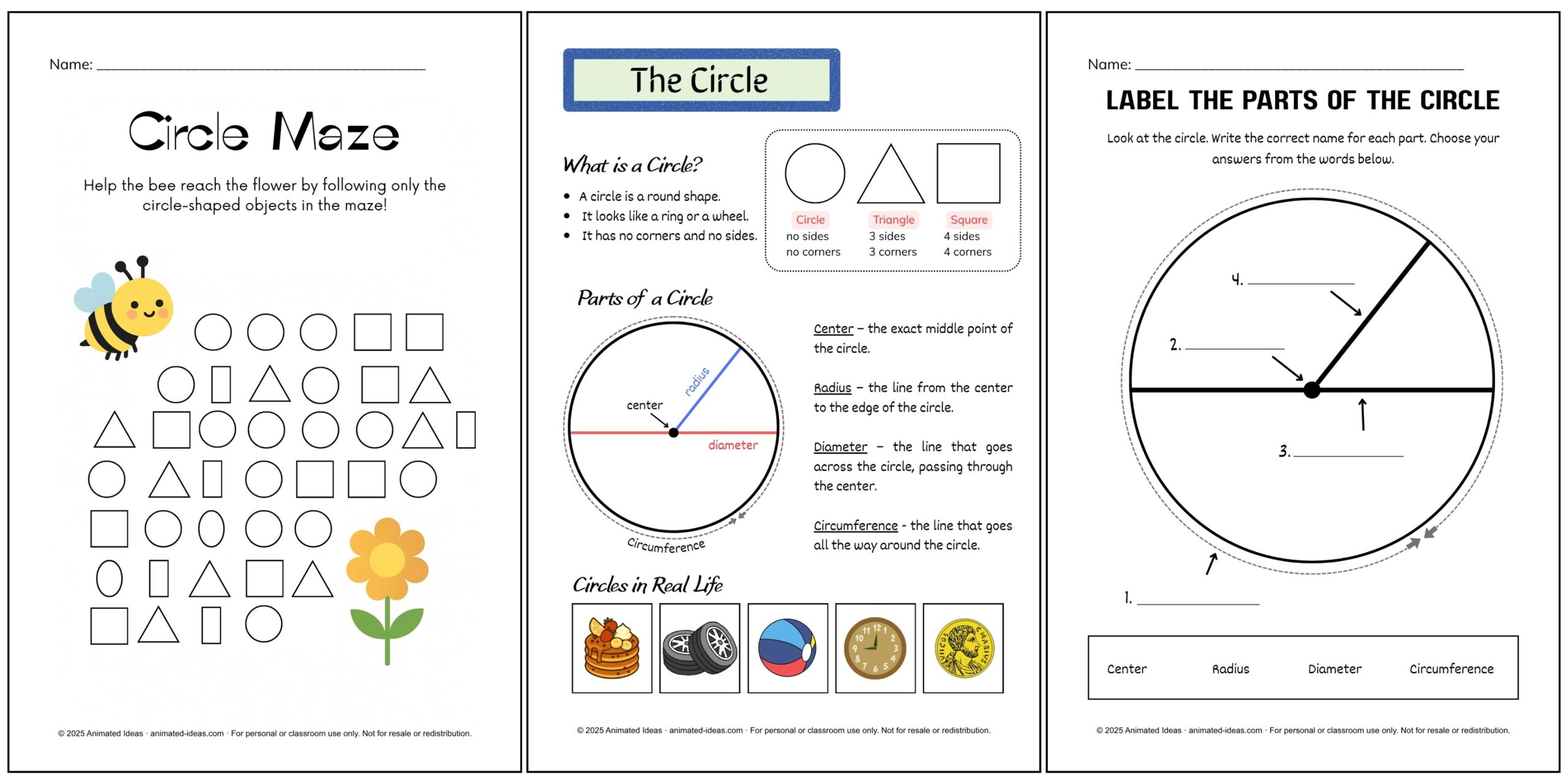
Download Free Worksheets and Notes
These free worksheets and notes are most suitable for Grade 2 students. They are designed to introduce the concept of the circle and its parts in a clear and age-appropriate way. The materials use simple language and visual support to help young learners understand each part of the circle with ease.


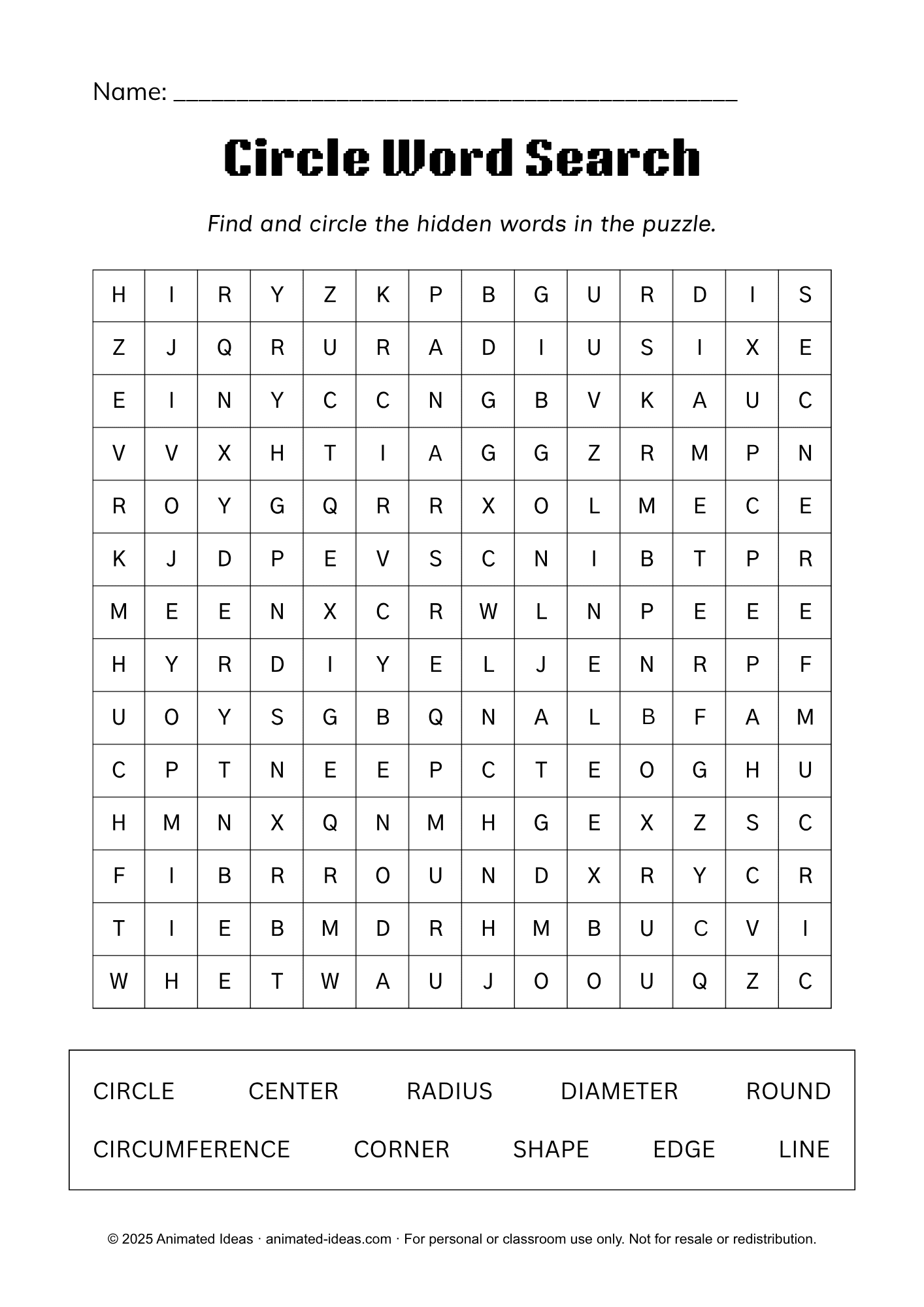

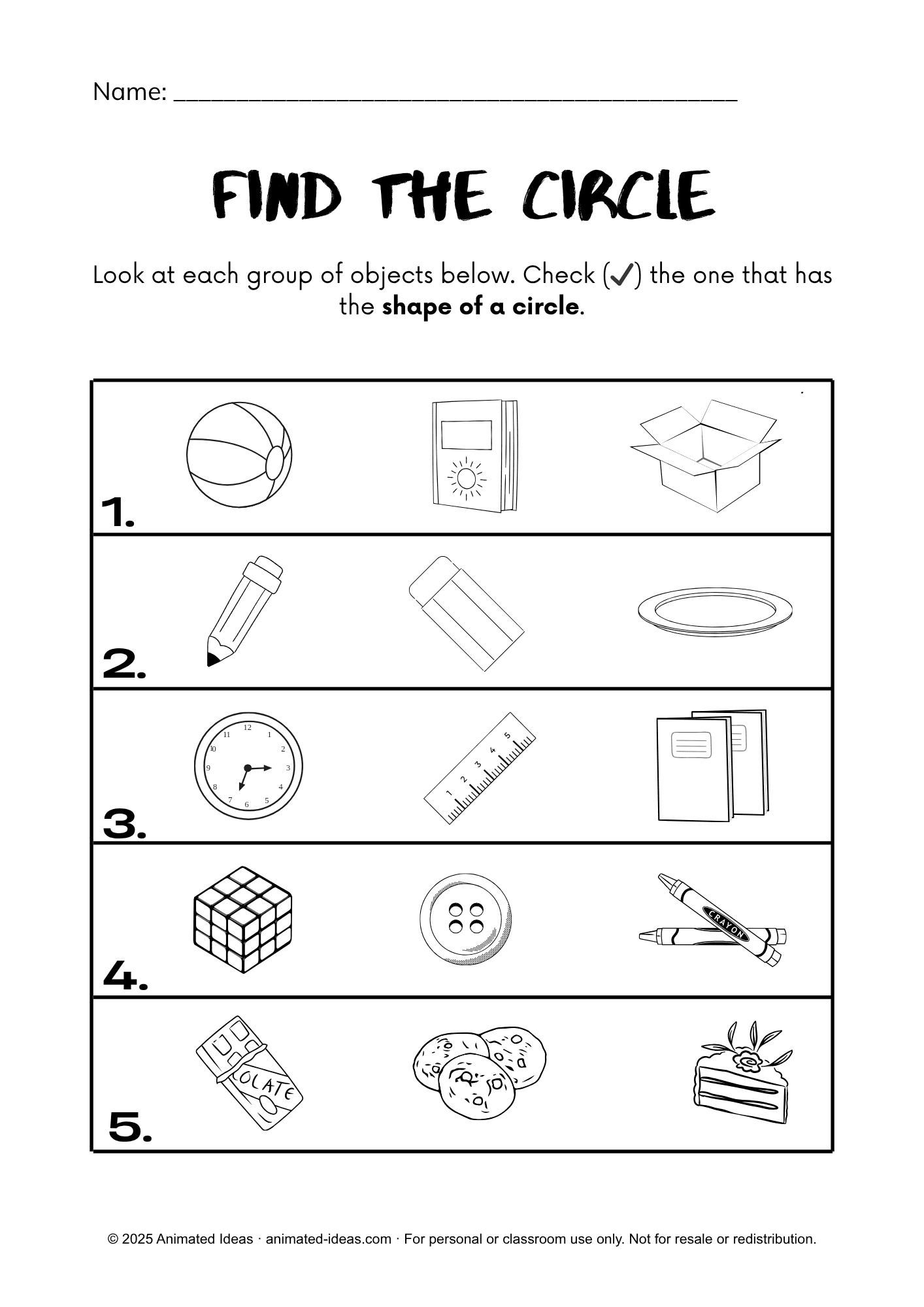
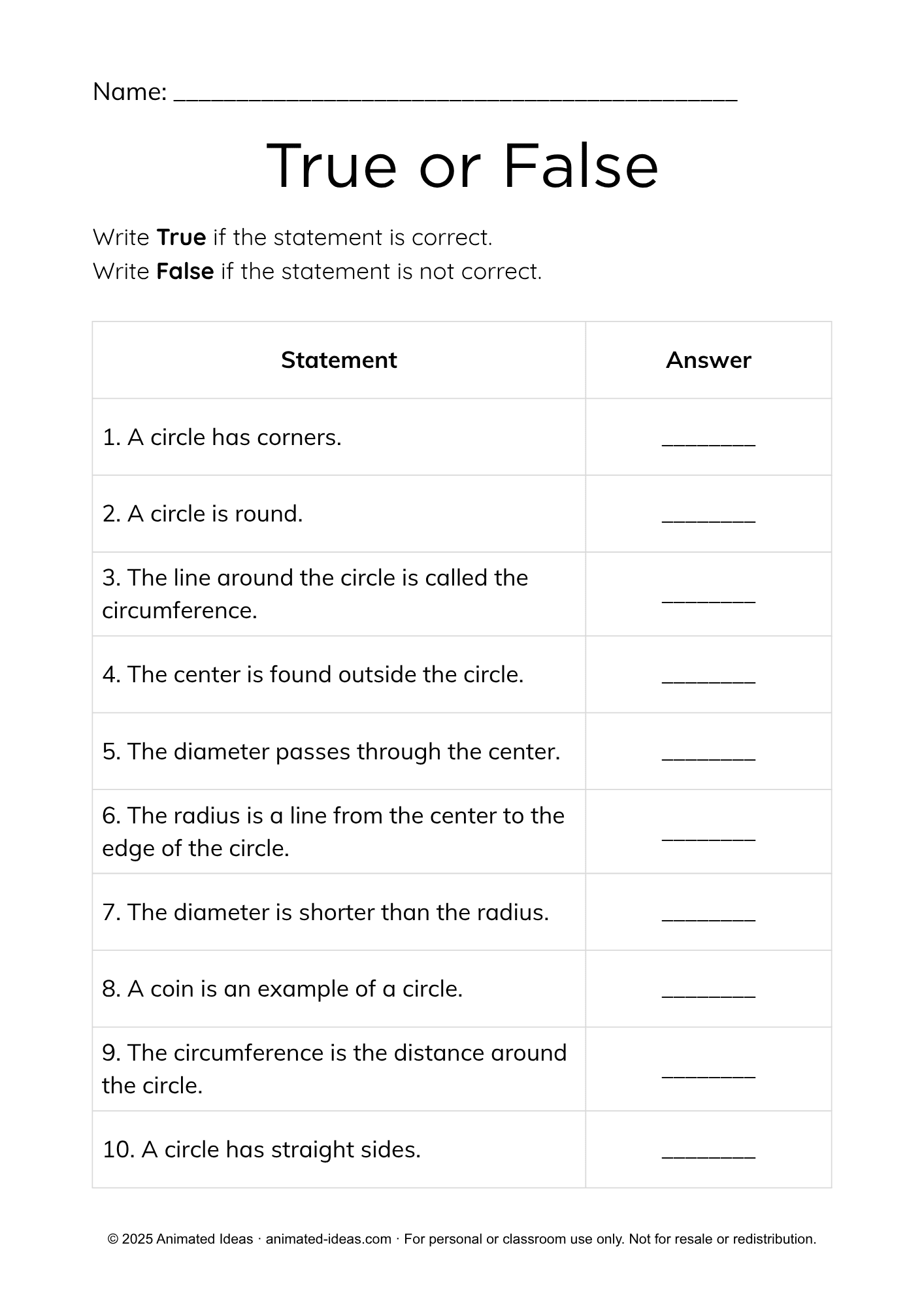
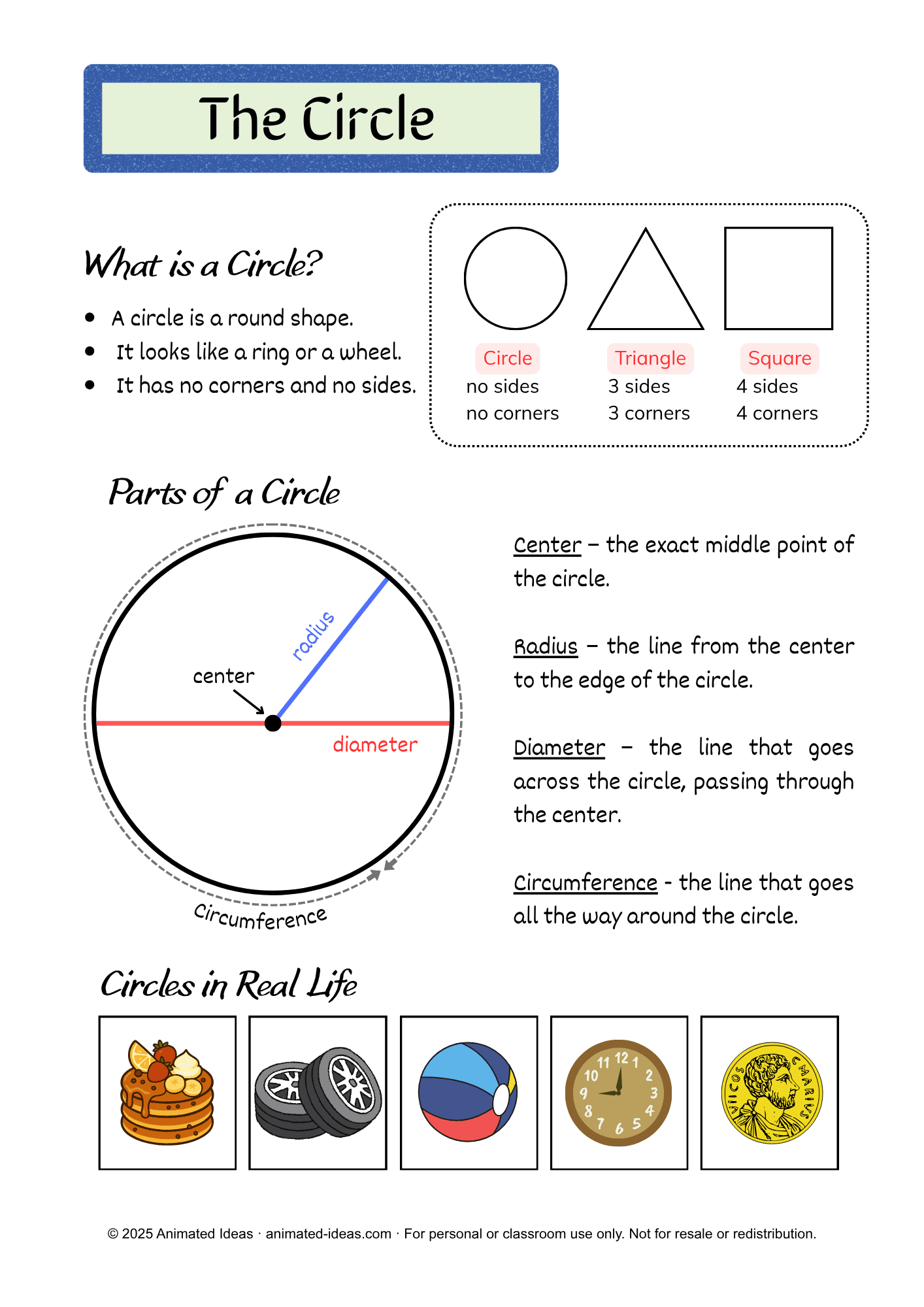
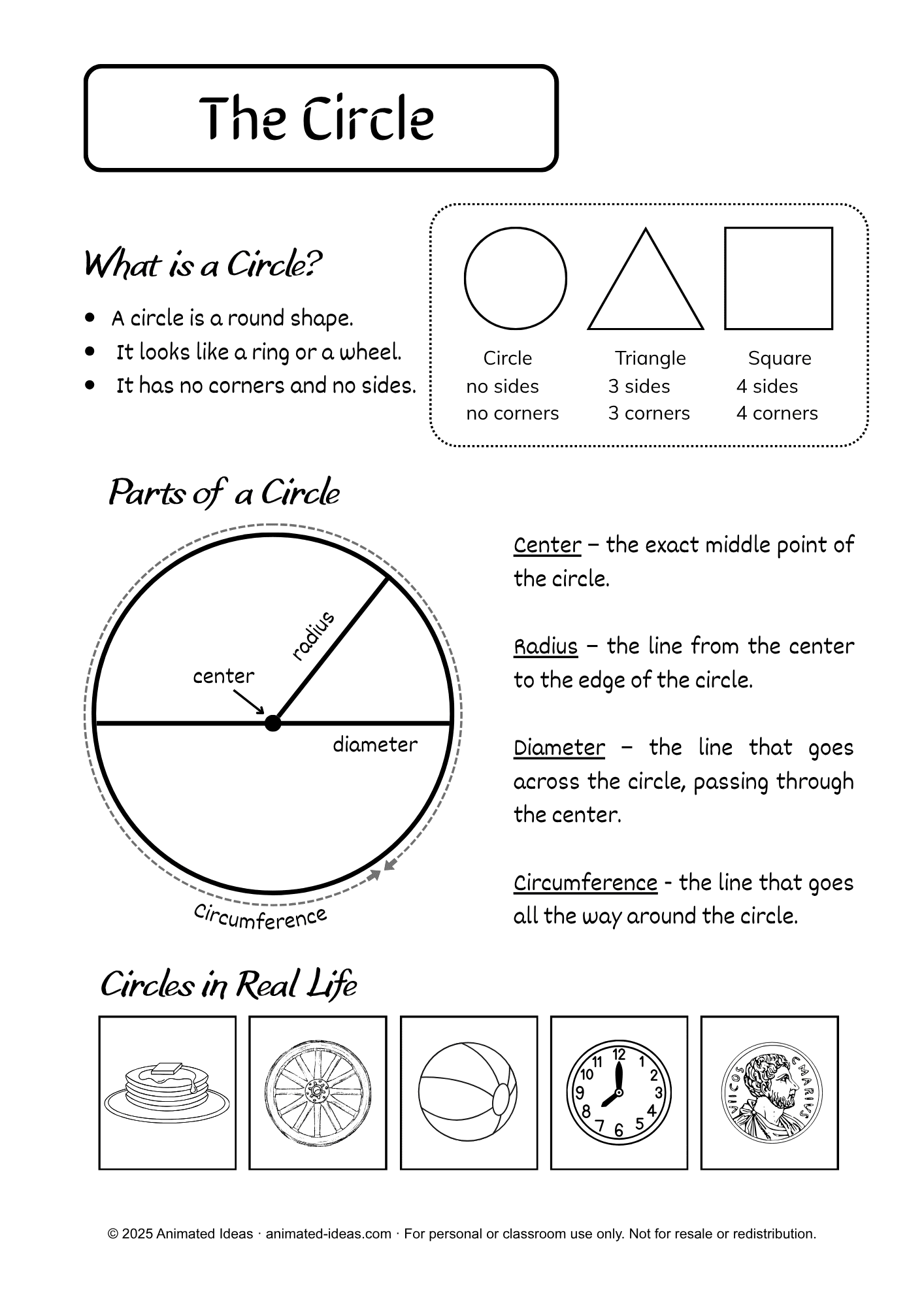
Teachers can use these resources for classroom lessons, guided practice, or review activities. Parents may also use them for home learning to reinforce geometry concepts. Each worksheet and note is structured to build understanding step by step, helping students develop confidence and accuracy in geometry.
What Is a Circle?
A circle is a flat, round shape. It has no corners and no straight sides. Instead, it has one continuous curved edge. This curved edge forms the boundary of the circle.
All points on the edge of a circle are the same distance from one central point. This special distance gives the circle its perfect shape. Because of this rule, a circle always stays balanced and even.
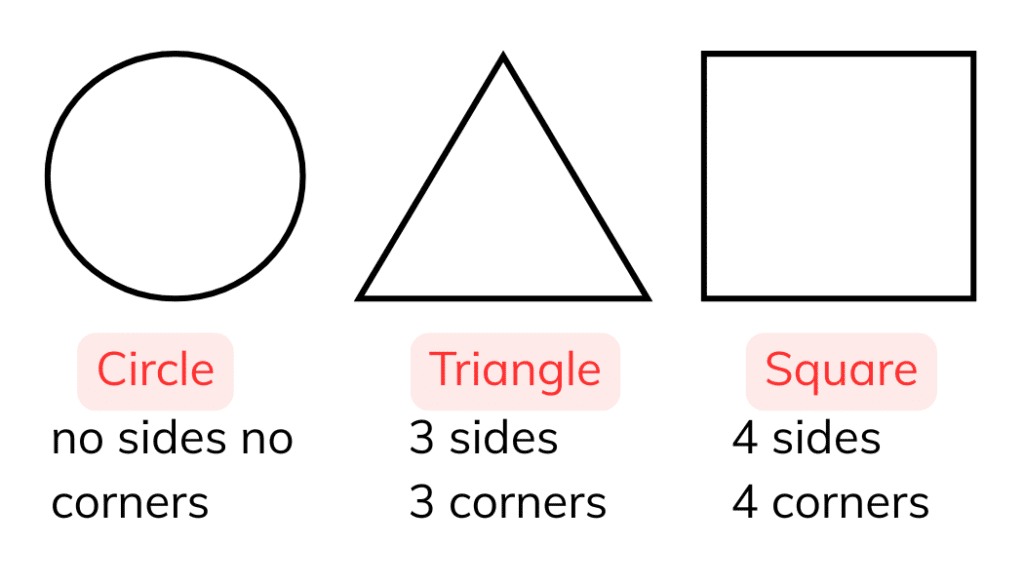
Circles can be found in many everyday objects. Examples include wheels, clocks, plates, and coins. Even though these objects may be different sizes, their circular shape follows the same rules.
Understanding what a circle is makes it easier to learn it and its parts. Each part depends on the basic definition of a circle.
The Circle and Its Parts
1. Center
The center is the most important point in a circle. It is located exactly in the middle. Every point on the edge of the circle is the same distance from this point.
Because of this equal distance, the center controls the shape of the circle. If the center moves, the entire circle changes position. Therefore, the center is the starting point for understanding all other parts.
Teachers often show the center as a small dot. This visual helps students see where measurements begin. From the center, the radius and diameter extend outward.
The cent re may not be visible in real objects. However, it always exists, even when it cannot be seen.
2. Radius
The radius is a straight line that starts at the center and ends at the edge of the circle. It shows the distance from the center to the circumference.
A circle has many radii. Each radius has the same length. This rule is always true and never changes. Because of this, the radius is used to describe the size of it.
When students draw circles, they often measure the radius first. This measurement helps create a correct and even shape. Later, the radius becomes important in geometry formulas.
Learning the radius helps students understand distance inside a circle. It also prepares them for more advanced topics.
3. Diameter
The diameter is a straight line that goes across the circle. It begins on one side, passes through the center, and ends on the opposite side.
The diameter is always twice the length of the radius. This relationship is very important. For example, if the radius is five units, the diameter is ten units.
Every circle has many diameters. However, all diameters have the same length. The diameter is also the longest chord in a circle.
Understanding the diameter helps students compare distances inside circles. It also supports later learning about measurement.
4. Circumference
The circumference is the distance around the circle. It is the curved boundary that forms the edge of the shape.
Unlike the radius and diameter, the circumference is not straight. It moves smoothly around the circle without corners. When someone traces the edge of a circle, they are following the circumference.
The circumference helps describe how large a circle is around the outside. Later, students learn how to measure this distance using formulas.
For now, it is important to understand the circumference as the circle’s outer boundary.
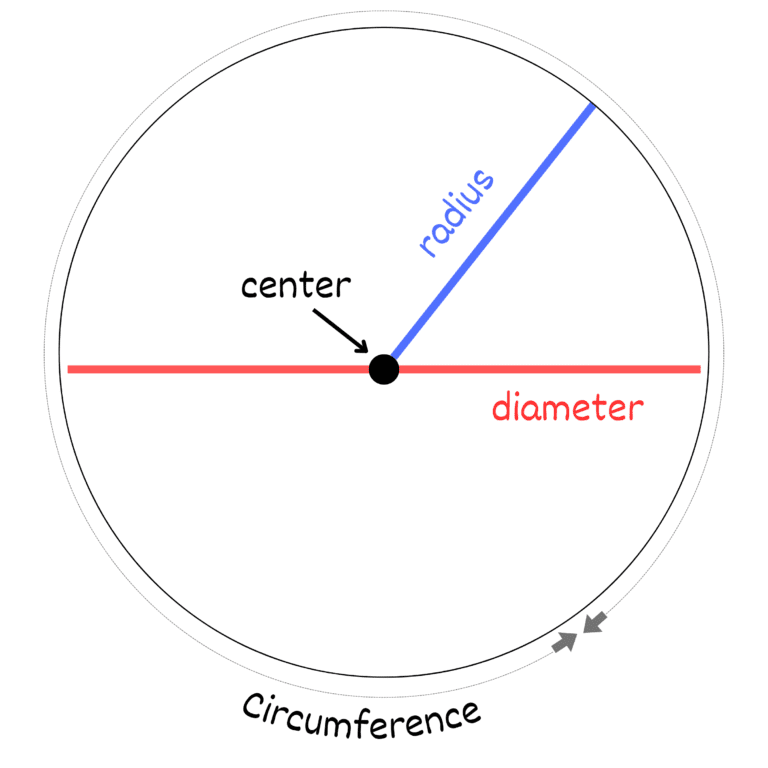
Each part of the circle has a special purpose, and understanding how they connect helps students see the whole shape more clearly. At the center, the exact middle point is located. From this point, the radius extends outward, connecting the center to the edge of the circle. In comparison, the diameter stretches all the way across the shape, passing through the center and linking two points on the circumference. Surrounding all these parts, the circumference forms the curved line around the circle. As a result, when students understand these relationships, geometry becomes easier. Most importantly, each part supports and relates to the others.
Because of these connections, learning relationships within a circle builds confidence and accuracy.
Circles in Real Life
Circles are everywhere around us, even in our daily activities. Many objects are designed with a circular shape because it is balanced, strong, and easy to use. Recognizing these shapes helps students understand that geometry is not only found in textbooks but also in the real world.
The table below shows common real-life objects that have a circular shape. Each example highlights how circles appear in everyday items that students easily recognize.
| Real-Life Object | Looks Like a Circle |
|---|---|
| 🕒 Clock | The face of a clock is round |
| 🍪 Cookie | Round and smooth all around |
| 🪙 Coin | Has a round edge |
| 🥞 Pancake | Round and flat |
| 🛞 Wheel | Spins around a center |
| ⚽ Ball | Round when seen from any side |
In nature, circles appear as well. The sun and the moon look circular when we see them in the sky. Tree rings form circles that show how a tree grows over time. Even ripples in water create circular patterns when something drops into a pond.
By observing these examples, students can better connect the concept of circles to familiar objects. This connection helps make learning geometry clearer, more meaningful, and easier to remember.
Circle and Its Parts: Summary
A circle is a simple yet important geometric shape that appears frequently in both mathematics and everyday life. Although it may seem basic at first, it is made up of several parts, and each part has a clear role and purpose. Understanding these parts helps students see how the shape is formed and how it functions as a whole.
By learning about the it and its parts, students build strong geometry foundations. They become more confident in identifying the center, radius, diameter, and circumference, as well as understanding how these parts are connected. This knowledge supports future learning in geometry, measurement, and problem-solving, allowing students to approach more advanced topics with accuracy and confidence.
To further support understanding, students can also watch a video explanation of the circle and its parts. Visual learning helps reinforce key concepts and allows learners to see how each part relates to the whole shape, making geometry easier to understand and remember.
Closing Note
Thank you for reading this lesson guide! 💡
Don’t forget to download the free worksheets and notes to review what you’ve learned. You can also check out more lesson guides or explore more math worksheets to keep practicing and improving your skills.
For more fun and educational videos, visit our YouTube channel, and to stay updated on new lessons and printable resources, follow us on our Facebook page.
Keep learning and exploring — math is always more fun when you keep practicing!